Why Is Digital Footprint Bad: Risks and Reduction Strategies
Your digital footprint aggregates into a profile that predicts behavior, exposing you to social engineering and automated discrimination long before you interact with a threat.

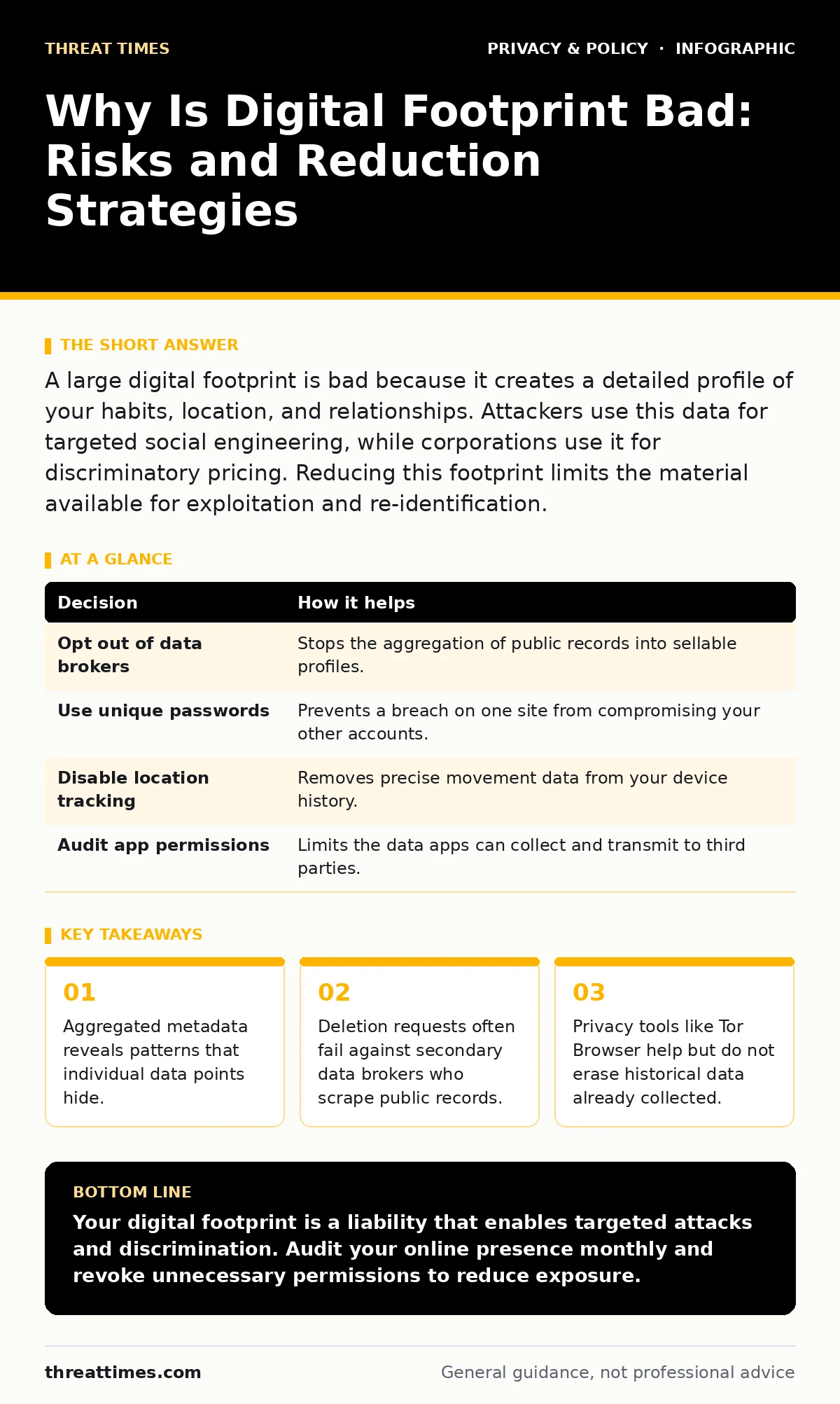
A large digital footprint is bad because it creates a detailed profile of your habits, location, and relationships. Attackers use this data for targeted social engineering, while corporations use it for discriminatory pricing. Reducing this footprint limits the material available for exploitation and re-identification.
Why Is Digital Footprint Bad
A digital footprint is bad because it transforms anonymous actions into a persistent identity. Every click, login, and location ping adds to a dataset that third parties aggregate. This aggregation allows strangers to reconstruct your daily routine, social circle, and financial status. The primary risk is not a single stolen password, but the contextual knowledge that makes password theft effective. An attacker who knows your pet’s name, your mother’s maiden name, and your usual gym route can bypass multi-factor authentication through social engineering. The footprint provides the context that turns noise into signal.
The Mechanics of Profile Aggregation
Data brokers collect fragments from public records, social media, and retail receipts. They stitch these fragments together using unique identifiers like email addresses or phone numbers. This process creates a unified profile that is far more detailed than any single source. You might share a photo on one platform and a purchase receipt on another. The aggregator links these events to build a timeline of your life. This timeline reveals sensitivities you never explicitly disclosed, such as health conditions or political affiliations. The aggregation happens silently and continuously.
Social Engineering and Identity Theft
The most immediate danger of a large footprint is targeted social engineering. Phishing attacks are no longer generic blasts. They are personalized messages that reference your recent purchases, your colleagues, or your hobbies. This personalization increases the likelihood of you clicking a malicious link. Identity theft also shifts from stealing a credit card number to assuming your entire digital persona. With enough metadata, an attacker can reset passwords, answer security questions, and impersonate you to customer support. The footprint provides the raw material for this impersonation.
Discrimination and Economic Impact
Corporate algorithms use your digital footprint to determine your value. Insurers may adjust premiums based on inferred lifestyle risks derived from your online behavior. Employers screen candidates by analyzing their social media presence and public records. This screening often leads to discriminatory outcomes that are difficult to challenge. You might be denied a loan or a job opportunity because an algorithm flagged a pattern in your data. The decision is automated, opaque, and based on data you did not consent to share for this purpose. The economic cost is real and often invisible.
What Goes Wrong Without Intervention
Without active management, your digital footprint grows exponentially. Each new service you sign up for adds another data point. Each smart device you connect adds another sensor. The problem is not just the volume, but the persistence. Data remains available long after you forget you created it. Old blog posts, deleted social media accounts, and abandoned email addresses continue to expose information. This historical data is often sold to secondary brokers who do not honor deletion requests. You lose control over your narrative and your security perimeter.
See also: Difference Between Tokenization and Chunking: Security vs NLP
Reducing Your Digital Footprint
Reducing your footprint requires shifting from passive consumption to active management. You must audit your presence across major platforms. Remove old accounts that you no longer use. Opt out of data broker lists where possible. This process is tedious but necessary. Use encrypted messaging apps for sensitive communications to prevent content interception. Review mobile app permission abuse regularly. Revoke access to contacts, location, and microphone for apps that do not need them. These steps reduce the amount of new data entering the system.
| Decision | How it helps |
|---|---|
| Opt out of data brokers | Stops the aggregation of public records into sellable profiles. |
| Use unique passwords | Prevents a breach on one site from compromising your other accounts. |
| Disable location tracking | Removes precise movement data from your device history. |
| Audit app permissions | Limits the data apps can collect and transmit to third parties. |
The Limits of Privacy Tools
No single tool erases your past. Tor Browser hides your current browsing activity from your internet service provider and local network. It does not delete data already stored by websites you visited previously. Consent management platforms help you withdraw permission for data processing, but enforcement varies by region and company. You cannot rely on these tools for complete anonymity. They are defensive measures that reduce future exposure. You must combine them with behavioral changes to minimize the data you generate in the first place.
Maintaining a Low Profile
Sustaining a small footprint requires ongoing vigilance. You must resist the convenience of single sign-on services that link your activities across platforms. Create separate email addresses for different types of services. Use a dedicated email for newsletters and another for financial accounts. This segmentation limits the damage if one address is compromised. Regularly search for your name online to discover new exposures. Check for leaked credentials in breach databases. Adjust your settings as new privacy features become available. Privacy is a continuous process, not a one-time fix.
Key takeaways
- Aggregated metadata reveals patterns that individual data points hide.
- Deletion requests often fail against secondary data brokers who scrape public records.
- Privacy tools like Tor Browser help but do not erase historical data already collected.
Your digital footprint is a liability that enables targeted attacks and discrimination. Audit your online presence monthly and revoke unnecessary permissions to reduce exposure.
Frequently asked questions
Does deleting social media accounts remove my data?
No. Companies often retain backups and metadata for legal or business reasons. Your data may persist in archives or be sold to third parties before deletion.
Can I stop all data collection?
No. Some data collection is inherent to using the internet. You can minimize it by using privacy-focused tools and limiting shared information, but you cannot eliminate it entirely.
How do data brokers get my information?
They aggregate public records, purchase data from other brokers, and scrape information from social media and websites. They link these fragments using identifiers like your name and address.
Is using Tor Browser enough for privacy?
No. Tor Browser hides your current browsing activity from local observers. It does not erase historical data, protect against malware, or hide your identity from the websites you visit.
How this guide was produced: written by the Threat Times editorial team with AI assistance, checked against the public references listed below, and reviewed when the facts change. See our editorial policy or report an error.