What Is Considered Biometric Data: Definitions, Risks, and Management
Biometric data is unique because it cannot be reset like a password, making its permanent exposure a distinct and irreversible privacy threat.
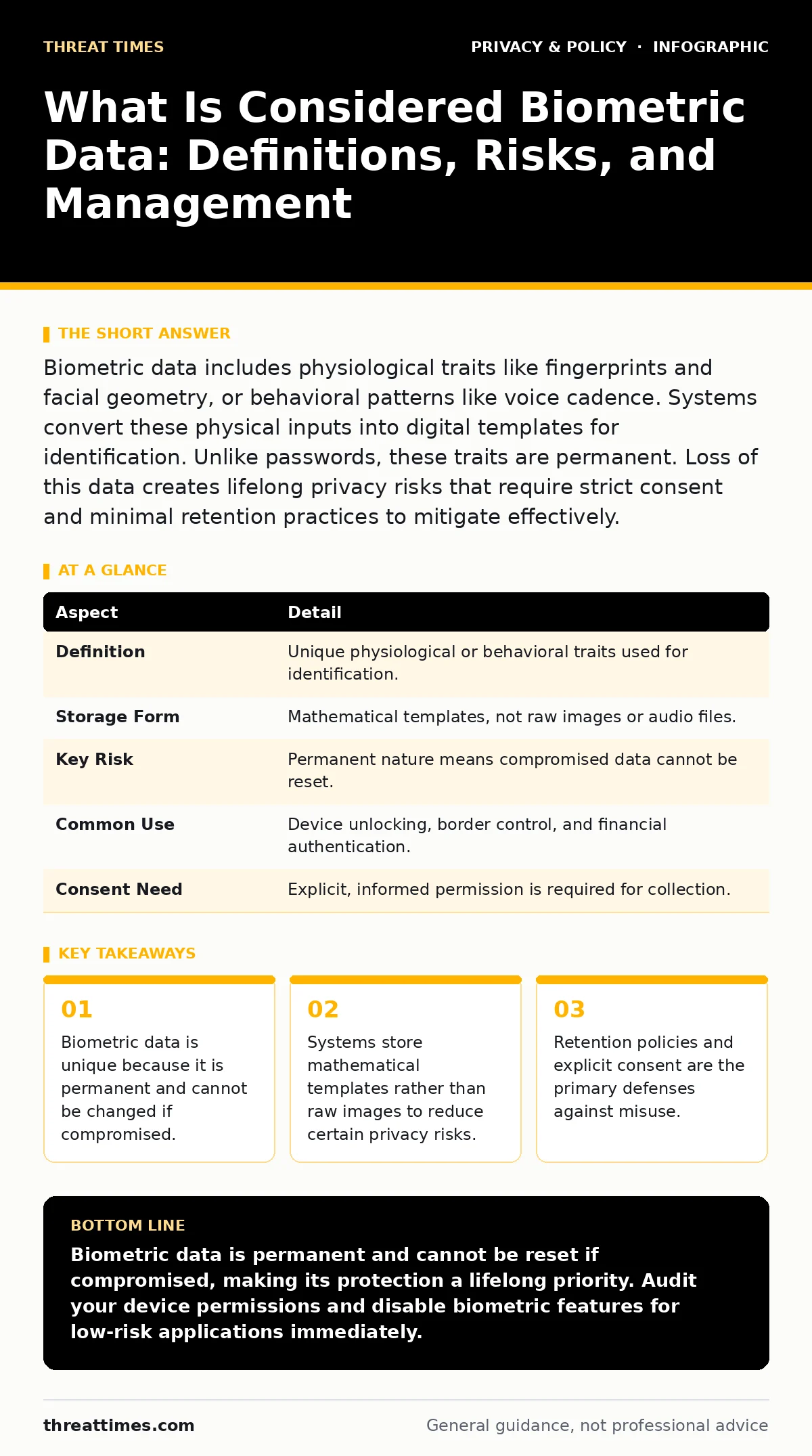
Biometric data includes physiological traits like fingerprints and facial geometry, or behavioral patterns like voice cadence. Systems convert these physical inputs into digital templates for identification. Unlike passwords, these traits are permanent. Loss of this data creates lifelong privacy risks that require strict consent and minimal retention practices to mitigate effectively.
Everyday Analogy: The Unchangeable Key
Imagine you lock your front door with a key. If you lose that key, you can buy a new lock and cut a new key. The old key no longer works. Now imagine the lock is your own fingerprint. If someone copies your fingerprint, you cannot generate a new one. You must live with the fact that the original access method has been compromised forever. Biometric data functions like this unchangeable key. It ties access directly to your body, removing the ability to revoke credentials remotely. This permanence changes the risk profile entirely.
What Is Considered Biometric Data
Biometric data refers to measurable physical or behavioral characteristics that uniquely identify a living person. This category excludes general personal information like your name or address. It specifically covers traits that are inherent to you or developed through long-term habit. Physiological biometrics include fingerprints, iris patterns, facial structure, and DNA sequences. Behavioral biometrics include voice recognition, typing rhythm, gait analysis, and signature dynamics. Systems capture these inputs using sensors or software. The raw input is processed into a digital template. This template is what the system actually stores and compares against.
| Aspect | Detail |
|---|---|
| Definition | Unique physiological or behavioral traits used for identification. |
| Storage Form | Mathematical templates, not raw images or audio files. |
| Key Risk | Permanent nature means compromised data cannot be reset. |
| Common Use | Device unlocking, border control, and financial authentication. |
| Consent Need | Explicit, informed permission is required for collection. |
How Biometric Systems Work
The process begins with capture. A sensor records your trait, such as a camera scanning your face. The system then isolates specific features. It ignores irrelevant background noise. Next, the system converts these features into a mathematical representation. This is the template. The template is a string of numbers derived from the distances between your eyes or the ridges in your fingerprint. The system stores this template, not the original image.
When you attempt to authenticate, the system captures new data and creates a fresh template. It compares the new template to the stored one. If the mathematical distance between them is below a set threshold, access is granted. This threshold balances security and convenience. A lower threshold increases security but may reject valid users. A higher threshold accepts more users but may allow impostors.
Who Is Affected by Biometric Collection
You are affected whenever a service uses your body to verify your identity. This happens on personal devices when you unlock a phone. It occurs in public spaces with surveillance cameras that map facial geometry. Employers may use biometrics for time tracking or secure facility access. Governments use biometrics for passports and border control. The scale of collection varies. A local gym may collect fingerprints for door entry.
A global tech platform may collect facial data for advertising targeting. The impact depends on the sensitivity of the data and the security of the storage. High-value targets attract sophisticated attacks. Your data may be sold or shared with partners. Understanding who holds your template is critical. Review privacy policies to see who accesses the data. Consider the risks of consent management in these contexts.
What People Usually Get Wrong
Many assume that biometric templates are just encrypted photos. This is incorrect. The template is a one-way mathematical derivation. You cannot reconstruct your face from the numbers. However, this does not make it safe. If the database is breached, attackers get the templates. They can create synthetic spoofing tools. Another common error is believing biometrics replace passwords. They often combine with them.
This is called multi-factor authentication. It adds a layer of security. But it also adds a layer of complexity. If the biometric system fails, you may be locked out. There is no simple way to reset your fingerprint. You must rely on backup methods. These methods are often weaker. Users frequently ignore the trade-off between convenience and privacy. They trade permanent biological data for faster login. This trade-off is rarely reversible.
See also: Difference Between Tokenization and Chunking: Security vs NLP
Managing Biometric Risks
You cannot change your biometrics, so you must control how they are used. Start by limiting collection. Disable biometric authentication on low-security apps. Use it only for high-value accounts like banking or email. Check device settings to see which apps have access. Turn off features that you do not actively use. For example, disable facial recognition for photo tagging. Read the privacy policy carefully. Look for sections on data retention and third-party sharing.
If a company shares biometric data with advertisers, consider avoiding the service. Compare this to risks in social media privacy risks. The stakes are higher with biometrics. Be aware of location tracking combined with biometrics. This creates a detailed profile of your movements. Reduce your exposure by using local processing. Some devices store templates only on the chip, not in the cloud. This is safer. Understand privacy policies to know where your data lives.
Legal and Ethical Frameworks
Regulations are evolving to address biometric privacy. Many regions now require explicit consent. Companies must explain how they use the data. They must allow you to opt out. Some laws prohibit selling biometric data. Others require strict security standards. Violations can lead to significant penalties. However, enforcement varies. You must know your rights. In some areas, you can sue for unauthorized collection. In others, consent is assumed. This disparity creates confusion.
Companies may exploit weaker regulations. Always assume your data is at risk. Treat biometric consent as a privilege, not a right. Withdraw consent whenever possible. Monitor how companies handle third-party cookies and similar tracking. The principles are similar. Transparency and control are key. Refer to guides on reducing your digital footprint for broader context. Biometric data is the most sensitive part of that footprint.
Practical Steps for Protection
Protecting biometric data requires proactive management. First, prefer local storage over cloud storage. Devices that keep templates on the secure enclave are safer. Second, disable unnecessary biometric features. Turn off facial recognition for payments if you do not use it. Third, use strong backup authentication methods. PINs or passwords should be complex. If your biometric fails, these backups protect you. Fourth, stay informed about breaches. While specific incidents are not named here, the risk is real.
Check news for updates on biometric security. Fifth, consider encrypted messaging apps for sensitive communications. They reduce the need for biometric verification in some cases. Finally, understand the limits of Tor Browser and other anonymity tools. They protect network traffic, not your physical traits. Biometric data is collected at the point of interaction. Network tools cannot stop a camera from scanning your face.
Key takeaways
- Biometric data is unique because it is permanent and cannot be changed if compromised.
- Systems store mathematical templates rather than raw images to reduce certain privacy risks.
- Retention policies and explicit consent are the primary defenses against misuse.
Biometric data is permanent and cannot be reset if compromised, making its protection a lifelong priority. Audit your device permissions and disable biometric features for low-risk applications immediately.
Frequently asked questions
Can biometric data be hacked?
Yes, attackers can steal biometric templates from databases. They can then create synthetic spoofs to bypass authentication systems.
Is facial recognition considered biometric data?
Yes, facial geometry and features are physiological biometrics. They are used to create unique digital templates for identification.
Can I delete my biometric data from a company?
You can request deletion, but companies may retain it for legal reasons. Check the specific privacy policy for retention terms.
Are biometrics safer than passwords?
Biometrics are harder to guess but cannot be changed. Passwords can be reset. The safety depends on the implementation and storage security.
How this guide was produced: written by the Threat Times editorial team with AI assistance, checked against the public references listed below, and reviewed when the facts change. See our editorial policy or report an error.