How Privacy Policies Actually Work: A Practical Explanation
Privacy policies function as legal contracts that define data boundaries, not as technical manuals that describe encryption methods or server locations.

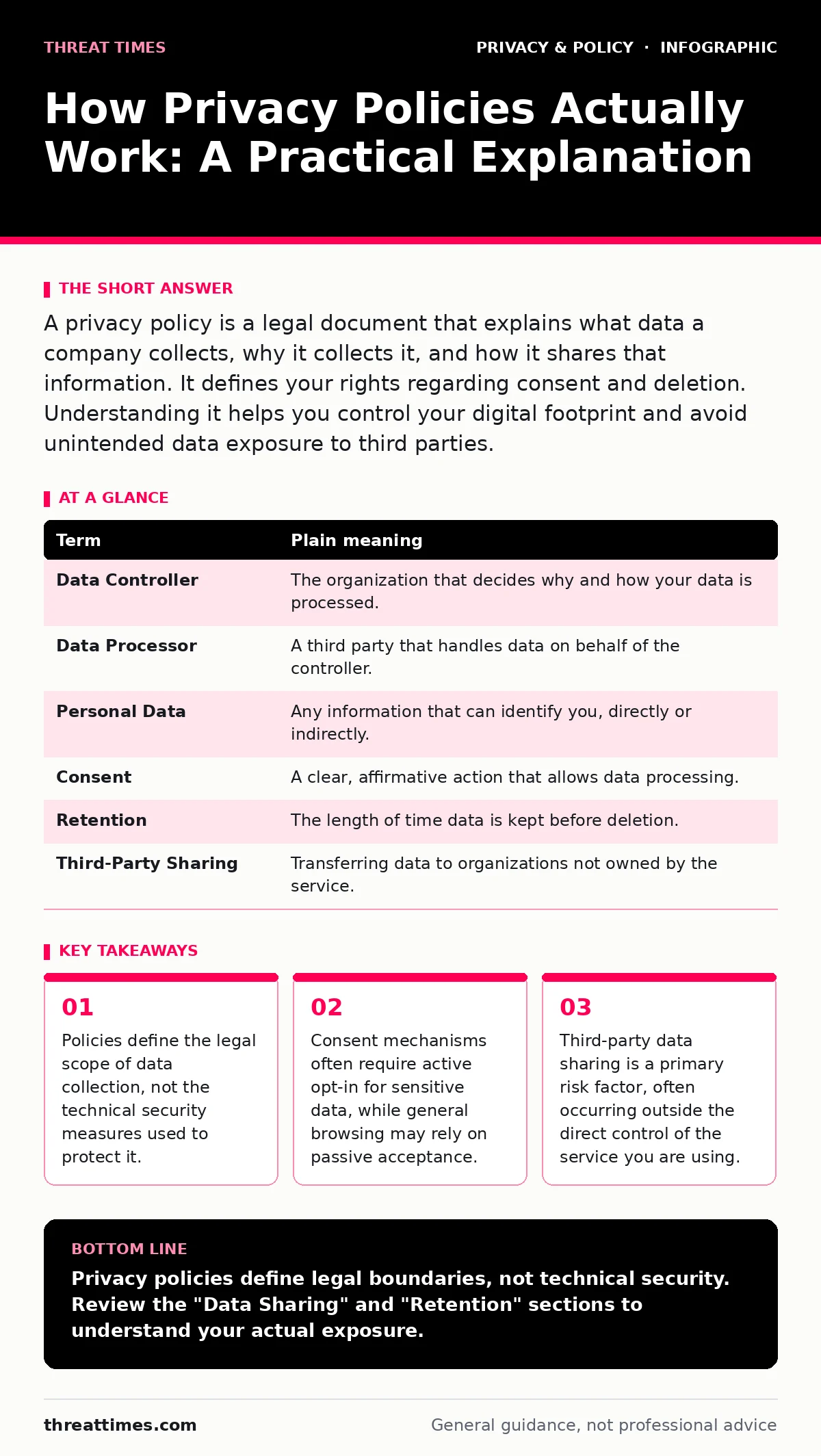
A privacy policy is a legal document that explains what data a company collects, why it collects it, and how it shares that information. It defines your rights regarding consent and deletion. Understanding it helps you control your digital footprint and avoid unintended data exposure to third parties.
The Library Analogy
Imagine you enter a public library to borrow a book. The librarian asks for your name and address to create a record. This exchange is necessary for the service. The library’s rules state they will keep your address on file for billing but will not sell it to advertisers. This rulebook is your privacy policy. It does not describe how the shelves are built or how the doors are locked. It only defines what the librarian can do with your name. If the librarian starts selling your address to a marketing firm, they have broken the rulebook. You can then complain to the library board. The policy is the contract between you and the institution.
Defining the Core Terms
To read these documents effectively, you must translate legal jargon into plain actions. Most policies use specific terms that carry legal weight. Misunderstanding these terms leads to accidental data sharing.
| Term | Plain meaning |
|---|---|
| Data Controller | The organization that decides why and how your data is processed. |
| Data Processor | A third party that handles data on behalf of the controller. |
| Personal Data | Any information that can identify you, directly or indirectly. |
| Consent | A clear, affirmative action that allows data processing. |
| Retention | The length of time data is kept before deletion. |
| Third-Party Sharing | Transferring data to organizations not owned by the service. |
The Data Controller is the entity you interact with. They bear the legal responsibility for your Personal Data. A Data Processor might be a cloud provider hosting the controller’s website. The controller remains liable for the processor’s actions. Understanding this distinction helps you identify who to contact when a breach occurs. You do not sue the server host; you sue the company that hired them.
The Hidden Cost of Convenience
Many users assume that reading a policy is a waste of time. This view ignores the hidden costs of blind consent. When you accept terms without reading, you often agree to data practices that feel reasonable in isolation but become problematic in aggregate. Suppose you use a fitness app that tracks your steps. The policy might state that anonymized movement data is shared with urban planning firms. Individually, this seems harmless. Combined with other apps, this data can reveal your home address and daily routine. This aggregation creates a detailed profile without your explicit knowledge.
This dynamic is similar to third-party cookies, which track user behavior across different websites. The privacy policy explains the tracking mechanism. It does not always highlight the extent of the aggregation. You must look for sections on "Data Sharing" or "Advertising Partners" to understand the full scope. If the policy is vague about who receives your data, assume the worst-case scenario. Vague language is often a shield for broad data harvesting.
Navigating Consent Mechanisms
Consent is not a one-time event. It is an ongoing legal requirement. Many services use dark patterns to make consent easy to give and hard to withdraw. A dark pattern is a user interface designed to trick users into doing something they did not mean to do. For example, a "Reject All" button might be grayed out or hidden behind a menu. This design choice violates the spirit of consent management frameworks, even if it technically complies with the letter of the law.
You should look for granular consent options. These allow you to accept necessary cookies while rejecting analytical or advertising ones. If a service forces you to accept all cookies to use the basic function, it is likely non-compliant with strict privacy regulations. This issue is common in mobile app permission abuse, where apps request access to your contacts for a flashlight function. The policy will justify this as "improving user experience." In reality, it is data harvesting. You can often deny these permissions in your device settings, overriding the app’s request.
Practical Steps for Review
You do not need to read every word of every policy. Instead, use a targeted approach to identify risks. This method saves time while providing meaningful protection.
- Search for "Sell" or "Share": Use the find function to locate these keywords. This reveals if your data is monetized. If the policy says "we may share data with partners," it is a red flag. Specific partners should be named or categorized.
- Check Retention Periods: Look for how long data is kept. Indefinite retention increases the risk of exposure. Policies should state a specific timeframe, such as "until account deletion" or "for seven years."
- Review Withdrawal Rights: Find the section on changing your mind. It should explain how to withdraw consent or delete your data. If this process is buried or requires manual email requests, the service is difficult to use.
When Policies Fail
A privacy policy is a promise, not a guarantee. Companies change policies without notice. They may update terms to include new data practices. You must check for updates, especially after major service changes. If a company merges with another entity, your data may transfer to the new owner. The updated policy will reflect this change.
This is why tools like Tor Browser exist for high-risk scenarios. While a policy might promise anonymity, technical measures provide actual obscurity. Relying solely on a policy is like trusting a library to never lose a book. It is a reasonable expectation, but not a certainty. For sensitive communications, use encrypted messaging apps that provide technical proof of privacy, not just legal promises.
The Role of Location Data
Location tracking is a frequent source of privacy violations. Many apps collect precise GPS data to provide services like weather updates. However, the policy may allow this data to be stored indefinitely. This creates a historical map of your movements. Even if you disable location services, some apps use Wi-Fi or cell tower data to approximate your position. The policy will describe this as "device information." You must review the "Data Collection" section to see if precise location is mandatory for the core service. If it is not, you can deny permission.
Key takeaways
- Policies define the legal scope of data collection, not the technical security measures used to protect it.
- Consent mechanisms often require active opt-in for sensitive data, while general browsing may rely on passive acceptance.
- Third-party data sharing is a primary risk factor, often occurring outside the direct control of the service you are using.
Privacy policies define legal boundaries, not technical security. Review the "Data Sharing" and "Retention" sections to understand your actual exposure.
Frequently asked questions
Do I have to read the entire privacy policy?
No. Focus on sections about data sharing, retention, and withdrawal rights. Use search functions to find keywords like "sell" or "third-party."
What happens if a company changes its privacy policy?
They must notify you, usually via email or in-app notification. You should review the changes, especially if they expand data collection practices.
Can I delete my data after reading the policy?
Yes, most policies outline a process for data deletion. Look for the "Your Rights" or "Account Deletion" section for specific instructions.
Are privacy policies legally binding?
Yes, they are legal contracts. Violations can lead to regulatory fines and lawsuits, depending on the jurisdiction and applicable laws.
How this guide was produced: written by the Threat Times editorial team with AI assistance, checked against the public references listed below, and reviewed when the facts change. See our editorial policy or report an error.