Consent Management: Real Benefits and Hidden Costs
Consent management shifts liability to users but fails to stop data collection when legal bases other than consent apply.

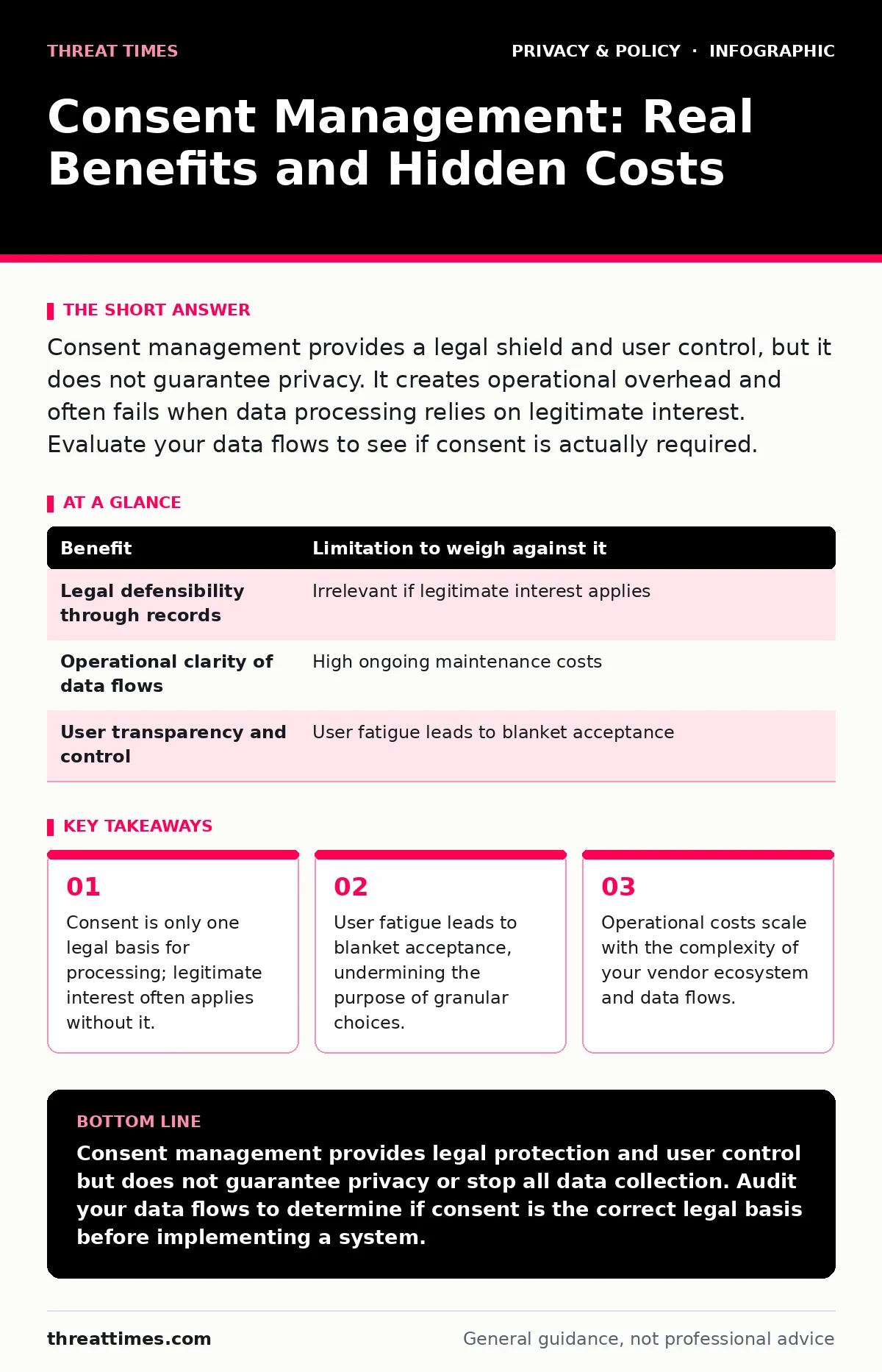
Consent management provides a legal shield and user control, but it does not guarantee privacy. It creates operational overhead and often fails when data processing relies on legitimate interest. Evaluate your data flows to see if consent is actually required.
The Mechanics of Preference Recording
Consent management involves the technical and procedural recording of user preferences regarding data processing. It relies on a Consent Management Platform or CMP to present choices and store decisions. The system must link these choices to specific data subjects and enforce them across all processing activities. This mechanism transforms a legal requirement into a technical constraint.
The core function is not privacy itself, but accountability. It proves you asked and received permission. Without this record, you cannot demonstrate compliance during an audit or investigation. The system must handle withdrawals as easily as initial grants. A decision to opt out must propagate instantly to all downstream systems.
Concrete Benefits of Formal Consent
The primary benefit is legal defensibility. A documented consent record shifts the burden of proof to you, showing you acted in good faith. This protection applies even if a regulator later disagrees with your interpretation of the law. It provides a clear audit trail for every data interaction.
You gain operational clarity by mapping data flows. To manage consent, you must know where data goes and who processes it. This inventory often reveals redundant or unnecessary data collection. You may discover vendors you no longer use or data points you no longer need.
Users receive transparency about what is being collected. Even if they do not read the details, the presence of a choice mechanism signals respect for their autonomy. This can improve trust in markets where privacy is a competitive differentiator. It allows users to withdraw permission without contacting support.
Honest Limitations of the Model
Consent does not stop data collection if another legal basis applies. Legitimate interest allows processing without explicit permission if your interests outweigh the user's rights. Consent management is irrelevant for data processed under this basis. Many organizations mistake consent for a universal privacy solution. It is not.
User fatigue severely degrades the quality of consent. Most users click "Accept All" to bypass banners and continue browsing. This behavior renders granular choices meaningless. The system records consent, but the user did not meaningfully evaluate the options. You have compliance, but not informed choice.
The system creates significant maintenance overhead. Every new vendor, feature, or data type requires updating the consent interface. You must re-verify consent when legal standards change or when you alter data purposes. This is a continuous cost, not a one-time project.
| Benefit | Limitation to weigh against it |
|---|---|
| Legal defensibility through records | Irrelevant if legitimate interest applies |
| Operational clarity of data flows | High ongoing maintenance costs |
| User transparency and control | User fatigue leads to blanket acceptance |
When It Is Worth It
Consent management is worth it when you rely on personal data for marketing or profiling. These activities often require explicit permission under strict regulations. If you serve users in jurisdictions with strong privacy laws, you have no choice. The cost of non-compliance exceeds the cost of implementation.
It is also worth it when you use third-party cookies for tracking. These technologies are under heavy scrutiny and often require explicit consent. Blocking them without a proper consent mechanism can break your analytics and advertising stacks. A managed approach ensures you only load scripts when permitted.
Consider it if your business model depends on trust. Some users will actively seek out sites that respect their preferences. Providing clear, easy-to-use controls can be a market advantage. It differentiates you from competitors who bury their practices in dense privacy policies.
When It Is Not Worth It
It is not worth it if you process data solely for contract fulfillment. If a user buys a product, you must process their address and payment details to deliver it. This is a contractual necessity, not a consent-based activity. Adding a consent banner here creates confusion and friction without legal benefit.
Do not invest heavily if your data processing is minimal. If you only collect email addresses for newsletters, a simple opt-in checkbox may suffice. A complex platform adds unnecessary cost and technical debt. The scale of your solution should match the scale of your data processing.
Avoid it if you cannot maintain it. A consent system that is not updated becomes a liability. Outdated records may claim consent for purposes you no longer pursue. This creates false confidence and potential legal exposure. If you lack the resources to maintain accuracy, do not implement it.
The Hidden Cost of Choice Architecture
The design of your consent interface influences user behavior. This is known as choice architecture. If you make opting out difficult, you may face regulatory scrutiny. If you make it too easy, you may lose necessary data for service functionality. Balancing these forces requires careful design.
Dark patterns, such as misleading buttons or hidden options, are increasingly illegal. Regulators are actively targeting interfaces that manipulate user choices. You must ensure your design is neutral and clear. This limits your ability to optimize for consent rates.
The psychological impact on users is significant. Constant prompts create banner blindness. Users may stop reading entirely, assuming all banners are the same. This reduces the effectiveness of any transparency efforts. You must find a way to communicate value without causing fatigue.
Integrating With Broader Privacy Efforts
Consent management does not exist in isolation. It must align with your broader data governance strategy. If you ignore mobile app permission abuse, your web consent efforts may be undermined. Users expect consistent privacy controls across all platforms.
You must also address social media privacy risks. Data shared on social platforms may be used for profiling without your direct consent. Your consent management system cannot control external data sources. Focus on what you can control: your own data collection and processing.
For users seeking maximum anonymity, tools like Tor Browser offer different protections. Consent management is irrelevant to them, as they do not wish to be identified at all. Your system must accommodate users who choose to reject all tracking. This includes handling requests for data deletion and portability.
Maintaining Accuracy Over Time
Consent records degrade over time. Users change their minds, laws change, and your business changes. You must have a process for refreshing consent. This may involve periodic re-verification or triggering new consent requests when purposes change.
Automate the enforcement of preferences. Manual checks are error-prone and slow. Your systems should automatically block data collection when consent is withdrawn. This requires tight integration between your consent platform and your data infrastructure.
Regularly audit your consent logs. Check for inconsistencies, such as consent granted for purposes that no longer exist. Clean up outdated records to maintain a clear audit trail. This reduces risk and simplifies future compliance efforts.
Key takeaways
- Consent is only one legal basis for processing; legitimate interest often applies without it.
- User fatigue leads to blanket acceptance, undermining the purpose of granular choices.
- Operational costs scale with the complexity of your vendor ecosystem and data flows.
Consent management provides legal protection and user control but does not guarantee privacy or stop all data collection. Audit your data flows to determine if consent is the correct legal basis before implementing a system.
Frequently asked questions
Does consent management stop all data collection?
No. It only stops collection that requires consent. Other legal bases, like legitimate interest or contractual necessity, allow processing without explicit permission.
What is the difference between consent and legitimate interest?
Consent requires explicit, informed permission from the user. Legitimate interest allows processing if your business needs outweigh the user's privacy rights, without needing explicit permission.
Can I use consent for employee data?
Generally no. Employee data is often processed under contractual or legal obligations. Consent is rarely the appropriate basis due to the power imbalance between employer and employee.
How often should I refresh user consent?
Refresh consent when you change data purposes, add new vendors, or when legal standards change. Periodic re-verification, such as annually, is also good practice.
How this guide was produced: written by the Threat Times editorial team with AI assistance, checked against the public references listed below, and reviewed when the facts change. See our editorial policy or report an error.