First-Party vs Third-Party Cookies: How to Choose the Right Tracking Method
First-party cookies persist longer in modern browsers, making them a more durable but privacy-intrusive alternative to blocked third-party trackers.

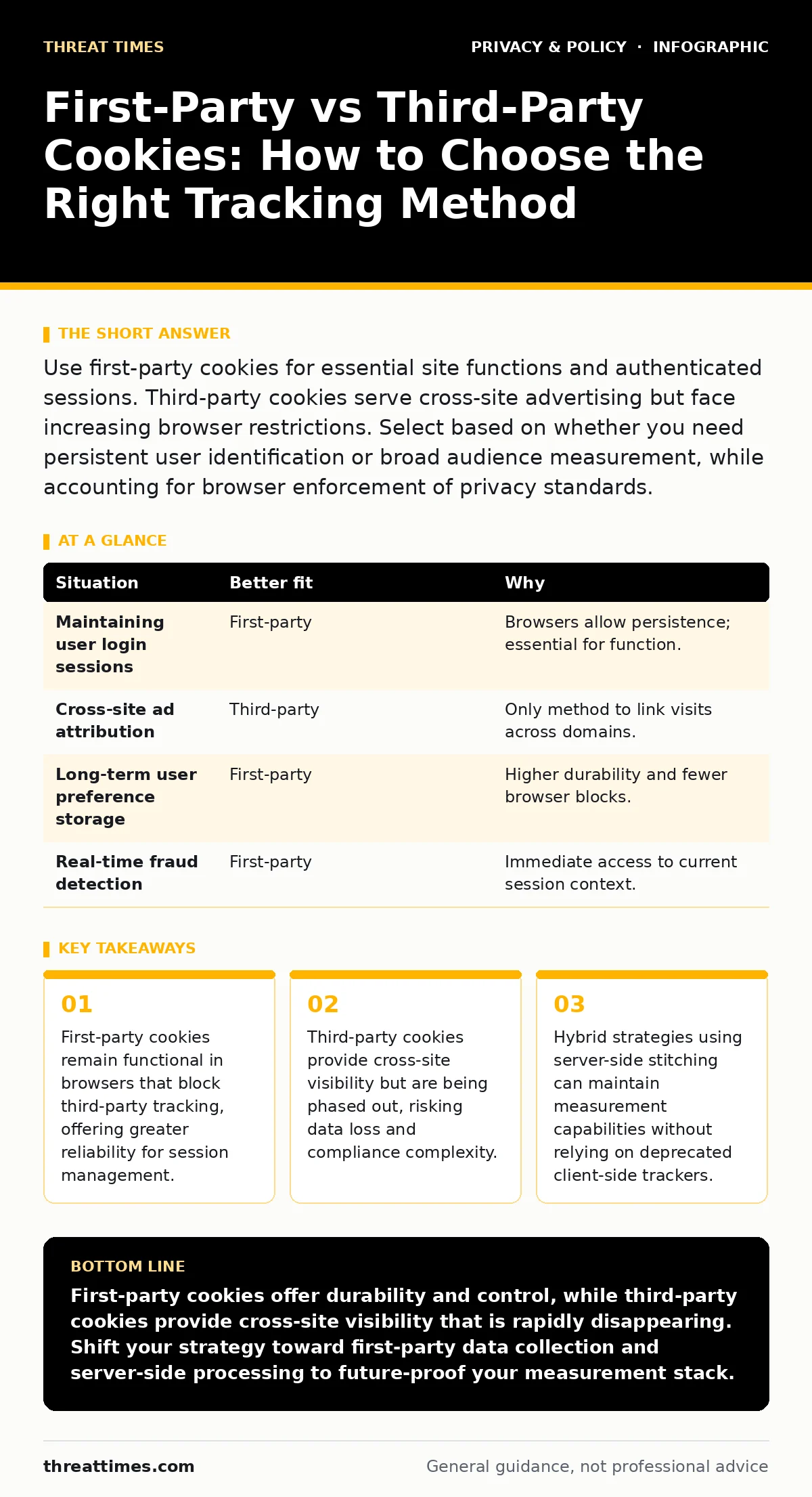
Use first-party cookies for essential site functions and authenticated sessions. Third-party cookies serve cross-site advertising but face increasing browser restrictions. Select based on whether you need persistent user identification or broad audience measurement, while accounting for browser enforcement of privacy standards.
Does the data need to persist across different domains?
First-party cookies are set by the domain the user is currently visiting. They are stored and sent back to that specific server with every subsequent request. This mechanism allows the server to recognize returning visitors and maintain state, such as keeping a user logged in.
Third-party cookies are set by a domain different from the one the user is viewing. These typically originate from advertising networks or analytics providers embedded in the page. They allow the external party to track the user’s behavior across multiple unrelated websites.
If your goal is to maintain a continuous session on your own platform, first-party cookies are the only reliable client-side method. Browsers treat these as essential for basic web functionality. Cross-site tracking relies entirely on third-party cookies, which many browsers now block by default.
How long must the identifier survive browser restrictions?
Modern browsers enforce strict storage policies. Many block third-party cookies entirely unless the user explicitly opts in. Even when allowed, these cookies often have shorter lifespans or are cleared more aggressively by privacy-focused extensions.
First-party cookies generally face fewer restrictions. Browsers allow them to persist for longer durations, sometimes months or years, depending on the expiration date set by the server. This durability makes them suitable for long-term user preferences and authenticated states.
The trade-off is privacy perception. Users are more likely to block or delete first-party cookies if they feel their data is being misused. Third-party cookies are often blocked automatically, shifting the burden of consent to the provider rather than the user.
What is the primary goal of the data collection?
If you need to measure individual user journeys across the entire web, third-party cookies have historically been the standard. They enable advertisers to build detailed profiles of user interests by aggregating data from hundreds of sites.
First-party cookies are limited to the domain that sets them. You can only see what happens on your own site. This limits your ability to attribute conversions to ads seen on other platforms, a process known as cross-site attribution.
For content publishers and e-commerce sites, first-party data is increasingly valuable. It provides accurate insights into user behavior on your property without depending on external parties. This data is also more compliant with emerging privacy regulations.
Can you implement a server-side alternative?
As third-party cookies disappear, many organizations are moving data processing to the server side. In this model, the browser sends limited data to your server, which then communicates with third-party partners directly.
This approach, often called server-side tagging, bypasses the need for third-party cookies in the browser. The third party receives data via a server-to-server connection, which does not rely on client-side storage.
This method preserves some measurement capabilities while respecting browser privacy settings. It requires more infrastructure and engineering effort but offers a sustainable path forward. It also reduces the attack surface for client-side injection attacks.
| Situation | Better fit | Why |
|---|---|---|
| Maintaining user login sessions | First-party | Browsers allow persistence; essential for function. |
| Cross-site ad attribution | Third-party | Only method to link visits across domains. |
| Long-term user preference storage | First-party | Higher durability and fewer browser blocks. |
| Real-time fraud detection | First-party | Immediate access to current session context. |
How to combine both for resilience
Using both cookie types creates a layered approach. First-party cookies handle authentication and local preferences. Third-party cookies, where still permitted, assist with broader measurement.
This hybrid model requires careful consent management. You must clearly disclose why each type is used. Users should understand that first-party data stays on your site, while third-party data may be shared.
Imagine a news site that uses first-party cookies to remember a user’s font size preference. It might also use third-party cookies to measure the effectiveness of a banner ad. If the browser blocks the third-party cookie, the ad measurement fails, but the user experience remains intact.
What are the hidden costs of compliance?
Managing consent for multiple cookie types adds complexity. You must update your consent management platform whenever browser policies change. This requires ongoing technical maintenance.
Third-party cookies are increasingly difficult to use legally. Regulations often require explicit consent for these trackers. First-party cookies may fall under "necessary" exemptions, but this depends on jurisdiction and specific use case.
The cost is not just technical. It is also reputational. Users are becoming more aware of tracking. Transparent use of first-party data builds trust. Aggressive third-party tracking erodes it.
Key takeaways
- First-party cookies remain functional in browsers that block third-party tracking, offering greater reliability for session management.
- Third-party cookies provide cross-site visibility but are being phased out, risking data loss and compliance complexity.
- Hybrid strategies using server-side stitching can maintain measurement capabilities without relying on deprecated client-side trackers.
First-party cookies offer durability and control, while third-party cookies provide cross-site visibility that is rapidly disappearing. Shift your strategy toward first-party data collection and server-side processing to future-proof your measurement stack.
Frequently asked questions
Do first-party cookies expire automatically?
They expire based on the date set by the server. If no expiration is set, they are session cookies and delete when the browser closes.
Can I use first-party cookies for advertising?
Yes, but you must obtain user consent if the data is used for profiling or personalized ads, just like third-party cookies.
What happens when browsers block third-party cookies?
Cross-site tracking stops. Advertisers lose the ability to link user actions across different websites, reducing attribution accuracy.
Is server-side tracking more secure?
It reduces exposure to client-side attacks but introduces server-side risks. You must secure your servers and data transmission channels.
How this guide was produced: written by the Threat Times editorial team with AI assistance, checked against the public references listed below, and reviewed when the facts change. See our editorial policy or report an error.