Side-Channel Attacks: How Physical Leaks Break Encryption
Side-channel attacks bypass cryptographic math by measuring power, time, or electromagnetic emissions to recover secrets without breaking the algorithm itself.
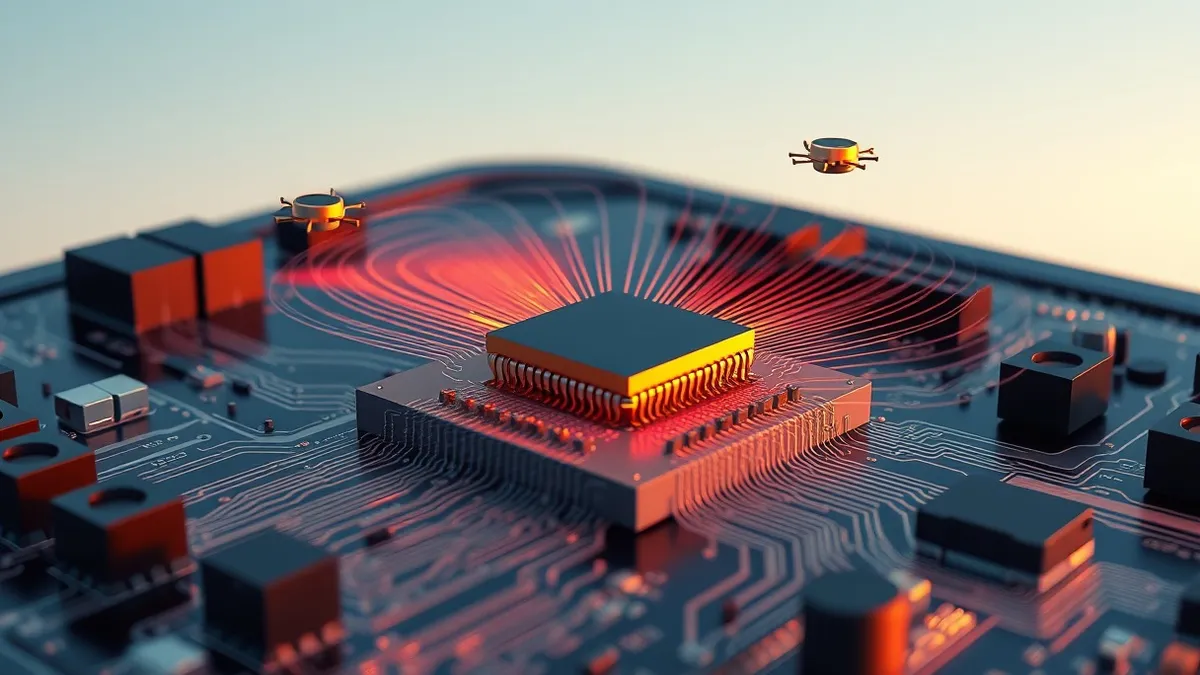
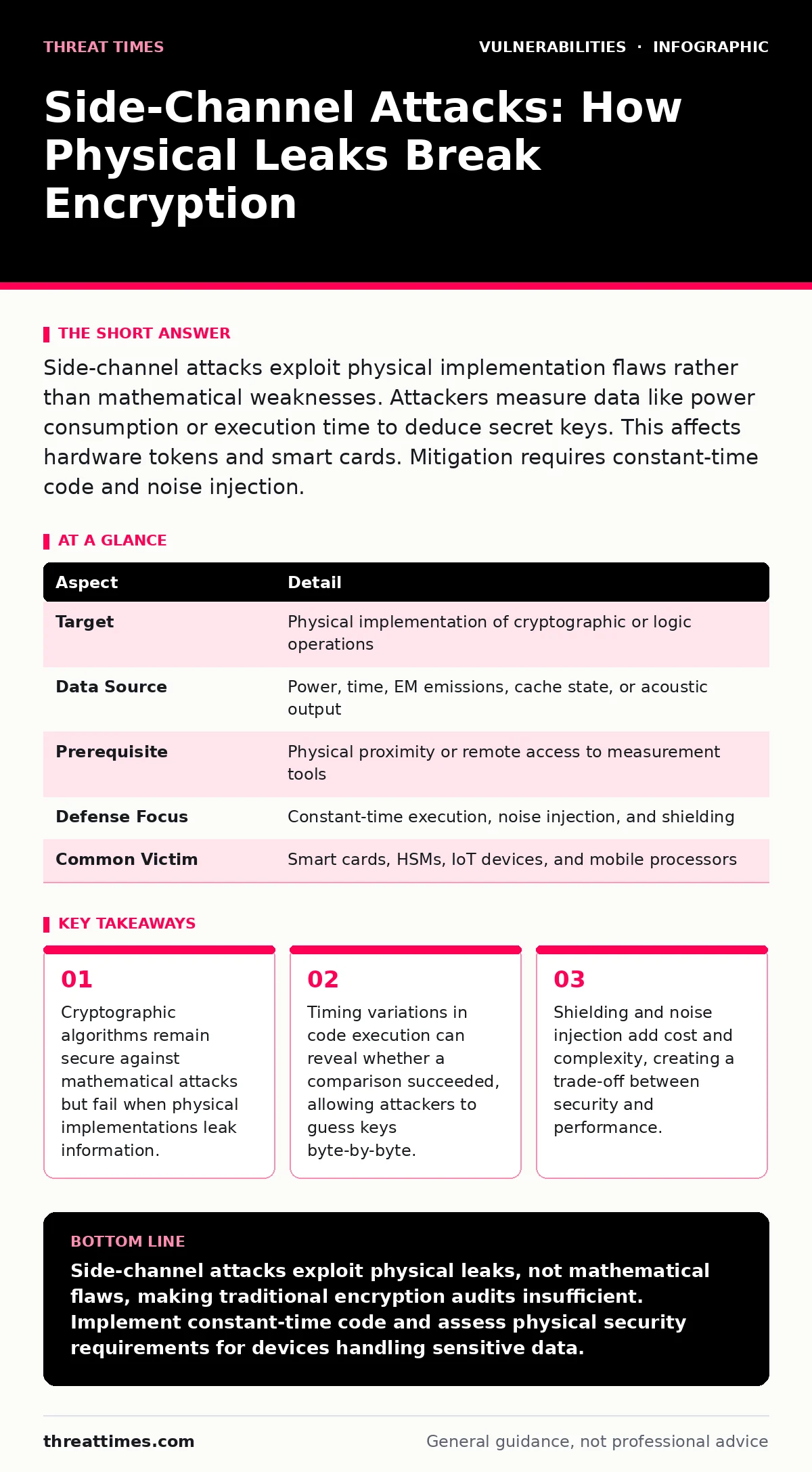
Side-channel attacks exploit physical implementation flaws rather than mathematical weaknesses. Attackers measure data like power consumption or execution time to deduce secret keys. This affects hardware tokens and smart cards. Mitigation requires constant-time code and noise injection.
The Lock Picking Analogy
Imagine a high-security vault. The combination lock is mathematically perfect. No amount of calculation can guess the code. However, the lock makes a distinct click when you enter the correct digit. An attacker listens to the clicks. They do not need to break the lock mechanism. They simply observe the physical reaction to their input. This is the core concept of a side-channel attack.
The cryptographic algorithm is the vault. The implementation is the lock. The side channel is the sound of the click. Most security discussions focus on the vault. They ignore the lock. This oversight allows attackers to bypass strong encryption by watching how the system behaves, not what it computes.
Defining the Attack Vector
A side-channel attack is a method of exploiting information gained from the physical implementation of a computer system. This information is not part of the intended data flow. It is a byproduct of operation. Common channels include power consumption, electromagnetic radiation, execution time, and acoustic noise.
These attacks target the hardware or software execution environment. They do not exploit bugs in the cryptographic logic. The algorithm works exactly as designed. The leakage comes from the physics of the silicon or the behavior of the processor. This distinction matters because standard security audits often miss these physical traits.
| Aspect | Detail |
|---|---|
| Target | Physical implementation of cryptographic or logic operations |
| Data Source | Power, time, EM emissions, cache state, or acoustic output |
| Prerequisite | Physical proximity or remote access to measurement tools |
| Defense Focus | Constant-time execution, noise injection, and shielding |
| Common Victim | Smart cards, HSMs, IoT devices, and mobile processors |
How Leakage Occurs in Practice
Every electronic component draws power. Transistors switch states to process bits. A switch from zero to one consumes a different amount of energy than a switch from one to one. This difference is tiny. It is measurable with sensitive equipment. An attacker records the power trace while the device processes data. They correlate the power spikes with the data being processed.
Suppose a device compares a user input to a stored secret. The code checks each byte sequentially. If the first byte matches, it checks the second. If it does not match, it stops early. The attacker sends many inputs. They measure the time taken for each. Inputs that take longer match more bytes. This reveals the secret one byte at a time. This is a timing attack. It requires no special hardware, only precise clock measurements.
Common Forms of Side Channels
Timing attacks measure the duration of operations. They are effective against software implementations that have variable execution paths. Cache timing attacks exploit the CPU cache. Accessing data in the cache is faster than fetching it from main memory. An attacker monitors cache hits and misses to infer what data the victim process accessed. This can leak encryption keys from a web browser.
Power analysis measures electrical consumption. Simple Power Analysis looks at the shape of the power trace to see patterns. Differential Power Analysis uses statistical methods to average out noise and reveal correlations. Electromagnetic analysis captures the radio frequency emissions from the chip. These emissions correlate with power usage but can be captured from a greater distance. Acoustic cryptanalysis listens to the piezoelectric effect in components. Capacitors change shape slightly when charged, producing audible sound.
Who Is Affected and Why
Any system that performs secret computation is at risk. Smart cards and payment tokens are primary targets. They are small, cheap, and handle sensitive data. Hardware Security Modules (HSMs) in data centers also face this threat. They protect high-value keys. If an attacker gains physical access, they can extract these keys.
Software on general-purpose computers is also vulnerable. Virtual machines share physical hardware. One tenant can monitor the cache behavior of another tenant. This allows cross-VM attacks. Mobile devices are particularly exposed. They combine sensitive data with powerful processors that exhibit clear power and timing signatures. The proximity of sensors in phones makes acoustic and power attacks easier.
What People Usually Get Wrong
Many believe that strong encryption prevents side-channel attacks. This is false. Encryption strength is mathematical. Side channels are physical. You can have the strongest algorithm in the world. If the implementation leaks power, the key is exposed. Security is only as strong as the weakest link in the implementation chain.
Another misconception is that side-channel attacks require sophisticated, expensive equipment. While professional labs use advanced tools, basic timing attacks can be performed with standard network equipment. Cache attacks can be executed through a web browser. The barrier to entry has lowered significantly. Developers cannot assume these attacks are theoretical.
Reducing the Risk
The primary defense is constant-time implementation. Code must take the same amount of time and use the same resources regardless of the input data. Branches that depend on secret data must be eliminated. Loop unrolling and bitwise operations can help achieve this. This prevents timing attacks from correlating execution time with data values.
Hardware defenses include noise injection. Adding random electrical noise to the power supply masks the signal. This makes it harder to correlate power traces with data. Shielding blocks electromagnetic emissions. These measures add cost and complexity. They also reduce performance. You must balance security needs with operational constraints.
Regular audits should include side-channel testing. Standard penetration testing often ignores these vectors. Specialized tools can measure power and timing. Developers should review code for early-exit conditions. They should also consider the broader context of security misconfigurations that might expose debug ports or logging interfaces. These interfaces can provide the raw data needed for side-channel analysis.
The Hidden Cost of Defense
Implementing side-channel resistance is expensive. Constant-time code is harder to write and verify. It often runs slower than optimized code. Shielding adds weight and bulk to devices. Noise injection reduces battery life. These trade-offs are real. You must decide which assets require this level of protection.
Not every system needs military-grade shielding. A web server may prioritize timing resistance in its cryptographic libraries. A payment token may require full physical shielding. Understanding the threat model is key. This approach complements other security practices. For instance, preventing memory corruption bugs ensures that an attacker cannot manipulate the execution flow to amplify side-channel leakage.
Key takeaways
- Cryptographic algorithms remain secure against mathematical attacks but fail when physical implementations leak information.
- Timing variations in code execution can reveal whether a comparison succeeded, allowing attackers to guess keys byte-by-byte.
- Shielding and noise injection add cost and complexity, creating a trade-off between security and performance.
Side-channel attacks exploit physical leaks, not mathematical flaws, making traditional encryption audits insufficient. Implement constant-time code and assess physical security requirements for devices handling sensitive data.
Frequently asked questions
Can side-channel attacks be performed remotely?
Yes, some attacks like cache timing or network-based timing attacks can be performed remotely over standard networks without physical access to the device.
Does using a stronger encryption algorithm help?
No, stronger algorithms do not prevent side-channel attacks because the vulnerability lies in the physical implementation, not the mathematical complexity of the cipher.
How do I know if my code is vulnerable?
Code that has variable execution time based on secret data, such as early-exit loops or conditional branches dependent on keys, is likely vulnerable to timing attacks.
Are side-channel attacks legal?
The legality depends on jurisdiction and intent. Accessing hardware to measure emissions may be legal, but using that data to steal secrets is typically illegal.
How this guide was produced: written by the Threat Times editorial team with AI assistance, checked against the public references listed below, and reviewed when the facts change. See our editorial policy or report an error.