Difference Between Tokenization and Chunking: Security vs NLP
Tokenization replaces data with irreversible references for security, while chunking splits text into smaller blocks for processing efficiency.

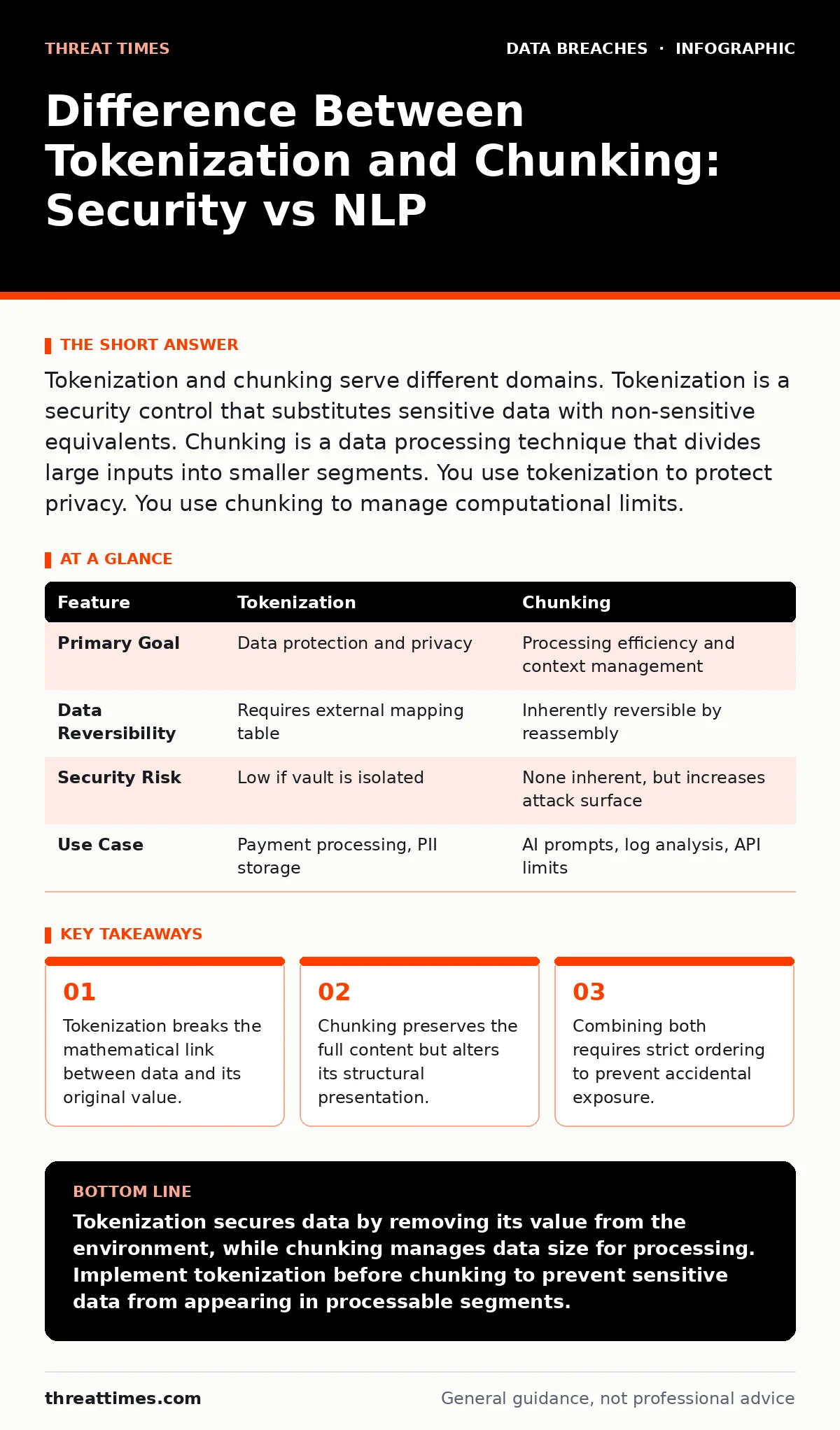
Tokenization and chunking serve different domains. Tokenization is a security control that substitutes sensitive data with non-sensitive equivalents. Chunking is a data processing technique that divides large inputs into smaller segments. You use tokenization to protect privacy. You use chunking to manage computational limits.
What is the difference between tokenization and chunking?
Tokenization and chunking address entirely different problems in data handling. Tokenization is a security mechanism that replaces sensitive information with a non-sensitive equivalent called a token. Chunking is a preprocessing step that divides large text or data streams into smaller, manageable pieces. One protects value; the other manages volume.
Why does tokenization protect data better than encryption?
Tokenization removes the sensitive data from the environment entirely. The system stores only the token, which has no mathematical relationship to the original value. Encryption transforms data using a key, meaning the encrypted string still contains the original information in a scrambled form. If an attacker obtains the encryption key, they recover the data. Tokens are useless without the separate mapping table, which is often isolated in a secure vault.
| Feature | Tokenization | Chunking |
|---|---|---|
| Primary Goal | Data protection and privacy | Processing efficiency and context management |
| Data Reversibility | Requires external mapping table | Inherently reversible by reassembly |
| Security Risk | Low if vault is isolated | None inherent, but increases attack surface |
| Use Case | Payment processing, PII storage | AI prompts, log analysis, API limits |
When should you use chunking instead of tokenization?
You use chunking when you need to process large volumes of text that exceed system limits. Many APIs and language models have strict character or token limits for input. Chunking splits the data into smaller blocks that fit within these constraints. This allows you to analyze or store the full dataset without losing information. Tokenization would destroy the usable content by replacing it with random references.
How does tokenization prevent data breaches?
Tokenization ensures that even if a database is stolen, the attacker gets only meaningless strings. The actual credit card numbers or personal identifiers remain in a separate, highly secured environment. This separation of duties limits the impact of a breach. Attackers cannot perform financial fraud or identity theft with tokens alone. This approach aligns with best practices for SOC 2 compliance by demonstrating effective data minimization.
What happens if you chunk data before tokenizing it?
Order matters significantly when combining these techniques. If you chunk data first, you might split a sensitive value across multiple chunks. A single chunk might contain only part of a social security number, which is safe. However, if an attacker reconstructs the chunks, they recover the full sensitive data. You must tokenize the data before chunking it to ensure that no single chunk contains complete sensitive information. This prevents partial data leaks that could be pieced together.
Can chunking accidentally expose sensitive information?
Chunking itself does not encrypt or hide data. It merely rearranges it. If you chunk a document containing passwords or keys, those secrets remain visible within the chunks. An attacker who gains access to the chunks can read the content directly. This is why chunking is not a security control. It is a utility for processing. Never rely on chunking to protect secrets. Use full disk encryption to protect stored chunks at rest.
How do you handle data subject rights with tokenized data?
When users request deletion or access to their data, tokenization adds complexity. You must locate the token, map it back to the original data, and then fulfill the request. This process requires a reliable and secure mapping system. If the mapping table is lost, you cannot fulfill data subject rights requests. You must maintain audit logs that track token creation and deletion to prove compliance. This ensures you can respond to legal inquiries without exposing raw data unnecessarily.
What are the risks of reversible tokenization?
Some systems use reversible tokenization, where the token can be converted back to the original data using a key. This defeats the primary security benefit of tokenization. It behaves more like encryption. If the key is compromised, the data is exposed. Irreversible tokenization is safer for most use cases. It ensures that only the authorized mapping service can retrieve the original value. This reduces the risk of insider threats and key theft.
How does tokenization impact digital forensics?
Forensic investigators need to correlate data across systems. Tokens obscure this correlation because the same data may have different tokens in different systems. This makes it harder to trace the flow of information during an investigation. You must preserve the mapping tables securely to aid in digital forensics. Without these tables, investigators cannot link tokenized records to specific individuals or transactions. This can delay incident response and legal proceedings.
When does chunking fail for large datasets?
Chunking can fail if the split point falls within a critical structure. For example, splitting a JSON object or a SQL query in the middle breaks its syntax. The resulting chunks are unreadable or unusable. You must use intelligent chunking strategies that respect data boundaries. This ensures that each chunk is a valid unit of data. Poor chunking leads to processing errors and data loss. Always validate chunk integrity before processing.
How do you prevent credential dumps with tokenization?
Credential dumps often contain hashed or plain-text passwords. Tokenization is not typically used for passwords. Instead, use secure hashing algorithms. However, for other sensitive credentials like API keys, tokenization can help. By replacing the key with a token, you limit the damage if the key store is compromised. The attacker gets tokens, not usable keys. This strategy complements credential dumps mitigation efforts by reducing the value of stolen data.
What is the role of user access provisioning in tokenization?
Access to the token mapping table must be strictly controlled. User access provisioning ensures that only authorized systems and personnel can query the vault. Over-provisioning access increases the risk of insider threats. Regularly review and revoke access rights to maintain security. This principle of least privilege is critical for maintaining the integrity of the tokenization system. Without proper access controls, the token vault becomes a high-value target.
How does tokenization differ from password rotation?
Tokenization and password rotation are distinct practices. Password rotation changes the secret periodically to limit exposure time. Tokenization replaces the data permanently with a reference. They can be used together. You might tokenize a password hash and then rotate the underlying password. This adds layers of security. However, tokenization does not replace the need for strong authentication mechanisms. It only protects the stored data.
Key takeaways
- Tokenization breaks the mathematical link between data and its original value.
- Chunking preserves the full content but alters its structural presentation.
- Combining both requires strict ordering to prevent accidental exposure.
Tokenization secures data by removing its value from the environment, while chunking manages data size for processing. Implement tokenization before chunking to prevent sensitive data from appearing in processable segments.
Frequently asked questions
Is tokenization the same as encryption?
No. Encryption uses mathematical algorithms and keys to scramble data. Tokenization replaces data with a random value that has no mathematical relationship to the original. Tokens are useless without the mapping table.
Can I use chunking to hide sensitive data?
No. Chunking only splits data into smaller pieces. It does not encrypt or obscure the content. Sensitive data remains visible within the chunks unless you apply additional security controls like encryption or tokenization.
What is the best chunking strategy for text?
Use semantic chunking that respects sentence or paragraph boundaries. This preserves the meaning and structure of the text. Avoid splitting at arbitrary character limits, which can break syntax and context.
Does tokenization work for unstructured data?
Tokenization works best for structured data like credit card numbers or IDs. For unstructured data, you must identify and extract sensitive fields first. Then you tokenize those specific fields while leaving the rest of the data intact.
How this guide was produced: written by the Threat Times editorial team with AI assistance, checked against the public references listed below, and reviewed when the facts change. See our editorial policy or report an error.