Detecting Credential Dumps in Enterprise Environments
Credential dumps often bypass perimeter defenses by exploiting legitimate authentication protocols, leaving traces only in internal log aggregation and behavioral anomalies.

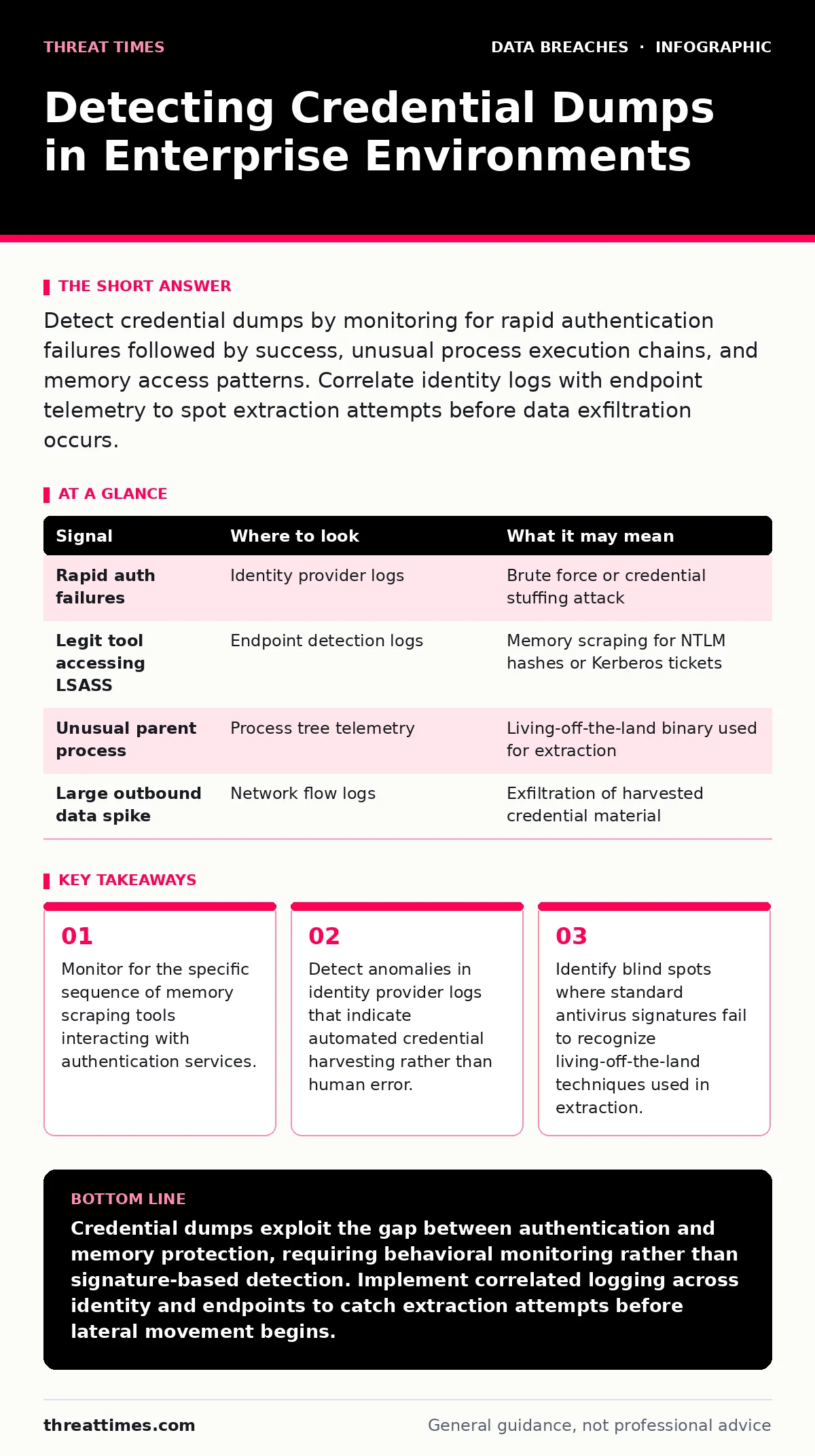
Detect credential dumps by monitoring for rapid authentication failures followed by success, unusual process execution chains, and memory access patterns. Correlate identity logs with endpoint telemetry to spot extraction attempts before data exfiltration occurs.
Identity Provider Anomalies
The first sign of a credential dump often appears in your identity provider logs. Attackers do not always brute force passwords; they often extract them from memory where they are already decrypted. Look for a high volume of authentication requests from a single machine or service account. This pattern suggests an automated script is testing extracted hashes or tokens.
Standard password rotation policies do not stop this method. If an attacker captures the credential material while it is in use, the credential remains valid until the session expires or the password is changed. You must treat successful logins from unexpected locations as potential compromise indicators. Review the context of the login, not just the success status.
Endpoint Process Chains
On the endpoint, credential dumping relies on specific process interactions. The attacker needs to read the memory of authentication processes. On Windows systems, this often involves tools like lsass.exe interaction. On Linux, it may involve accessing /proc filesystem entries or keyring services.
You should monitor for parent-child process relationships that do not make sense. A web browser spawning a memory dump utility is highly suspicious. A system service spawning a command shell that then accesses credential stores is another red flag. These chains indicate that an attacker has moved from initial access to privilege escalation and credential harvesting.
| Signal | Where to look | What it may mean |
|---|---|---|
| Rapid auth failures | Identity provider logs | Brute force or credential stuffing attack |
| Legit tool accessing LSASS | Endpoint detection logs | Memory scraping for NTLM hashes or Kerberos tickets |
| Unusual parent process | Process tree telemetry | Living-off-the-land binary used for extraction |
| Large outbound data spike | Network flow logs | Exfiltration of harvested credential material |
Memory Access Patterns
Credential dumping is fundamentally a memory access problem. The operating system keeps credentials in memory to allow seamless authentication. Attackers exploit this convenience. They inject code into legitimate processes to read this memory space.
Your detection strategy must include monitoring for memory access APIs. Functions that read process memory without a legitimate reason are dangerous. You cannot rely on file-based antivirus to catch this. The malicious code often exists only in RAM. You need endpoint detection and response platforms that can inspect process behavior and memory integrity.
Network Lateral Movement
Once credentials are dumped, the attacker needs to use them. This leads to lateral movement. You will see internal network traffic that uses the stolen credentials. This traffic often looks like normal administrative activity.
Look for connections between machines that do not typically communicate. A workstation connecting to a database server using a service account is unusual. A file server connecting to a domain controller with high frequency is also suspicious. These patterns indicate that the attacker is using the dumped credentials to move deeper into the network.
Log Aggregation Correlation
No single log source tells the whole story. You must correlate identity logs, endpoint telemetry, and network flows. A failed login alert is noise. A failed login followed by a successful login from the same IP, followed by a memory access alert on that host, is a signal.
Use a security information and event management system to create these correlations. Define rules that link these events within a short time window. This reduces false positives and highlights genuine extraction attempts. The speed of correlation is critical because attackers move quickly.
Common Blind Spots
Many organizations miss credential dumps because they focus on the wrong indicators. They look for known malware hashes. Credential dumping often uses system binaries. This is known as living-off-the-land. The tools are already trusted by the operating system.
Another blind spot is cloud environments. Cloud identity providers have different logging mechanisms. You must ensure your cloud security posture management tools are configured to track credential usage. Also, consider the impact of full disk encryption. While it protects data at rest, it does not protect credentials in memory. Attackers target the memory because encryption keys are loaded there during operation.
Detection Tooling Limitations
Commercial endpoint protection platforms vary in their ability to detect these attacks. Some rely heavily on signature matching. They will miss novel extraction techniques. You need behavioral detection. This means the tool watches what the process does, not what the file is named.
Also, consider the cost of false positives. If you alert on every memory access, you will drown in noise. You must tune your rules to focus on high-value targets. Domain controllers and servers with sensitive data should have stricter monitoring. Workstations can have broader rules.
Incident Response Preparation
When you detect a credential dump, assume all credentials from that machine are compromised. You cannot trust any session that started from that host. You must revoke tokens and force password changes. This is where user access provisioning policies come into play. Automated revocation speeds up containment.
Do not ignore the possibility of combo lists. Attackers may combine your dumped credentials with data from other breaches. This increases the risk of account takeover. Monitor for login attempts using credentials that appear in public breach databases. This connects to the broader issue of social engineering, where attackers use stolen data to build trust.
Key takeaways
- Monitor for the specific sequence of memory scraping tools interacting with authentication services.
- Detect anomalies in identity provider logs that indicate automated credential harvesting rather than human error.
- Identify blind spots where standard antivirus signatures fail to recognize living-off-the-land techniques used in extraction.
Credential dumps exploit the gap between authentication and memory protection, requiring behavioral monitoring rather than signature-based detection. Implement correlated logging across identity and endpoints to catch extraction attempts before lateral movement begins.
Frequently asked questions
How do I distinguish between a legitimate admin task and a credential dump?
Legitimate tasks usually follow established process chains and occur during business hours. Credential dumps often involve unusual parent processes and occur at odd times or in rapid succession.
Can firewalls detect credential dumping?
Firewalls inspect network traffic, not internal memory activity. They cannot detect the act of dumping credentials from a local process. They can only detect the subsequent exfiltration if it leaves the network.
Does multi-factor authentication stop credential dumping?
MFA protects against password reuse but not against token theft or pass-the-hash attacks. If an attacker steals a valid Kerberos ticket or session token, MFA may not prevent access.
What is the role of digital forensics in this context?
Digital forensics helps reconstruct the timeline of the attack after detection. It identifies the initial entry point and the scope of the compromise, guiding remediation efforts.
How this guide was produced: written by the Threat Times editorial team with AI assistance, checked against the public references listed below, and reviewed when the facts change. See our editorial policy or report an error.