Warning Signs of Insecure Deserialization in Web Applications
Insecure deserialization often manifests as subtle state anomalies or unexpected object behaviors rather than immediate crashes, hiding critical access control failures within routine data processing.

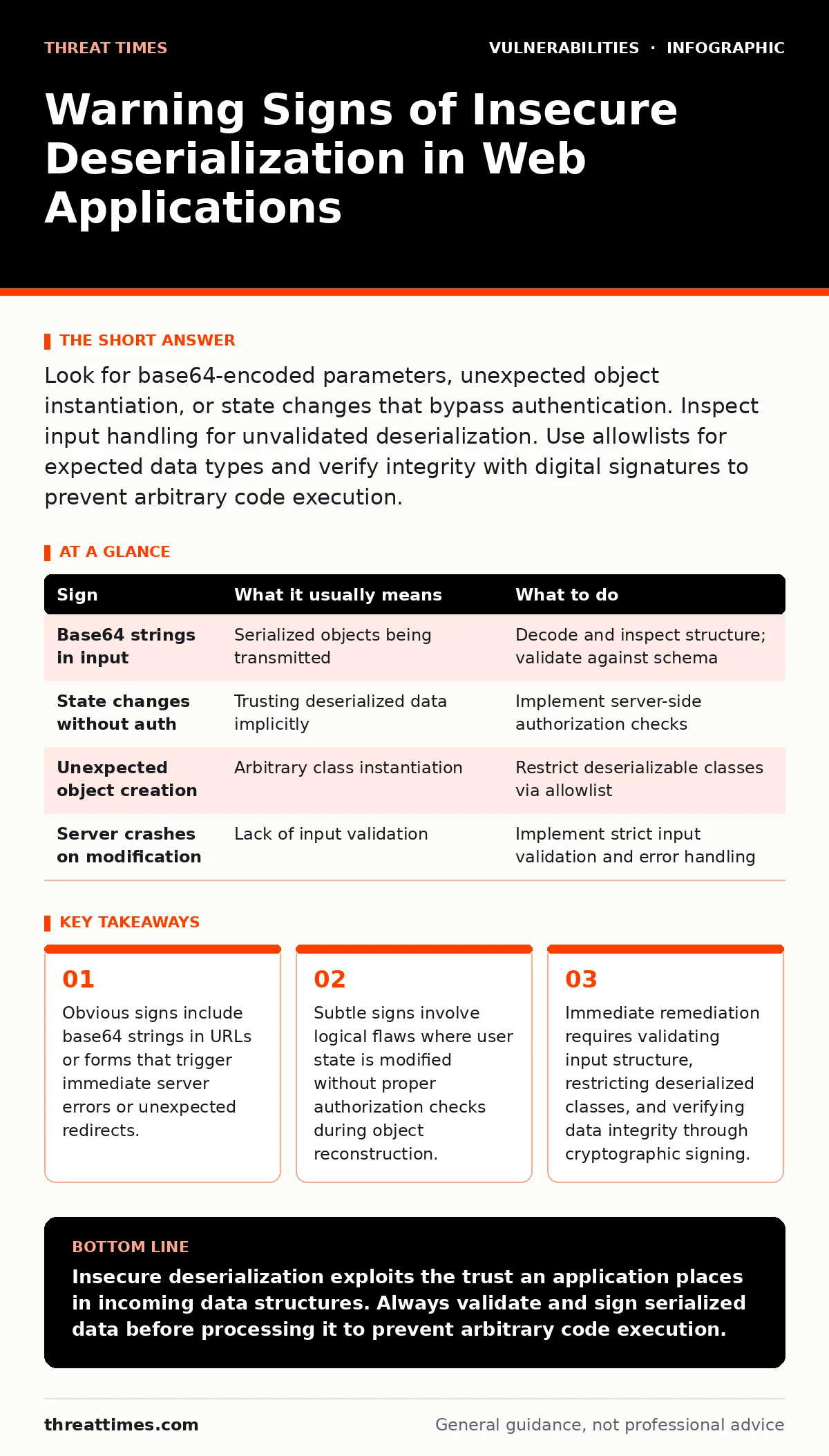
Look for base64-encoded parameters, unexpected object instantiation, or state changes that bypass authentication. Inspect input handling for unvalidated deserialization. Use allowlists for expected data types and verify integrity with digital signatures to prevent arbitrary code execution.
Recognizing Obvious Input Anomalies
The first sign you will likely notice is the presence of encoded data structures in HTTP requests. Developers often use base64 encoding to transmit complex objects across network boundaries. When you see long, alphanumeric strings in query parameters or POST bodies, suspect serialized objects. These strings frequently contain prefixes or suffixes that hint at the serialization format.
If the application crashes or returns a generic error when you modify these strings slightly, the backend is likely attempting to deserialize invalid data. This behavior indicates a lack of input validation before the deserialization process begins. The application expects a specific structure and fails gracefully or not at all when that structure is violated.
Identifying Logical State Manipulation
A more insidious sign is the ability to alter application state without proper authentication. Suppose you can change a user’s role from "viewer" to "administrator" by modifying a field within a serialized session object. This indicates the application trusts the deserialized data implicitly. The backend reconstructs the object and applies its properties without verifying if the changes are authorized.
This flaw bypasses traditional access control mechanisms because the logic resides in the data itself. The application assumes the object was created by a trusted source. You may notice this when privilege escalation occurs without a corresponding login event or permission check in the logs.
Detecting Unexpected Object Instantiation
Insecure deserialization often allows the creation of objects that the application did not intend to instantiate. If you observe that modifying input leads to the execution of unexpected functions or the creation of new resources, the deserializer is likely vulnerable. This happens when the deserialization process can specify arbitrary classes to instantiate.
The application may attempt to load classes that are not part of the standard workflow. This can lead to remote code execution if the instantiated class has a constructor that performs dangerous operations. You might see this as unexpected file creation, network connections, or command execution on the server.
Understanding the Hidden Costs of Trust
The hidden cost of insecure deserialization is the erosion of the trust boundary between client and server. The server assumes the data it receives is safe and well-formed. This assumption is rarely valid in untrusted networks. Every deserialization event is a potential entry point for an attacker to inject malicious logic.
This vulnerability is distinct from memory corruption bugs because it does not rely on buffer overflows. Instead, it exploits the logic of the application. The attacker provides validly formatted data that contains malicious instructions. The server executes these instructions because it trusts the format.
Differentiating From Configuration Errors
It is easy to confuse insecure deserialization with security misconfigurations. Both can lead to unauthorized access. However, misconfigurations usually involve exposed endpoints or default credentials. Insecure deserialization involves the processing of data.
If the issue persists after hardening server settings, look at the data handling logic. The problem lies in how the application interprets incoming data, not in how the server is configured. This distinction is critical for effective remediation.
Immediate Mitigation Steps
When you identify a potential vulnerability, the first step is to stop trusting the input. Implement strict input validation that rejects any data that does not match the expected schema. Use allowlists to specify exactly which classes can be deserialized. This prevents the instantiation of arbitrary objects.
Second, verify the integrity of the data. Use digital signatures to ensure the data has not been tampered with. This requires a shared secret or asymmetric key pair. The server verifies the signature before deserializing. This adds a layer of security that prevents modification of the serialized data.
| Sign | What it usually means | What to do |
|---|---|---|
| Base64 strings in input | Serialized objects being transmitted | Decode and inspect structure; validate against schema |
| State changes without auth | Trusting deserialized data implicitly | Implement server-side authorization checks |
| Unexpected object creation | Arbitrary class instantiation | Restrict deserializable classes via allowlist |
| Server crashes on modification | Lack of input validation | Implement strict input validation and error handling |
Long-Term Architectural Changes
Consider replacing insecure serialization formats with safer alternatives. Use JSON or XML with strict schema validation. These formats are less prone to arbitrary code execution. If you must use binary serialization, ensure it is restricted to trusted internal communications.
Integrate these checks into your bug bounty programs to encourage external testing. Provide clear guidelines on what constitutes a valid finding. This helps identify vulnerabilities before they are exploited in the wild.
Key takeaways
- Obvious signs include base64 strings in URLs or forms that trigger immediate server errors or unexpected redirects.
- Subtle signs involve logical flaws where user state is modified without proper authorization checks during object reconstruction.
- Immediate remediation requires validating input structure, restricting deserialized classes, and verifying data integrity through cryptographic signing.
Insecure deserialization exploits the trust an application places in incoming data structures. Always validate and sign serialized data before processing it to prevent arbitrary code execution.
Frequently asked questions
How do I know if my application uses insecure deserialization?
Look for libraries that deserialize user input without validation. Check for base64 encoded parameters that trigger server-side object creation.
Can encryption prevent insecure deserialization?
Encryption protects confidentiality but not integrity. Attackers can still modify encrypted data if they can predict the structure. Use digital signatures for integrity.
What is the difference between deserialization and parsing?
Parsing converts data into a usable format. Deserialization reconstructs objects with their state and behavior. Deserialization is riskier because it can execute code.
Should I disable deserialization entirely?
Not necessarily. Use it only when required and restrict it to trusted inputs. Prefer simpler data formats like JSON with strict validation.
How this guide was produced: written by the Threat Times editorial team with AI assistance, checked against the public references listed below, and reviewed when the facts change. See our editorial policy or report an error.