Cloud Identity Governance: Definition, Mechanics, and Common Pitfalls
Identity governance shifts security from perimeter defense to continuous verification of who accesses what and why, preventing silent privilege creep.

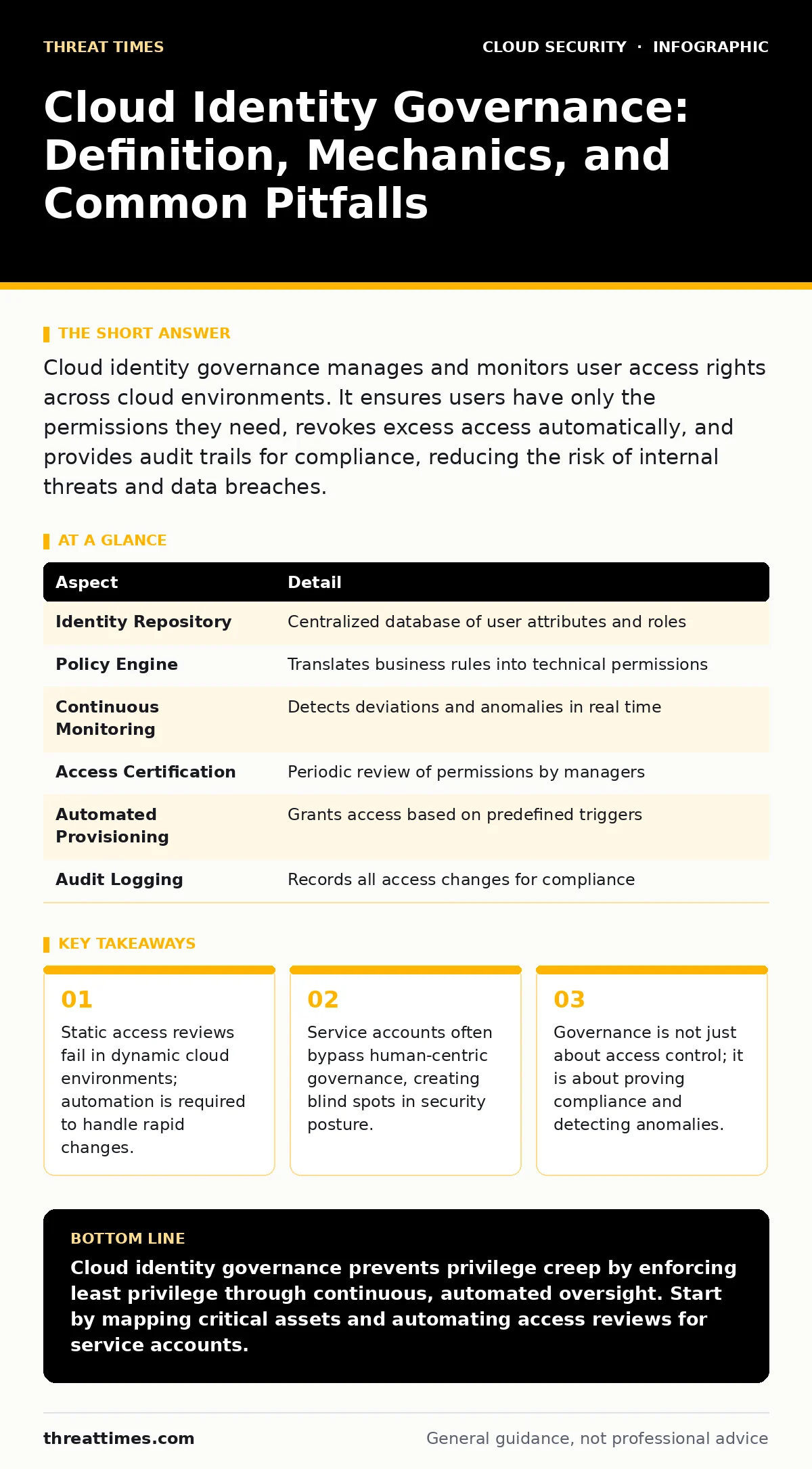
Cloud identity governance manages and monitors user access rights across cloud environments. It ensures users have only the permissions they need, revokes excess access automatically, and provides audit trails for compliance, reducing the risk of internal threats and data breaches.
The Digital Keyring Analogy
Imagine a large office building where every employee holds a master key that opens every door. This is how many organizations approach cloud access. When an employee leaves or changes roles, the key is rarely returned or modified. Instead, it sits in a drawer, unused but dangerous. Cloud identity governance is the process of issuing specific keys for specific doors, tracking who holds them, and automatically collecting them when they are no longer needed.
This analogy highlights the core problem: static access. In traditional on-premises networks, changes were slow. In the cloud, resources spin up and down in seconds. Manual key management cannot keep pace. You need a system that understands context, not just credentials.
Defining the Scope and Purpose
Cloud identity governance is the set of policies, processes, and technologies that manage who can access cloud resources and what they can do. It sits between identity management, which handles authentication, and access control, which enforces permissions. Governance adds the layer of oversight, review, and compliance.
The primary purpose is to enforce the principle of least privilege. This means users receive only the minimum access necessary to perform their jobs. Without governance, privileges accumulate over time. This phenomenon, known as privilege creep, occurs when employees retain old permissions after changing roles. It creates a wide attack surface for insiders and compromised accounts.
The Core Components
A functional governance framework relies on three interconnected parts. First, you need an identity repository. This is the single source of truth for user attributes, roles, and relationships. Second, you require policy engines. These translate business rules into technical permissions. Third, you need continuous monitoring. This detects deviations from expected behavior in real time.
| Aspect | Detail |
|---|---|
| Identity Repository | Centralized database of user attributes and roles |
| Policy Engine | Translates business rules into technical permissions |
| Continuous Monitoring | Detects deviations and anomalies in real time |
| Access Certification | Periodic review of permissions by managers |
| Automated Provisioning | Grants access based on predefined triggers |
| Audit Logging | Records all access changes for compliance |
Where Governance Fits in Defense
Governance does not operate in isolation. It feeds into broader security strategies. For example, effective cloud security groups rely on accurate identity data to restrict network traffic. If your governance fails to remove a former employee’s access, that user can still trigger rules that bypass network controls.
Similarly, service account security is a critical subset of identity governance. Service accounts are non-human identities used by applications. They often have broad permissions and are rarely reviewed. Ignoring them leaves a significant gap in your defense. Governance must include these accounts, applying strict rotation and scope limitations.
The Hidden Cost of Static Reviews
Many organizations rely on quarterly access reviews. Managers receive a list of users and permissions and must approve or deny them. This process is flawed. It is manual, error-prone, and often rubber-stamped. Managers lack the context to judge technical permissions. They approve access they do not understand.
The real cost is latency. By the time the review is complete, the environment has changed. New roles exist, and old ones are obsolete. Static reviews create a snapshot that is already outdated. You need dynamic governance that adjusts permissions based on real-time behavior and job function.
Common Misconceptions
One common mistake is equating governance with identity management. Identity management handles login and password resets. Governance handles the logic of access. You can have strong identity management with poor governance. Users may log in securely, but they might have access to data they should not see.
Another misconception is that automation eliminates the need for human oversight. Automation executes policies, but humans define them. Poorly defined policies lead to automated errors. You must regularly audit the policies themselves, not just the access they grant. This includes reviewing cloud misconfigurations that might inadvertently grant public access to private resources.
Integrating with Broader Security
Governance supports other security domains. For instance, microsegmentation requires precise identity labels to enforce network boundaries. If your identity data is inaccurate, microsegmentation rules will fail. Similarly, SaaS account takeover prevention depends on recognizing anomalous access patterns. Governance provides the baseline of normal behavior needed for detection.
It also complements deception technology. By understanding who should have access to what, you can place decoys in areas where unauthorized users might look. This helps detect breaches faster. However, governance alone cannot stop all attacks. It must be part of a layered defense strategy that includes endpoint protection, network monitoring, and incident response.
The Path Forward
Implementing cloud identity governance is not a one-time project. It is an ongoing discipline. Start by mapping your critical assets and the identities that access them. Define clear roles and responsibilities. Automate provisioning and de-provisioning. Then, introduce continuous monitoring and anomaly detection.
Remember that governance is about risk reduction, not elimination. It reduces the likelihood of insider threats and privilege abuse. It provides the evidence needed for compliance audits. But it requires constant tuning. As your organization grows and changes, your governance policies must evolve.
Key takeaways
- Static access reviews fail in dynamic cloud environments; automation is required to handle rapid changes.
- Service accounts often bypass human-centric governance, creating blind spots in security posture.
- Governance is not just about access control; it is about proving compliance and detecting anomalies.
Cloud identity governance prevents privilege creep by enforcing least privilege through continuous, automated oversight. Start by mapping critical assets and automating access reviews for service accounts.
Frequently asked questions
How does cloud identity governance differ from IAM?
IAM handles authentication and authorization. Governance adds policy management, access reviews, and compliance reporting to ensure those permissions are appropriate.
Can governance prevent all insider threats?
No. Governance reduces risk by limiting access and detecting anomalies. It cannot stop a determined insider with legitimate credentials from acting maliciously within their scope.
Is automation required for effective governance?
Yes. Manual processes cannot keep pace with cloud dynamics. Automation ensures consistent policy enforcement and reduces human error in access reviews.
How often should access reviews occur?
Reviews should be continuous or near-real-time. Quarterly reviews are too slow for cloud environments where changes happen daily.
How this guide was produced: written by the Threat Times editorial team with AI assistance, checked against the public references listed below, and reviewed when the facts change. See our editorial policy or report an error.