Microsegmentation FAQ: Architecture, Policy, and Enforcement Details
Microsegmentation isolates workloads at the application layer, ensuring that compromised credentials cannot automatically grant access to adjacent systems.

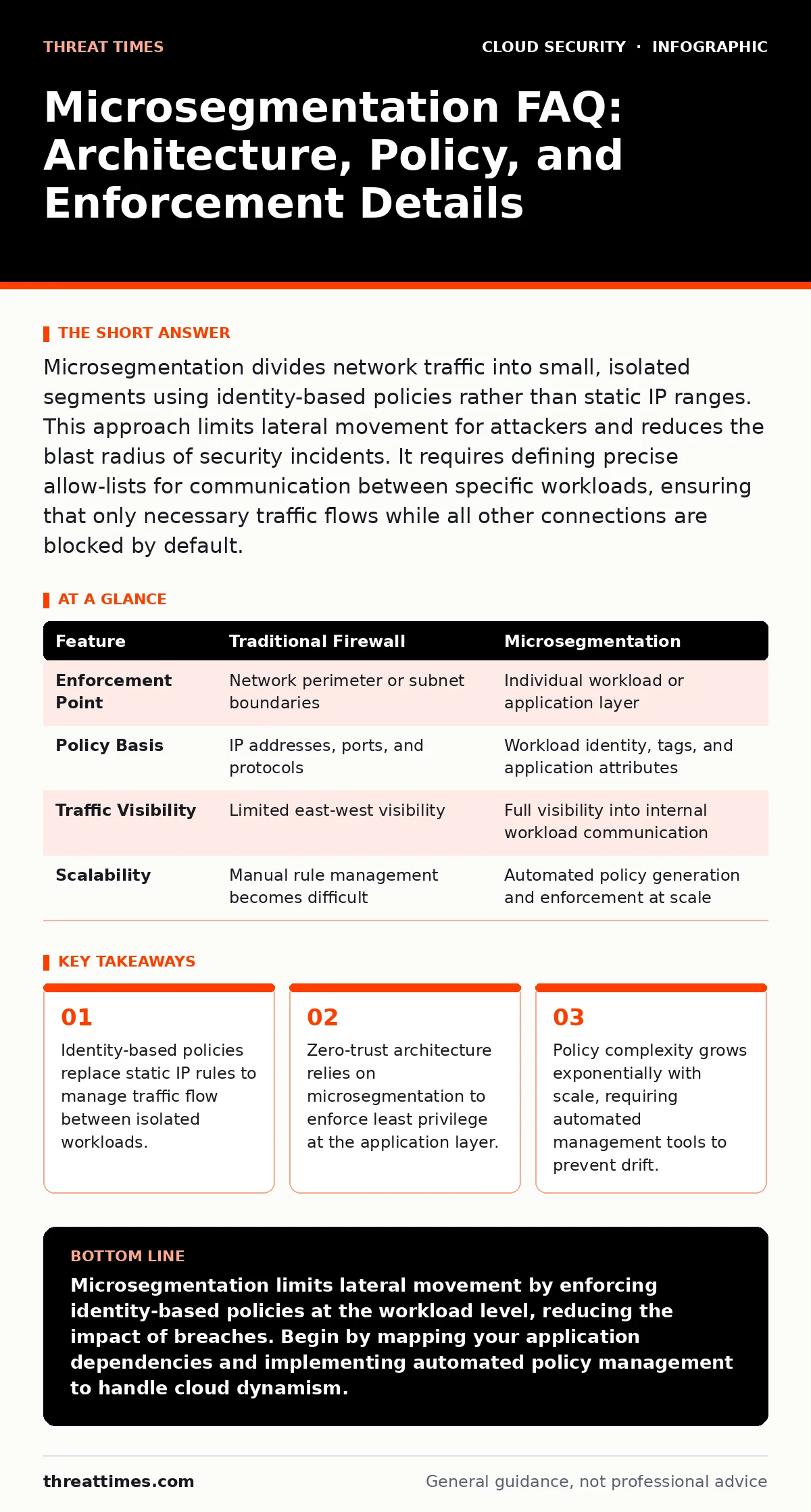
Microsegmentation divides network traffic into small, isolated segments using identity-based policies rather than static IP ranges. This approach limits lateral movement for attackers and reduces the blast radius of security incidents. It requires defining precise allow-lists for communication between specific workloads, ensuring that only necessary traffic flows while all other connections are blocked by default.
What is microsegmentation in cloud security?
Microsegmentation is a security strategy that divides a network into distinct, isolated zones at the workload or application level. Unlike traditional perimeter defenses, it controls traffic flow between individual servers, containers, or virtual machines. This method ensures that even if an attacker breaches the outer perimeter, they cannot move freely across the internal network.
How does microsegmentation differ from security groups?
Security groups act as virtual firewalls attached to individual instances, typically filtering traffic based on IP addresses and ports. Microsegmentation goes further by applying policies based on workload identity, attributes, and application context. While security groups define broad access rules, microsegmentation enforces granular, east-west traffic controls between specific applications. You should review our guide on cloud security groups to understand the baseline controls that microsegmentation enhances.
Why is east-west traffic the primary focus?
East-west traffic refers to communication between servers within the same data center or cloud environment. Most modern breaches involve attackers moving laterally across this internal traffic after gaining initial access. Traditional firewalls often overlook this internal flow, assuming the perimeter is secure. Microsegmentation inspects and restricts this lateral movement, preventing compromised systems from accessing sensitive data stores.
How do you define policies for microsegmentation?
Policies are defined using tags, labels, or metadata associated with each workload rather than static IP addresses. For example, a policy might allow traffic only from "web-tier" tags to "database-tier" tags on specific ports. This identity-based approach remains valid even if workloads change IP addresses due to auto-scaling or migration. It aligns closely with principles found in cloud identity governance frameworks.
What are the challenges of implementing microsegmentation?
The primary challenge is policy complexity and the risk of breaking application dependencies. Defining correct allow-lists requires deep visibility into application communication patterns, which can be difficult in dynamic cloud environments. Incorrect policies may block legitimate traffic, causing service outages. Additionally, managing thousands of individual rules manually is prone to human error and configuration drift.
How does microsegmentation support zero-trust architecture?
Zero-trust assumes no user or system is trusted by default, regardless of location. Microsegmentation enforces this by verifying every connection request against strict policies before allowing traffic. It eliminates implicit trust within the network, ensuring that access is granted only to specific, authorized services. This granular control is a foundational component of any mature zero-trust implementation.
| Feature | Traditional Firewall | Microsegmentation |
|---|---|---|
| Enforcement Point | Network perimeter or subnet boundaries | Individual workload or application layer |
| Policy Basis | IP addresses, ports, and protocols | Workload identity, tags, and application attributes |
| Traffic Visibility | Limited east-west visibility | Full visibility into internal workload communication |
| Scalability | Manual rule management becomes difficult | Automated policy generation and enforcement at scale |
Can microsegmentation protect against insider threats?
Yes, microsegmentation limits the damage an insider can cause by restricting their access to only the systems necessary for their role. Even with valid credentials, an insider cannot pivot to unrelated systems without explicit policy permission. This containment strategy reduces the potential impact of malicious or negligent internal actions. It complements strategies discussed in service account security by limiting the scope of automated identities.
How does microsegmentation handle dynamic cloud environments?
Cloud workloads frequently change IP addresses, scale up or down, and migrate across regions. Microsegmentation policies based on identity tags remain consistent despite these changes. Automated policy engines update enforcement points in real-time to match the current state of the infrastructure. This adaptability is critical for maintaining security in containerized and serverless architectures.
What is the relationship between microsegmentation and service meshes?
Service meshes provide infrastructure-level support for microsegmentation by managing service-to-service communication at the sidecar proxy level. They offer deep visibility and fine-grained traffic control, including mutual TLS encryption. While microsegmentation is the security strategy, service meshes often serve as the technical implementation layer. Explore service mesh security to understand how proxies enforce these policies efficiently.
How do you measure the effectiveness of microsegmentation?
Effectiveness is measured by the reduction in lateral movement paths and the speed of incident containment. Regular audits should verify that policies match intended business logic and that no unauthorized connections exist. You can also simulate attacks to test how quickly the segmentation isolates compromised workloads. This validation process helps identify gaps that manual reviews might miss.
Does microsegmentation replace other security controls?
No, microsegmentation is a layer of defense that complements, not replaces, other security measures. It does not prevent initial compromise, so you still need strong perimeter defenses, patch management, and identity verification. It works best when integrated with broader strategies like protecting against cloud misconfigurations and preventing SaaS account takeover. A layered approach ensures resilience against diverse threat vectors.
Key takeaways
- Identity-based policies replace static IP rules to manage traffic flow between isolated workloads.
- Zero-trust architecture relies on microsegmentation to enforce least privilege at the application layer.
- Policy complexity grows exponentially with scale, requiring automated management tools to prevent drift.
Microsegmentation limits lateral movement by enforcing identity-based policies at the workload level, reducing the impact of breaches. Begin by mapping your application dependencies and implementing automated policy management to handle cloud dynamism.
Frequently asked questions
Does microsegmentation work for on-premises data centers?
Yes, modern microsegmentation solutions support hybrid environments, allowing consistent policy enforcement across cloud and on-premises infrastructure.
How does microsegmentation affect network performance?
When implemented efficiently using native cloud capabilities or lightweight agents, the performance impact is minimal and often negligible for most applications.
Can microsegmentation prevent ransomware spread?
It significantly slows ransomware propagation by isolating infected workloads, preventing them from encrypting adjacent systems or accessing shared storage.
Is microsegmentation suitable for small businesses?
While beneficial for all sizes, small businesses may find cloud-native security features sufficient until their infrastructure complexity grows.
How this guide was produced: written by the Threat Times editorial team with AI assistance, checked against the public references listed below, and reviewed when the facts change. See our editorial policy or report an error.