Token Theft Warning Signs: Early Indicators and Silent Alerts
Token theft often bypasses password checks, making session behavior anomalies the only reliable indicator of a compromised identity without new credentials.

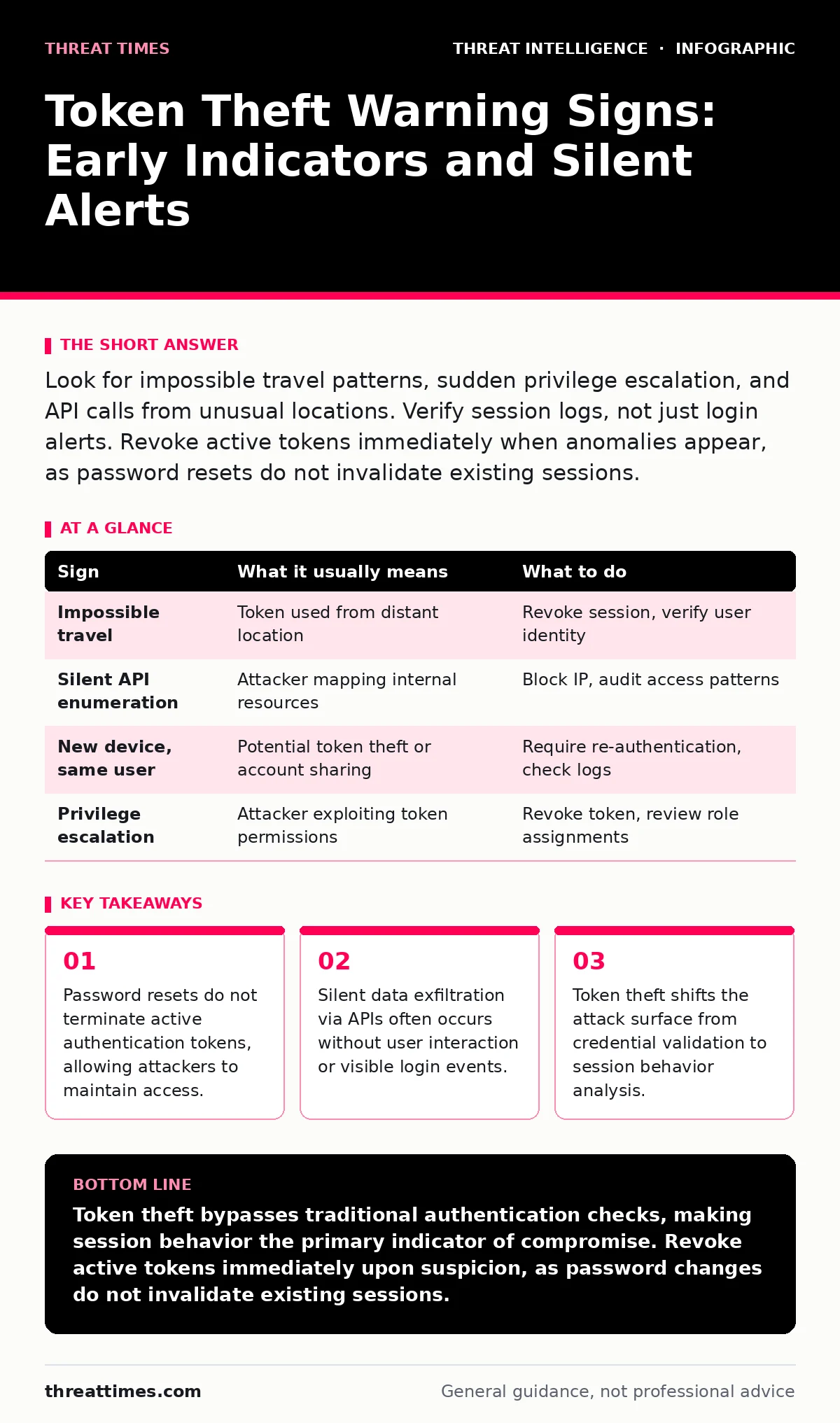
Look for impossible travel patterns, sudden privilege escalation, and API calls from unusual locations. Verify session logs, not just login alerts. Revoke active tokens immediately when anomalies appear, as password resets do not invalidate existing sessions.
The Illusion of Secure Login
Authentication tokens allow users to remain logged in without re-entering credentials. This convenience creates a significant blind spot. An attacker who steals a valid token does not need to bypass multi-factor authentication or crack passwords. They simply replay the token to the service.
You may see successful logins with no failed attempts. This absence of brute force noise is a hallmark of token theft. Traditional security tools often ignore successful authentications. This leaves the initial compromise undetected for days or weeks.
Immediate Behavioral Anomalies
The first signs usually involve user behavior that defies logic. Imagine a user logging in from New York at 9:00 AM and then accessing internal resources from an IP address in Eastern Europe at 9:05 AM. This is impossible travel.
Another obvious sign is a sudden change in role. A marketing analyst suddenly accessing engineering source code repositories triggers alerts. These actions are loud. They violate standard access controls and user baselines.
However, these loud signs are rare. Attackers often mimic legitimate user behavior to avoid detection. They perform low-and-slow actions that blend into normal traffic.
Silent Indicators in the Logs
The signs that are easy to miss reside in the metadata of API calls. Attackers often use stolen tokens to enumerate users or export data via application programming interfaces. These calls look like normal application traffic.
You might notice an increase in read-only operations from a single session. The user is not editing files; they are downloading them. Another subtle sign is the use of undocumented API endpoints. Legitimate users rarely interact with raw APIs directly.
These actions do not trigger standard login alerts. They require deep packet inspection or behavioral analytics. Without these tools, the theft remains invisible until data loss is confirmed.
Response and Remediation Steps
When you suspect token theft, speed matters. The immediate goal is to invalidate the stolen session. Changing the user’s password is insufficient. The token remains valid until it expires or is explicitly revoked.
- Identify the compromised token ID from the logs.
- Revoke the specific token or force a global session logout for the user.
- Audit recent API activity for data exfiltration.
- Check for lateral movement using the stolen identity.
This process stops the current access but does not recover stolen data. You must assume the attacker has already accessed sensitive information.
Detection Engineering Strategies
To catch token theft early, you need detection engineering that focuses on session behavior. Static rules are easily bypassed. You must build rules that analyze the context of each request.
For example, a rule that flags any API call from a new device is too noisy. A better approach is to flag API calls that access high-value data from a new device. This reduces false positives while catching malicious activity.
Integrating with threat intelligence platforms helps identify known malicious IPs. However, attackers often use residential proxies. Behavioral analysis remains more reliable than IP reputation alone.
Mitigating Session Risks
Shortening token expiration times reduces the window of opportunity. If a token expires in fifteen minutes, the attacker has less time to act. This adds friction for legitimate users but increases security.
Another mitigation is binding tokens to specific device fingerprints. If the token is used from a different browser or operating system, the server rejects it. This prevents simple token replay attacks.
Regularly rotating API keys and enforcing least privilege limits the damage. Even if a token is stolen, the attacker can only access what the token allows.
| Sign | What it usually means | What to do |
|---|---|---|
| Impossible travel | Token used from distant location | Revoke session, verify user identity |
| Silent API enumeration | Attacker mapping internal resources | Block IP, audit access patterns |
| New device, same user | Potential token theft or account sharing | Require re-authentication, check logs |
| Privilege escalation | Attacker exploiting token permissions | Revoke token, review role assignments |
Integrating with Broader Security
Token theft detection should not exist in isolation. It must feed into your broader security operations. Correlating session anomalies with other alerts provides context.
Using IOC enrichment helps identify if the token was used with known malicious infrastructure. While not always applicable, it adds another layer of verification.
Deception technology can also help. Placing fake high-value data in the environment can trigger alerts when an attacker accesses it. This confirms the compromise and provides evidence.
The Hidden Cost of Convenience
The trade-off for seamless user experience is increased attack surface. Every active token is a potential entry point. You must balance convenience with security.
Implementing microsegmentation can limit the damage. Even if an attacker gains access via a stolen token, they cannot move laterally to other systems.
Personal data protection requires strict access controls. Ensure that tokens do not grant broader access than necessary. Regular audits of token permissions are vital.
Key takeaways
- Password resets do not terminate active authentication tokens, allowing attackers to maintain access.
- Silent data exfiltration via APIs often occurs without user interaction or visible login events.
- Token theft shifts the attack surface from credential validation to session behavior analysis.
Token theft bypasses traditional authentication checks, making session behavior the primary indicator of compromise. Revoke active tokens immediately upon suspicion, as password changes do not invalidate existing sessions.
Frequently asked questions
Does changing a password stop a stolen token?
No, changing a password does not invalidate existing authentication tokens. You must explicitly revoke the token or force a session logout.
How long do authentication tokens typically last?
Token expiration varies by service configuration. Some last minutes, others days. Shorter expiration times reduce the risk window.
Can multi-factor authentication prevent token theft?
MFA protects the initial login but not the token itself. Once the token is issued, MFA is not required for subsequent requests.
What is the best way to detect token reuse?
Monitor for impossible travel, unusual API usage, and access from new devices. Behavioral analytics are more effective than static rules.
How this guide was produced: written by the Threat Times editorial team with AI assistance, checked against the public references listed below, and reviewed when the facts change. See our editorial policy or report an error.