How Threat Intelligence Platforms Actually Work
These tools transform raw data into actionable context by correlating indicators across multiple sources, revealing hidden attack patterns that isolated alerts miss.

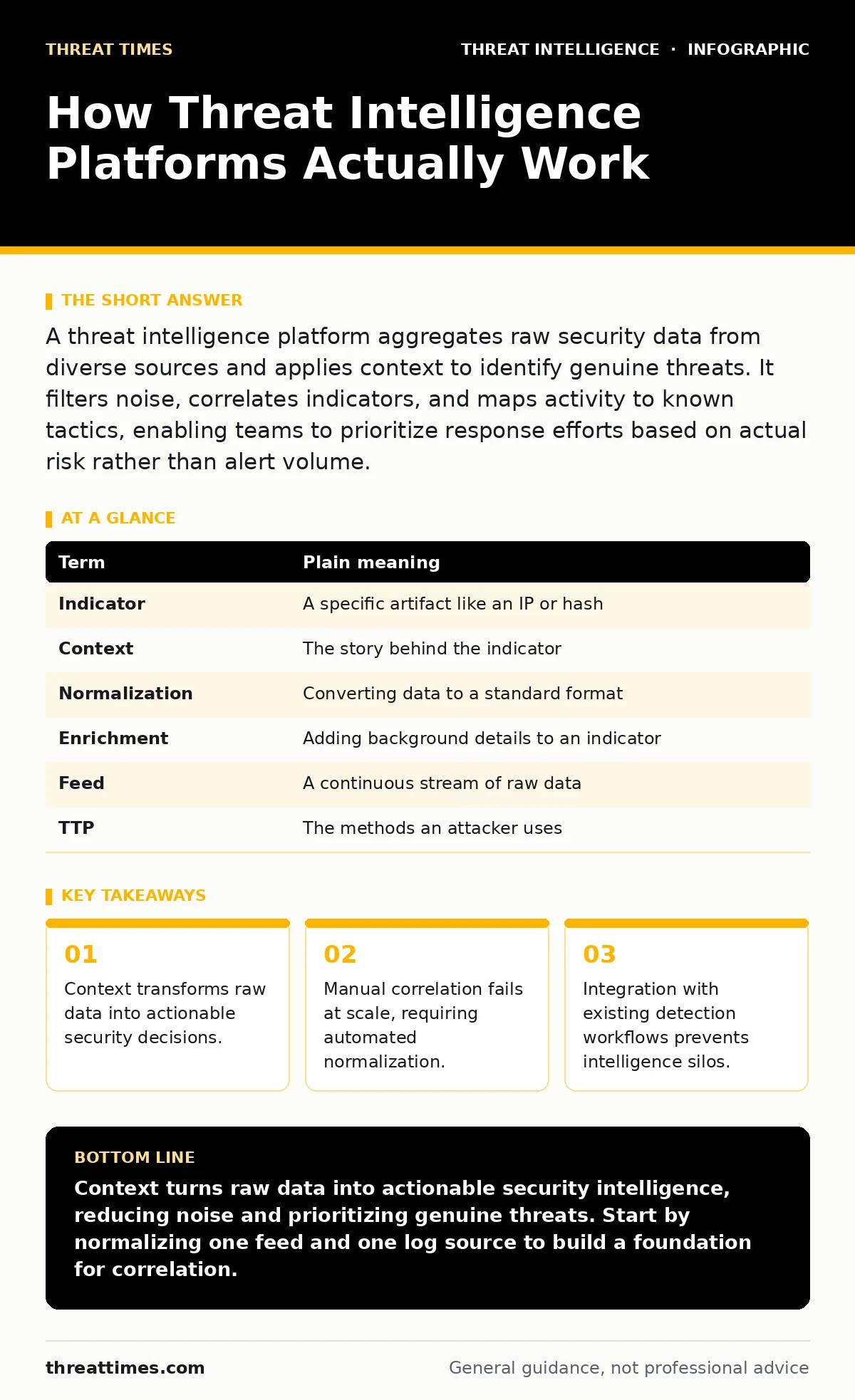
A threat intelligence platform aggregates raw security data from diverse sources and applies context to identify genuine threats. It filters noise, correlates indicators, and maps activity to known tactics, enabling teams to prioritize response efforts based on actual risk rather than alert volume.
The Library Analogy
Imagine a vast library where every book represents a single security event. A new book arrives every second, containing titles like "Failed Login" or "Port Scan." If you walk into this library and pick up one random book, you know little about the story. You might find a suspicious title, but without context, it is just noise.
A threat intelligence platform acts as the head librarian. It does not just store books; it reads the metadata, cross-references authors, and identifies patterns. If three different books suddenly cite the same obscure footnote, the librarian flags this connection. This correlation turns isolated incidents into a coherent narrative about an emerging threat.
Defining the Core Components
To understand how these systems operate, you must distinguish between the raw material and the processed product. Indicators of compromise are specific artifacts like IP addresses, file hashes, or domain names. These are the "books" in our library. They are static and often short-lived.
Threat intelligence is the context applied to these indicators. It answers why an IP address is malicious and what it is trying to achieve. This context includes the attacker’s tactics, techniques, and procedures. Without this layer, you have data, but you do not have intelligence.
| Term | Plain meaning |
|---|---|
| Indicator | A specific artifact like an IP or hash |
| Context | The story behind the indicator |
| Normalization | Converting data to a standard format |
| Enrichment | Adding background details to an indicator |
| Feed | A continuous stream of raw data |
| TTP | The methods an attacker uses |
The Problem of Noise
Security tools generate millions of alerts daily. Most are false positives or low-priority events. If you investigate every alert, you will burn out. This is the primary reason organizations adopt centralized platforms. The platform acts as a filter, suppressing known benign activity and highlighting anomalies.
Imagine the library again. If every book that mentions "error" triggers an alarm, the alarm system becomes useless. The platform learns which errors are routine. It silences the noise so you can hear the signal. This reduction in cognitive load allows analysts to focus on high-fidelity threats rather than chasing ghosts.
Normalization and Enrichment
Raw data comes in many formats. One vendor sends timestamps in one format; another uses a different standard. Before correlation can happen, the platform must normalize this data. It converts everything into a common schema. This allows the system to compare apples with apples.
Enrichment adds depth to the normalized data. When the platform sees a suspicious IP, it queries internal and external sources. It checks if that IP has been seen before, what geolocation it claims, and what reputation score it holds. This process is similar to IOC enrichment, where you add layers of detail to a single data point. Without enrichment, an IP address is just a number.
Mapping to Frameworks
Once data is normalized and enriched, the platform maps it to known attack frameworks. This helps you understand the stage of an attack. For example, if you see reconnaissance activity, the platform tags it as such. If you see command-and-control communication, it flags it as post-exploitation.
This mapping aligns with concepts like the Unified Kill Chain, which breaks attacks into distinct phases. By seeing where your alerts fall in the chain, you can prioritize response. An alert indicating data exfiltration is more urgent than one indicating initial scanning. The platform automates this triage based on the framework’s logic.
Integration and Action
Intelligence is useless if it sits in a dashboard. The platform must push findings to your detection and response tools. This integration ensures that the context travels with the alert. When an analyst receives an alert, they see the enriched data and the mapped TTPs immediately.
This workflow supports detection engineering, where you build rules that respond to specific threat behaviors. For instance, you might create a rule that triggers only when a known malicious domain is accessed during non-business hours. The platform provides the domain list and the context; your detection engine provides the trigger. This synergy reduces response time significantly.
Starting Your Implementation
You do need to build a custom platform to begin. Start with a free or open-source tool that supports standard data formats. Focus on ingesting one high-quality feed and one internal log source. Configure basic normalization rules to ensure the data aligns.
Next, define a simple use case. Choose a common threat type, such as phishing or malware download. Build a correlation rule that links indicators from your feed to your internal logs. Test this rule in a staging environment. Verify that it triggers on known malicious activity and remains silent on benign traffic.
- Select a platform that supports standard data ingestion.
- Ingest one trusted threat feed and one internal log source.
- Build and test a single correlation rule for a specific threat.
This gradual approach ensures you understand the mechanics before scaling. As you gain confidence, you can add more feeds, complex rules, and integration with your response tools. The goal is not to collect everything, but to act on what matters.
Key takeaways
- Context transforms raw data into actionable security decisions.
- Manual correlation fails at scale, requiring automated normalization.
- Integration with existing detection workflows prevents intelligence silos.
Context turns raw data into actionable security intelligence, reducing noise and prioritizing genuine threats. Start by normalizing one feed and one log source to build a foundation for correlation.
Frequently asked questions
Do I need a commercial platform to start?
No, many open-source options exist that support standard data formats and basic correlation rules.
How do I handle data volume?
Focus on high-fidelity feeds and strict normalization to reduce noise before scaling ingestion.
What is the difference between a feed and a platform?
A feed is raw data; a platform processes, normalizes, and correlates that data into context.
Can these platforms prevent attacks?
No, they identify and prioritize threats; prevention requires integration with blocking and response tools.
How this guide was produced: written by the Threat Times editorial team with AI assistance, checked against the public references listed below, and reviewed when the facts change. See our editorial policy or report an error.