Recovery Point Objective: Why Data Gaps Drive Ransomware Success
Recovery point objective defines the maximum acceptable data loss window, forcing teams to accept financial trade-offs between storage costs and business continuity risks.

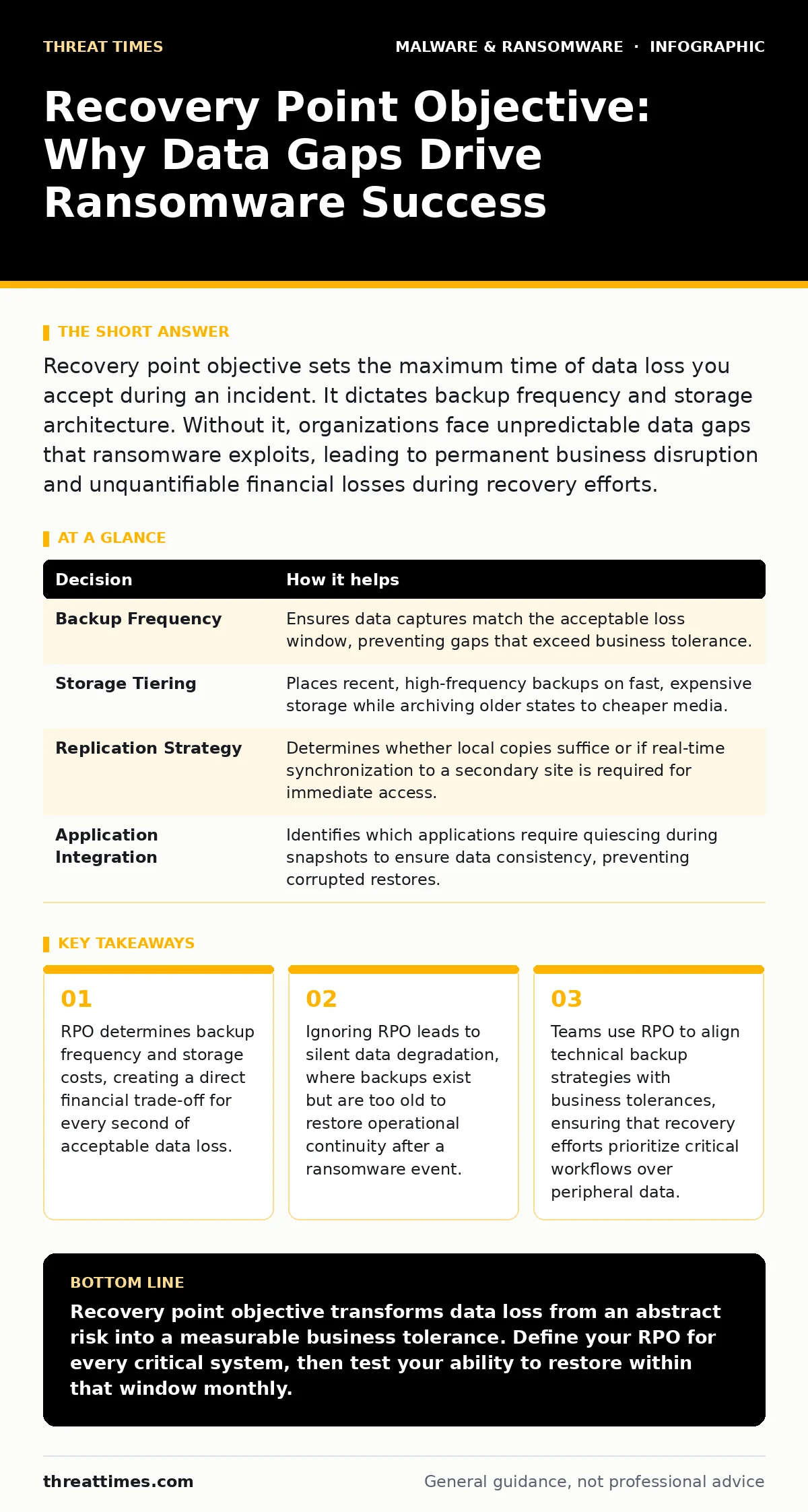
Recovery point objective sets the maximum time of data loss you accept during an incident. It dictates backup frequency and storage architecture. Without it, organizations face unpredictable data gaps that ransomware exploits, leading to permanent business disruption and unquantifiable financial losses during recovery efforts.
Defining the Tolerance for Loss
Recovery point objective, or RPO, measures the maximum amount of data an organization can afford to lose during a disruption. It is not a technical specification but a business decision expressed in time. If your RPO is four hours, you accept losing up to four hours of transactions, edits, or communications. This metric dictates how often you must capture state changes in your systems.
Many professionals confuse RPO with recovery time objective, which measures how long restoration takes. You can have instant backups but slow restoration, or slow backups but instant restoration. RPO focuses strictly on the data gap. A short RPO requires frequent snapshots, which increases storage consumption and network bandwidth usage. A long RPO reduces costs but increases the risk of significant data loss.
The Cost of Silent Data Gaps
Without a defined RPO, backup schedules are often arbitrary. Administrators might run daily backups because it is the default setting in their software. This approach ignores the actual value of data generated between backups. Imagine a financial trading platform that processes transactions every second. A daily backup means losing twenty-three hours and fifty-nine minutes of trade history. That loss is not just inconvenient; it is catastrophic for audit trails and customer trust.
Ransomware attackers study these gaps. They know that many organizations rely on nightly backups. By encrypting systems late in the day, they force victims to restore from the previous night’s snapshot. The attacker wins because the victim loses the day’s work. Defining an RPO forces you to confront this reality. It pushes you to implement continuous data protection or more frequent snapshots, narrowing the window the attacker can exploit.
Informing Technical Architecture Decisions
Your RPO dictates the underlying technology you must deploy. A thirty-minute RPO cannot be achieved with manual tape backups. It requires automated, frequent snapshots stored in a separate location. This often means moving from block-level backups to file-level or application-consistent snapshots. Each reduction in RPO increases infrastructure complexity.
| Decision | How it helps |
|---|---|
| Backup Frequency | Ensures data captures match the acceptable loss window, preventing gaps that exceed business tolerance. |
| Storage Tiering | Places recent, high-frequency backups on fast, expensive storage while archiving older states to cheaper media. |
| Replication Strategy | Determines whether local copies suffice or if real-time synchronization to a secondary site is required for immediate access. |
| Application Integration | Identifies which applications require quiescing during snapshots to ensure data consistency, preventing corrupted restores. |
The Hidden Cost of Compliance
Compliance frameworks often mandate data retention periods but rarely specify RPOs. This leaves a dangerous ambiguity. You might retain data for seven years to satisfy legal requirements, but if your RPO is twenty-four hours, you cannot prove what happened at 2:00 PM yesterday. In an investigation, that gap can be fatal.
Teams that ignore RPO often find themselves unable to produce forensic evidence. If malware altered files three hours before detection, and your last backup was twelve hours prior, you have lost the pre-compromise state. You cannot differentiate between legitimate changes and malicious ones. This forces you to restore from a much older point, losing days of legitimate work. Defining RPO ensures that your forensic capability matches your operational needs.
Contrasting Operational Approaches
The difference is not just technical; it is cultural. Team B accepts the cost of higher storage and more complex networking because they value continuity. Team A assumes weekly backups are "good enough." That assumption is the vulnerability. Ransomware does not care about your assumptions; it exploits the silence between backups.
Implementing Realistic Targets
Setting an RPO requires honest conversation with business leaders. They must state how much revenue or reputation damage they will tolerate per hour of data loss. Do not start with technical capabilities. Start with business impact. If the CFO says losing one hour of sales data is acceptable, your RPO is one hour. If losing one hour of customer PII is unacceptable, your RPO is near-zero.
This process reveals hidden dependencies. You might discover that a legacy application cannot support frequent snapshots. In that case, you must either upgrade the application or accept a longer RPO for that specific dataset. You cannot retrofit a short RPO onto infrastructure that does not support it. This is where the ransomware attack chain meets your architectural limits.
Testing the Restoration Path
A defined RPO is useless if you cannot restore within that window. Many teams test restoration annually, if at all. This is insufficient. File systems change, permissions drift, and backup software updates introduce bugs. You must test restoration frequently, simulating a ransomware event where recent files are encrypted.
If your RPO is one hour, your test must verify that you can identify and restore files from the last hour. If the test takes three hours, your RPO is effectively three hours. You must adjust your processes or technology to close that gap. This validation step is where many organizations fail. They have the backups, but not the ability to use them quickly.
Key takeaways
- RPO determines backup frequency and storage costs, creating a direct financial trade-off for every second of acceptable data loss.
- Ignoring RPO leads to silent data degradation, where backups exist but are too old to restore operational continuity after a ransomware event.
- Teams use RPO to align technical backup strategies with business tolerances, ensuring that recovery efforts prioritize critical workflows over peripheral data.
Recovery point objective transforms data loss from an abstract risk into a measurable business tolerance. Define your RPO for every critical system, then test your ability to restore within that window monthly.
Frequently asked questions
How does RPO differ from backup frequency?
Backup frequency is a technical action; RPO is a business requirement. You might backup every hour to meet a thirty-minute RPO, allowing for processing delays and verification time.
Can I have an RPO of zero?
True zero RPO is nearly impossible for all data. It requires real-time replication, which is expensive and complex. Most organizations aim for near-zero for critical transactional data.
Does RPO protect against data corruption?
RPO protects against data loss, not necessarily corruption. If you backup corrupted data, you restore corruption. You need integrity checks and immutable storage to combat this.
How often should I review my RPO?
Review your RPO whenever business processes change, new applications are deployed, or after a security incident. Data value and criticality shift over time.
How this guide was produced: written by the Threat Times editorial team with AI assistance, checked against the public references listed below, and reviewed when the facts change. See our editorial policy or report an error.