How the Ransomware Attack Chain Works: Mapping the Kill Chain
Ransomware succeeds because defenders monitor for file encryption, while attackers spend most of their time moving laterally to find backup credentials before any data changes occur.

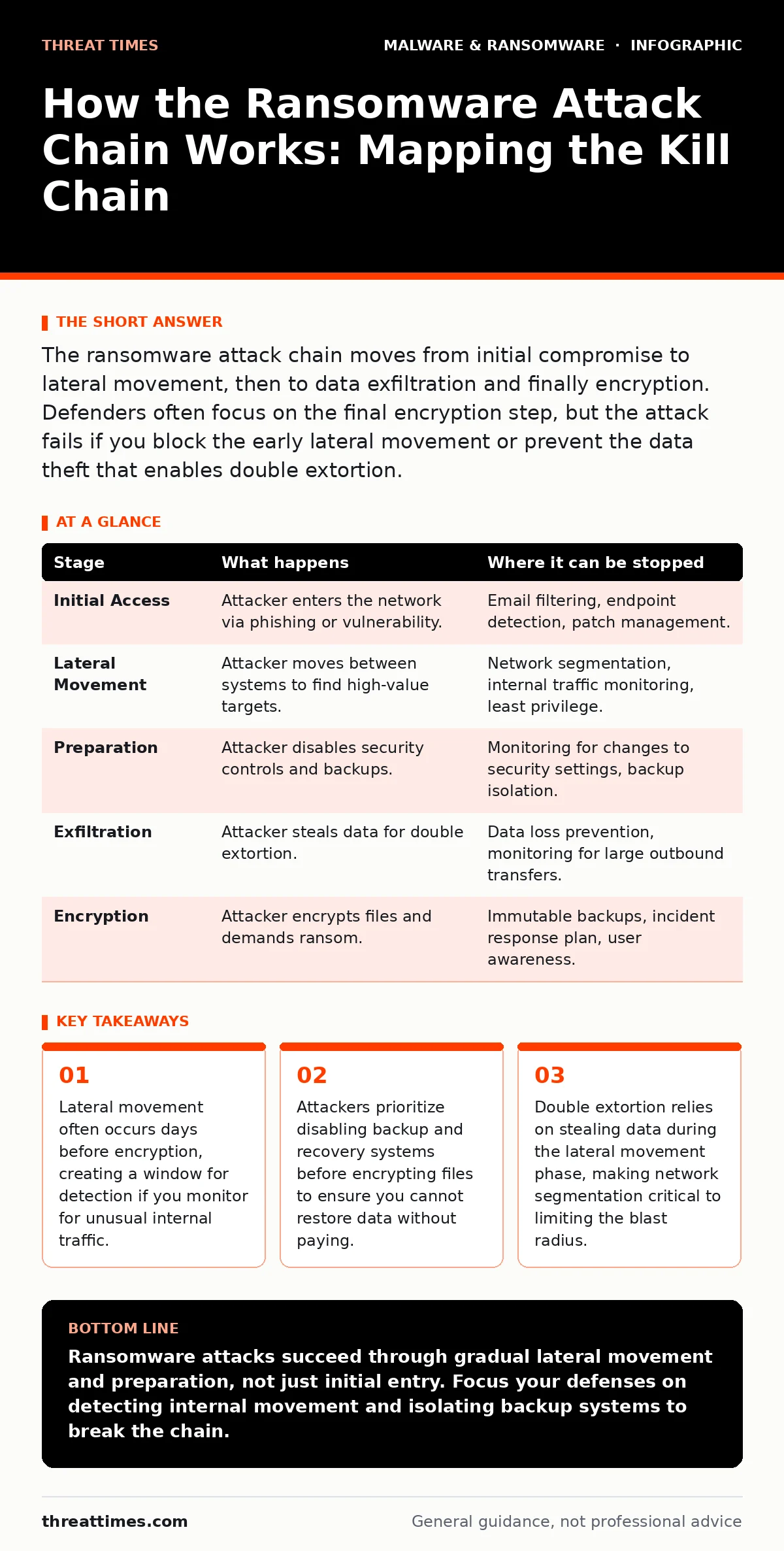
The ransomware attack chain moves from initial compromise to lateral movement, then to data exfiltration and finally encryption. Defenders often focus on the final encryption step, but the attack fails if you block the early lateral movement or prevent the data theft that enables double extortion.
The Anatomy of Compromise
Ransomware is rarely a single file that runs and locks your computer. It is a process that unfolds over hours or days. Understanding this process requires looking at the attack as a chain of dependencies. Each link must hold for the next one to work. If you break one link, the attack stops.
Most organizations focus on preventing the initial entry point. This is a common mistake. Entry is inevitable in large networks. The real danger lies in what happens after an attacker gets inside. They do not immediately encrypt files. They first map your network to find high-value targets.
This phase is known as lateral movement. It is the quietest and most dangerous part of the chain. Attackers use stolen credentials to move from one system to another. They look for domain admin rights, backup servers, and sensitive databases. If you only monitor for malware signatures, you will miss this phase entirely.
Stage 1: Initial Access and Persistence
The chain begins with an initial access vector. This could be a phishing email, a vulnerable remote service, or compromised credentials. The attacker’s goal here is not to cause damage yet. The goal is to establish a foothold.
Once inside, the attacker installs persistence mechanisms. These are tools that ensure the attacker can return even if the system is rebooted. Common methods include scheduled tasks, registry run keys, or legitimate administrative tools. This stage is often invisible to standard antivirus software because the tools used are legitimate.
Imagine an attacker gains access through a weak password. They do not steal data immediately. Instead, they create a new user account with administrative privileges. This account becomes their backdoor. If you change the password for the original account, the attacker remains inside via the new account.
Stage 2: Discovery and Lateral Movement
With persistence established, the attacker begins discovery. They scan the network to understand its structure. They identify servers, file shares, and cloud storage connections. This reconnaissance informs their strategy. They need to know where the valuable data lives.
Lateral movement follows. The attacker uses tools to move between systems. They may use Remote Desktop Protocol or PowerShell to execute commands on other machines. They are looking for privilege escalation opportunities. A standard user account is not enough. They need administrative control over domain controllers.
This is where many defenses fail. Internal traffic is often trusted. Firewalls allow traffic between internal subnets without inspection. The attacker moves freely, copying files and testing credentials. If you rely on perimeter security alone, this movement goes unnoticed.
Stage 3: Preparation and Disabling Defenses
Before encryption, the attacker prepares the environment. They disable security controls. This includes turning off antivirus software, deleting volume shadow copies, and disabling log collection. These actions leave no trace of their activities.
They also target backup systems. If backups are online and accessible, the attacker will encrypt or delete them. This ensures you cannot restore your data without paying the ransom. This step is critical for double extortion strategies. Without backups, your options are limited.
Stage 4: Exfiltration and Encryption
With defenses disabled and backups compromised, the attacker proceeds to exfiltration. They copy sensitive data to external servers. This data becomes leverage. If you refuse to pay, they threaten to publish it. This is the second part of double extortion.
Finally, the encryption phase begins. The ransomware encrypts files using strong cryptographic keys. The private key is held by the attacker. A note appears on the screen, demanding payment. By this time, the damage is done. The attacker has already left the network or is destroying evidence.
Reading the Chain for Defense
To defend against ransomware, you must read the chain backwards. Start with the final goal: encryption. What must happen before encryption can occur? Backups must be disabled. What must happen before backups are disabled? Administrative access must be obtained.
By mapping these dependencies, you can identify critical control points. Instead of trying to block every possible entry point, you focus on detecting lateral movement and privilege escalation. You monitor for unusual access to backup systems. You segment your network to limit movement.
This approach changes your monitoring strategy. You look for behavior, not just signatures. You alert on multiple failed login attempts. You alert on access to sensitive directories from unusual workstations. You alert on the deletion of shadow copies.
Applying Segmentation and Least Privilege
Network segmentation is your primary defense against lateral movement. Divide your network into smaller zones. Restrict traffic between zones. Only allow the traffic that is necessary for business operations. If an attacker compromises a workstation, they should not be able to reach the file server.
Least privilege is equally important. Users and services should only have the permissions they need. No standard user should have administrative rights. Service accounts should not have domain admin privileges. This limits the impact of a compromised credential.
Consider the role of threat intelligence platforms in this context. These platforms can provide indicators of compromise that help you detect early stages of the chain. However, they are not a substitute for proper architecture. You still need to segment your network and enforce least privilege.
A Worked Illustration
Imagine a mid-sized company with a flat network structure. All systems can communicate with each other. An employee clicks a phishing link and installs a remote access tool. The attacker uses this tool to scan the network.
Within hours, the attacker discovers the domain controller. They use a password spraying attack to gain administrative access. They copy sensitive financial data to an external server. They then delete the volume shadow copies on the file server.
Finally, they encrypt the files on the file server. The company discovers the attack when users report locked files. The attacker contacts them, demanding payment. The company realizes their backups are also encrypted. They have no way to restore their data.
Summary of Attack Stages
The following table summarizes the stages of the ransomware attack chain and potential detection points.
| Stage | What happens | Where it can be stopped |
|---|---|---|
| Initial Access | Attacker enters the network via phishing or vulnerability. | Email filtering, endpoint detection, patch management. |
| Lateral Movement | Attacker moves between systems to find high-value targets. | Network segmentation, internal traffic monitoring, least privilege. |
| Preparation | Attacker disables security controls and backups. | Monitoring for changes to security settings, backup isolation. |
| Exfiltration | Attacker steals data for double extortion. | Data loss prevention, monitoring for large outbound transfers. |
| Encryption | Attacker encrypts files and demands ransom. | Immutable backups, incident response plan, user awareness. |
Beyond the Basics
Understanding the attack chain is just the first step. You must also consider the broader context. For instance, polymorphic malware changes its code signature to evade detection. This makes signature-based defenses less effective. You need behavioral analysis to detect such threats.
Similarly, firmware malware can reside in the hardware itself. This makes it difficult to remove. Even if you reinstall the operating system, the malware remains. This highlights the importance of hardware-level security.
For those managing Mac environments, removing malware from a Mac requires different tools and techniques. The attack chain is similar, but the tools and persistence mechanisms differ. You must tailor your defenses to each platform.
Moving Forward
Defending against ransomware is not about preventing every attack. It is about reducing the impact and increasing the cost for the attacker. By understanding the attack chain, you can identify the most critical control points. You can focus your resources on detecting lateral movement and protecting backups.
This approach requires a shift in mindset. You must move from perimeter defense to internal monitoring. You must assume breach and plan accordingly. By doing so, you make your organization a harder target. You reduce the likelihood of a successful attack.
The key is to stay proactive. Regularly review your network segmentation. Test your backup restoration processes. Update your incident response plan. By taking these steps, you build resilience against ransomware and other advanced threats.
Key takeaways
- Lateral movement often occurs days before encryption, creating a window for detection if you monitor for unusual internal traffic.
- Attackers prioritize disabling backup and recovery systems before encrypting files to ensure you cannot restore data without paying.
- Double extortion relies on stealing data during the lateral movement phase, making network segmentation critical to limiting the blast radius.
Ransomware attacks succeed through gradual lateral movement and preparation, not just initial entry. Focus your defenses on detecting internal movement and isolating backup systems to break the chain.
Frequently asked questions
How can I tell if an attacker is moving laterally in my network?
Look for unusual login times, access from unexpected locations, or multiple failed login attempts followed by a successful one. Monitor for unusual process execution on servers.
Is network segmentation enough to stop ransomware?
No. Segmentation limits the spread, but you also need strong access controls, patch management, and user awareness to prevent initial compromise and lateral movement.
What is double extortion in ransomware attacks?
Double extortion involves stealing data before encrypting it. The attacker threatens to publish the stolen data if the ransom is not paid. This adds pressure even if you can restore from backups.
How often should I test my backup restoration process?
You should test restoration regularly, at least quarterly. This ensures your backups are not corrupted and that you can restore data within your recovery time objective.
How this guide was produced: written by the Threat Times editorial team with AI assistance, checked against the public references listed below, and reviewed when the facts change. See our editorial policy or report an error.