Detection Engineering Best Practices for Reliable Alerting
Most detection failures stem from poor data quality and lack of context, not from missing logic or insufficient rule complexity in your monitoring stack.

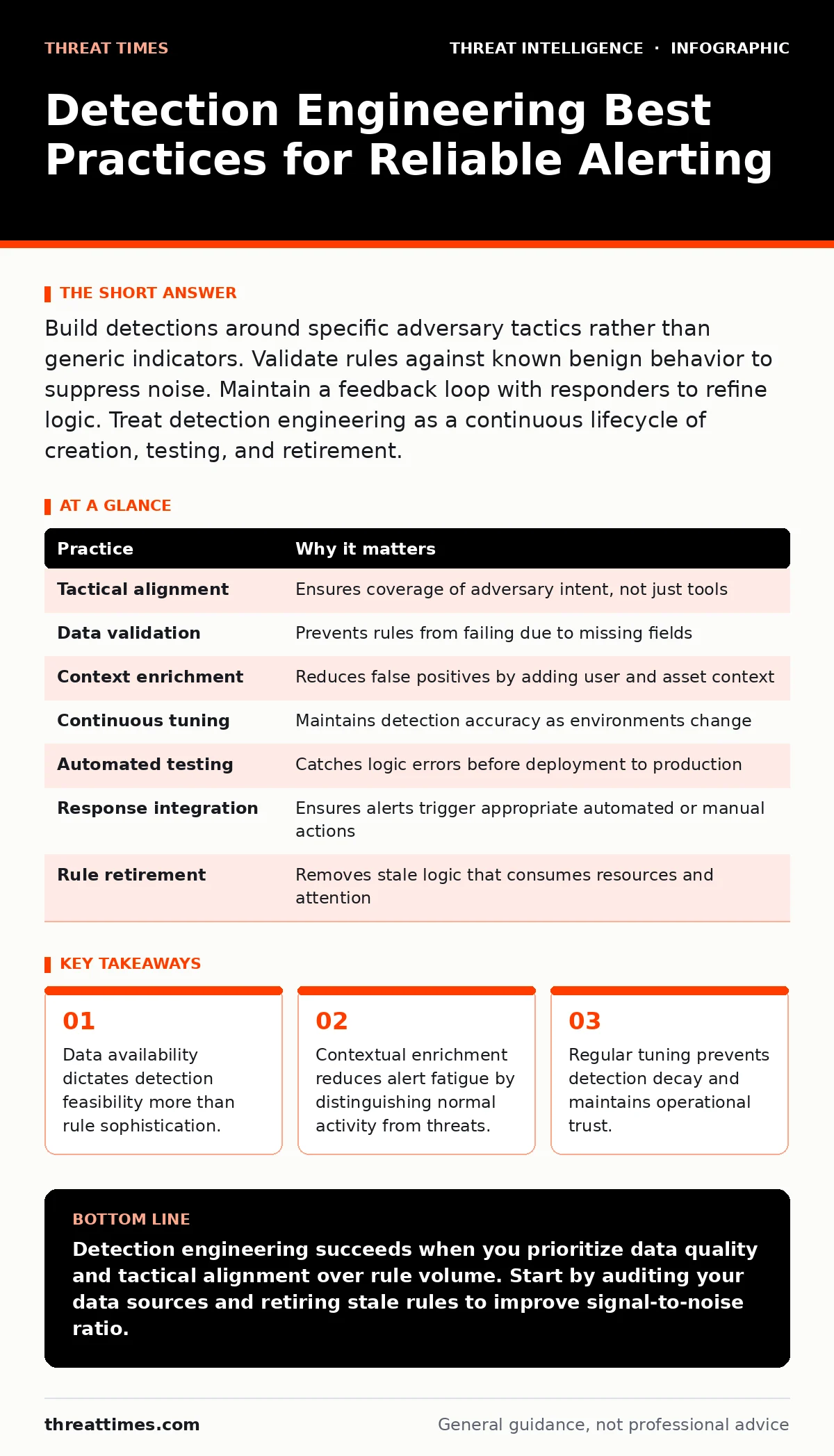
Build detections around specific adversary tactics rather than generic indicators. Validate rules against known benign behavior to suppress noise. Maintain a feedback loop with responders to refine logic. Treat detection engineering as a continuous lifecycle of creation, testing, and retirement.
Align Detections with Adversary Tactics
Effective detection engineering begins with understanding how attackers operate. You must map your rules to specific behaviors rather than relying on static signatures. Static indicators, such as file hashes or IP addresses, change frequently and provide little insight into intent. Behavioral detection focuses on the actions an adversary takes to achieve their objectives, such as privilege escalation or data exfiltration. This approach remains effective even when attackers modify their tools or infrastructure.
You should reference established frameworks like the Unified Kill Chain to identify gaps in your coverage. This model breaks down attack phases into discrete steps, allowing you to design detections for each stage. By covering early-stage activities, you increase the likelihood of stopping an intrusion before significant damage occurs. Late-stage detections are easier to create but often arrive after the breach has succeeded.
| Practice | Why it matters |
|---|---|
| Tactical alignment | Ensures coverage of adversary intent, not just tools |
| Data validation | Prevents rules from failing due to missing fields |
| Context enrichment | Reduces false positives by adding user and asset context |
| Continuous tuning | Maintains detection accuracy as environments change |
| Automated testing | Catches logic errors before deployment to production |
| Response integration | Ensures alerts trigger appropriate automated or manual actions |
| Rule retirement | Removes stale logic that consumes resources and attention |
Validate Data Availability First
Before writing a single line of logic, verify that your data sources actually capture the events you intend to monitor. Many detection concepts fail in practice because the required fields are missing, inconsistent, or incomplete. This is often referred to as data fidelity. If your endpoint agents do not log command-line arguments, you cannot detect malicious commands executed via the shell.
Check your data pipeline for gaps. Ensure that critical fields such as user identity, process ID, and parent process ID are consistently populated. Missing context makes it difficult to distinguish between a legitimate administrative task and a malicious action. You cannot detect what you do not see. Prioritize data collection improvements before expanding your detection logic.
Enrich Alerts with Context
Raw alerts provide limited value without context. An alert indicating a login from a new location is meaningless if that user frequently travels for work. You must enrich alerts with additional data to determine their significance. This process involves correlating the alert with user profiles, asset criticality, and historical behavior.
Integrate your detection engine with threat intelligence platforms to check for known malicious indicators. This allows you to flag activities associated with active threat campaigns. However, rely on behavioral context rather than just indicator matches. Indicators can be false positives, but unusual behavior patterns often reveal genuine threats. Enrichment transforms noise into actionable intelligence.
Implement Automated Testing
Manual testing of detection rules is error-prone and inefficient. You need automated pipelines to validate logic before deployment. These pipelines simulate attack scenarios and verify that your rules trigger as expected. This process is similar to software testing, where you ensure code behaves correctly under various conditions.
Use frameworks like Sigma rules to standardize your detection logic. This allows you to share and reuse rules across different platforms. Automated testing ensures that changes to your environment or data schema do not break existing detections. It also helps you identify false positives by running rules against known benign datasets. Consistent testing builds confidence in your detection capabilities.
Establish a Feedback Loop with Responders
Detection engineers often work in isolation from incident responders. This separation leads to alerts that are technically accurate but operationally useless. You must establish a continuous feedback loop with the teams who handle the alerts they generate. Responders know which alerts are noise and which require immediate attention.
Collect metrics on alert resolution times and false positive rates. Use this data to refine your logic. If a rule triggers too frequently without yielding incidents, it needs tuning. If responders ignore certain alerts, investigate why. They may lack the necessary context or the alert may not align with their workflow. Collaboration ensures that detections support operational goals.
See also: Certificate Management FAQs: Fixing Expiry, Rotation, and Trust
Integrate with Response Actions
A detection is only as valuable as the response it enables. Alerts should trigger automated actions where appropriate, such as isolating a compromised host or disabling a compromised account. This reduces the time between detection and containment. However, automated responses must be carefully tested to avoid disrupting legitimate business operations.
Define clear playbooks for each detection type. These playbooks outline the steps responders should take and the tools they should use. Ensure that your detection engine can pass relevant context to your response platform. This allows for precise actions rather than broad, disruptive measures. Integration streamlines the incident response process and improves overall security posture.
Retire Stale Detections
Detection rules decay over time. As systems change, some rules become irrelevant or generate excessive noise. You must regularly review and retire stale detections. Keeping unused rules consumes resources and clutters your monitoring dashboard. It also increases the cognitive load on responders.
Set a schedule for reviewing detection effectiveness. Remove rules that have not triggered in a significant period or that consistently produce false positives. Archive the logic for historical reference but disable it in production. This keeps your detection stack lean and focused on current threats. Regular maintenance ensures that your engineering efforts remain impactful.
Leverage Deception for Early Warning
Traditional detection relies on analyzing real traffic and events. This approach can miss low-and-slow attacks that blend in with normal activity. Deception technology places fake assets, accounts, or data in your environment. When an attacker interacts with these decoys, it triggers an immediate alert.
This method shifts the burden of proof. Legitimate users have no reason to access fake resources, so any interaction is likely malicious. This reduces false positives and provides high-fidelity alerts. Integrate deception with your detection engineering practices to cover blind spots. It serves as an early warning system for lateral movement and reconnaissance.
Key takeaways
- Data availability dictates detection feasibility more than rule sophistication.
- Contextual enrichment reduces alert fatigue by distinguishing normal activity from threats.
- Regular tuning prevents detection decay and maintains operational trust.
Detection engineering succeeds when you prioritize data quality and tactical alignment over rule volume. Start by auditing your data sources and retiring stale rules to improve signal-to-noise ratio.
Frequently asked questions
How do I balance detection coverage with alert fatigue?
Focus on high-fidelity detections that require minimal triage. Use context enrichment to filter noise and automate responses for clear-cut cases. Regularly tune rules based on responder feedback.
What is the role of threat intelligence in detection engineering?
Intelligence provides context for adversary tactics and indicators. Use it to inform rule creation and enrich alerts, but do not rely on it exclusively. Behavioral detection remains more resilient to evasion.
Should I automate all detection responses?
Automate only low-risk, high-confidence actions. Complex or high-impact responses require human judgment to avoid business disruption. Start with simple actions and expand as confidence grows.
How often should I review my detection rules?
Review rules quarterly or after significant infrastructure changes. Retire stale rules and update logic to reflect new threats. Continuous improvement is key to maintaining effectiveness.
How this guide was produced: written by the Threat Times editorial team with AI assistance, checked against the public references listed below, and reviewed when the facts change. See our editorial policy or report an error.