Unified Kill Chain: Correcting Six Common Misreadings
The Unified Kill Chain maps adversary infrastructure rather than just steps, revealing how misreading its scope breaks detection logic and wastes analyst time.
The Unified Kill Chain is not a linear timeline but a structural map of adversary capabilities and infrastructure. Misinterpreting it as a sequence of events leads to missed detections. You must treat it as a framework for correlating infrastructure with tactics, not as a checklist for incident response steps.
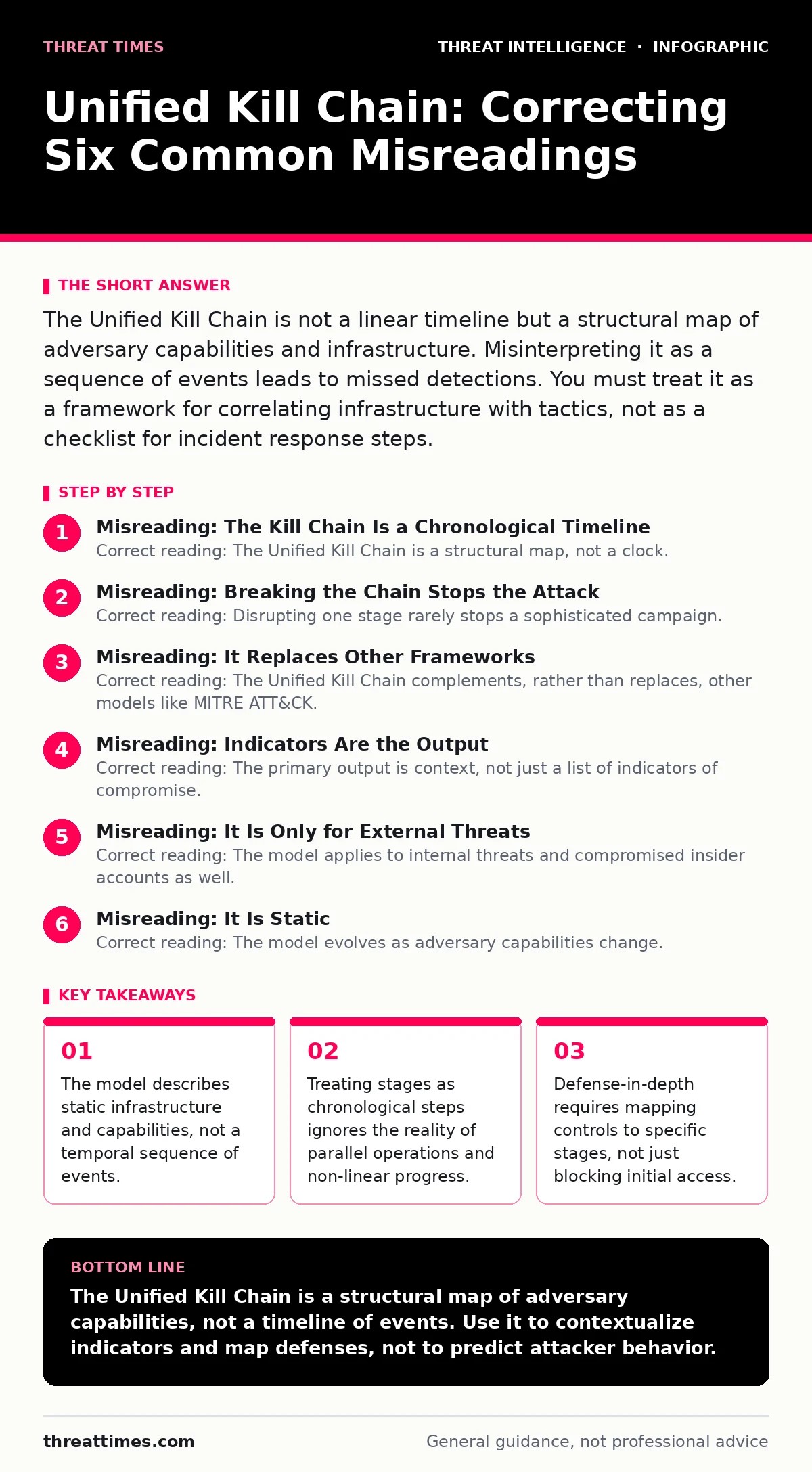
Misreading: The Kill Chain Is a Chronological Timeline
Correct reading: The Unified Kill Chain is a structural map, not a clock. It organizes adversary capabilities and infrastructure into distinct categories for analysis. It does not dictate the order in which an attacker performs actions.
Attackers do not follow a rigid script. They may reuse infrastructure from a previous campaign or skip stages entirely if they already have access. Treating the model as a timeline causes analysts to wait for "Stage 4" before investigating suspicious activity in "Stage 2". This delay allows adversaries to establish persistence while you are still looking for the initial exploit.
The model helps you categorize what you see, not predict when it will happen next. You must recognize that an adversary can operate in multiple stages simultaneously. For example, an attacker might be weaponizing payloads while simultaneously conducting reconnaissance on a new target.
Misreading: Breaking the Chain Stops the Attack
Correct reading: Disrupting one stage rarely stops a sophisticated campaign. Adversaries design their operations with redundancy and alternative paths. Blocking one vector often forces them to switch tactics, not abandon the target.
Imagine you block the initial phishing email. The attacker may then use a compromised legitimate website to deliver the malware. Or they may use social engineering to get a user to download a file directly. The goal of the Unified Kill Chain is to increase the cost and effort required for the adversary, not to create an impenetrable wall.
You should view each stage as a layer of defense-in-depth. Each layer slows the adversary down and creates more observable noise. This noise is what allows your detection engineering teams to build better rules. If you believe one block is enough, you leave the other stages unmonitored.
Misreading: It Replaces Other Frameworks
Correct reading: The Unified Kill Chain complements, rather than replaces, other models like MITRE ATT&CK. Each framework serves a different analytical purpose. Using them together provides a more complete picture of the threat.
MITRE ATT&CK focuses on specific tactics, techniques, and procedures. It is granular and behavioral. The Unified Kill Chain focuses on the infrastructure and capabilities supporting those behaviors. It is broader and structural.
You need both. Use MITRE ATT&CK to understand exactly what an adversary is doing. Use the Unified Kill Chain to understand what resources they are using and how those resources are organized. Relying on only one gives you a blind spot. You might see the technique but miss the infrastructure, or see the infrastructure but not understand the specific tactic.
Misreading: Indicators Are the Output
Correct reading: The primary output is context, not just a list of indicators of compromise. An IP address or domain name is useless without knowing which stage it belongs to and what capability it supports.
Many teams collect indicators and push them into threat intelligence platforms without mapping them to the chain. This creates noise. You do not know if an IP is used for command and control or just for reconnaissance. This ambiguity makes it hard to prioritize alerts.
You must enrich your indicators with stage mapping. When you see a new domain, ask which stage it supports. Is it hosting malware? Is it receiving exfiltrated data? This context allows you to build better detection logic. It also helps in IOC enrichment, where you add behavioral context to raw data.
Misreading: It Is Only for External Threats
Correct reading: The model applies to internal threats and compromised insider accounts as well. The stages describe actions and infrastructure, not just external actors.
An insider threat may not need to conduct reconnaissance in the same way an external hacker does. They may already have access to the network. However, they still need to weaponize their access, deliver the payload, or exfiltrate data. The later stages of the chain are critical for insider threat detection.
You should map internal user behavior to the kill chain stages. If a user starts accessing unusual systems, that is reconnaissance. If they start moving large amounts of data, that is exfiltration. Ignoring the early stages for insiders is a common mistake. You must monitor for capability expansion, not just initial access.
Misreading: It Is Static
Correct reading: The model evolves as adversary capabilities change. New stages or sub-stages may emerge as technology advances. You must update your understanding and mapping regularly.
The original model did not account for cloud-native attacks or supply chain compromises in the same way modern threats do. You must adapt the framework to your environment. If you are using cloud services, you need to consider how infrastructure is provisioned and used in that context.
This adaptation is part of detection engineering. You build rules that reflect the current reality of your environment and the threats you face. Do not treat the model as a fixed artifact. Treat it as a living framework that requires regular review and adjustment.
Key takeaways
- The model describes static infrastructure and capabilities, not a temporal sequence of events.
- Treating stages as chronological steps ignores the reality of parallel operations and non-linear progress.
- Defense-in-depth requires mapping controls to specific stages, not just blocking initial access.
- Intelligence value comes from linking infrastructure to tactics, not just collecting indicators.
The Unified Kill Chain is a structural map of adversary capabilities, not a timeline of events. Use it to contextualize indicators and map defenses, not to predict attacker behavior.
Frequently asked questions
How does the Unified Kill Chain differ from the Cyber Kill Chain?
The Unified Kill Chain is a broader framework that includes external and internal threats, while the Cyber Kill Chain focuses more on external attacks. The Unified version also emphasizes infrastructure and capabilities.
Can I use the Kill Chain for compliance reporting?
Yes, mapping controls to Kill Chain stages can help demonstrate defense-in-depth. However, compliance requires more than just mapping; you need evidence of control effectiveness.
How do I map cloud infrastructure to the Kill Chain?
Treat cloud resources as infrastructure. Map cloud accounts, APIs, and services to the stages they support. For example, a cloud storage bucket used for data exfiltration belongs to the Exfiltration stage.
Is the Kill Chain useful for threat hunting?
Yes, it provides a structure for hunting. You can hunt for specific stages or capabilities. For example, you might hunt for unusual network connections that indicate command and control.
How this guide was produced: written by the Threat Times editorial team with AI assistance, checked against the public references listed below, and reviewed when the facts change. See our editorial policy or report an error.