Machine Learning for Fraud Detection Checklist
Most fraud detection failures stem from data drift and model decay, not from algorithmic complexity or insufficient compute power.

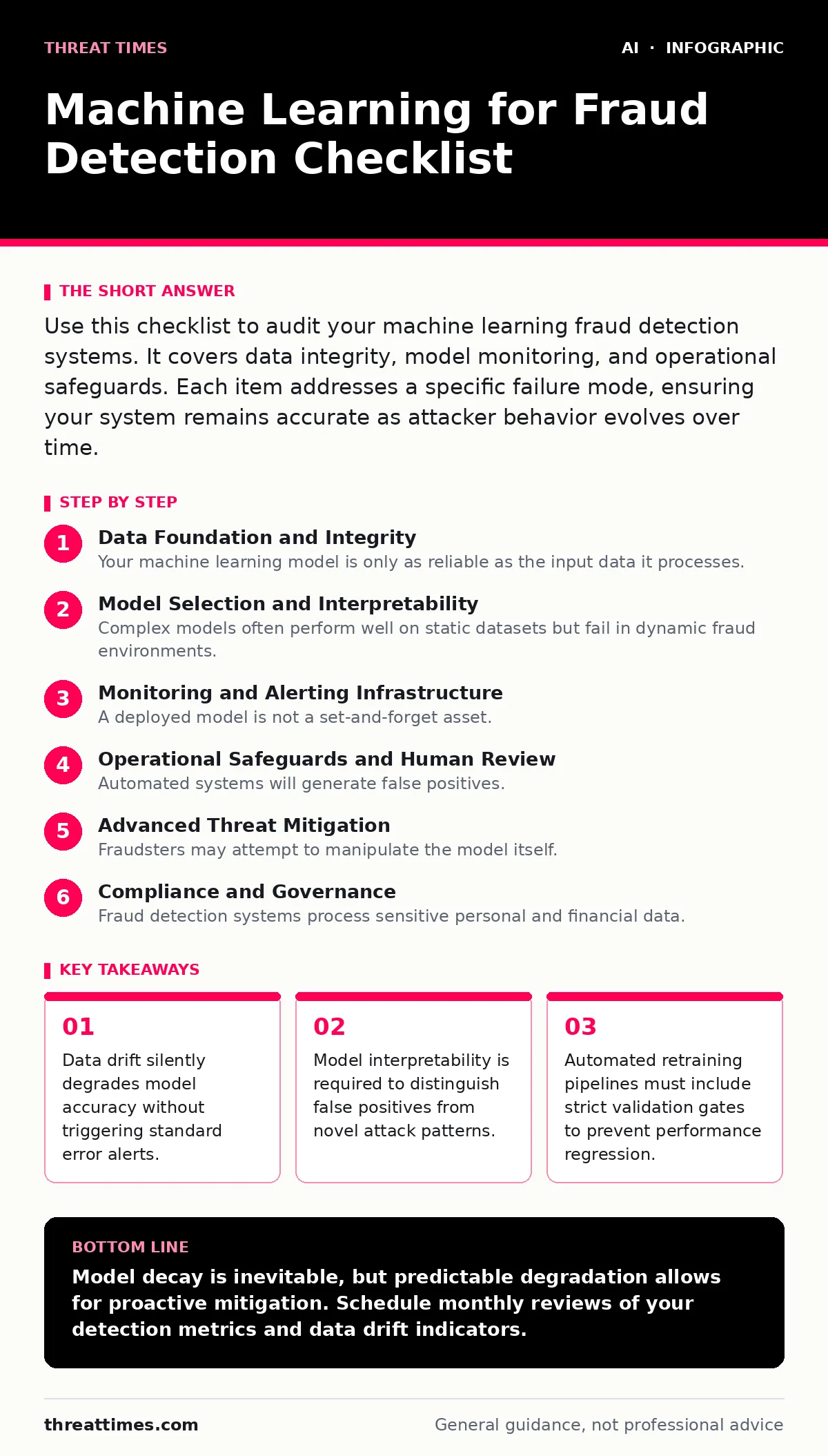
Use this checklist to audit your machine learning fraud detection systems. It covers data integrity, model monitoring, and operational safeguards. Each item addresses a specific failure mode, ensuring your system remains accurate as attacker behavior evolves over time.
Data Foundation and Integrity
Your machine learning model is only as reliable as the input data it processes. Fraudsters constantly change their tactics, meaning the statistical distribution of your data shifts over time. If your training data does not reflect current realities, the model will fail to recognize new threats.
- Implement data drift detection: Statistical tests must monitor input features to alert you when the distribution of transaction data changes significantly from the training baseline.
- Validate data lineage: You must trace every feature back to its source to ensure no corruption or manipulation occurred during ingestion.
- Segment training data by risk profile: Grouping low-risk and high-risk transactions separately prevents the model from ignoring rare but catastrophic events.
- Sanitize historical labels: Incorrectly labeled past transactions will teach the model to miss similar future fraud.
Model Selection and Interpretability
Complex models often perform well on static datasets but fail in dynamic fraud environments. You need models that can explain their decisions, not just predict them. Black-box algorithms make it difficult to determine if a rejection was caused by legitimate fraud or a data anomaly.
- Prioritize interpretable models: Use algorithms like gradient boosting or logistic regression where feature importance can be explicitly measured and explained.
- Establish baseline performance metrics: Define specific thresholds for precision and recall before deployment to measure degradation accurately.
- Test for adversarial robustness: Verify that small, intentional changes to input data do not cause the model to misclassify fraudulent transactions.
- Document model assumptions: Clearly state what conditions the model expects, so operators know when external factors may invalidate its predictions.
Refer to our guide on neural networks to understand when deep learning structures offer tangible benefits over simpler classifiers for fraud detection.
Monitoring and Alerting Infrastructure
A deployed model is not a set-and-forget asset. It requires continuous monitoring to detect performance decay and operational issues. Alerts must be actionable, distinguishing between data quality issues and model accuracy drops.
- Monitor prediction distribution shifts: Track the volume and confidence scores of predictions to identify when the model becomes uncertain or biased.
- Set up latency thresholds: High processing times can indicate resource contention or overly complex inference paths that degrade user experience.
- Implement feedback loops: Capture outcomes of flagged transactions to update training data with real-world ground truth.
- Log all inference requests: Store input data and model outputs for post-incident analysis and regulatory compliance.
Operational Safeguards and Human Review
Automated systems will generate false positives. A robust workflow includes human review for edge cases and high-value transactions. The goal is to balance automation efficiency with the necessity of human judgment for complex scenarios.
- Define escalation rules: Specify which transactions bypass automatic approval and require manual investigation based on risk scores.
- Train analysts on model behavior: Reviewers must understand how the model generates scores to provide meaningful feedback for retraining.
- Establish a rollback procedure: You must be able to quickly revert to a previous model version if the current one exhibits critical errors.
- Conduct regular red teaming: Simulate fraudulent activities to test both the model and the human response workflow.
See our guide on AI security testing for methods to evaluate these operational controls under stress.
Advanced Threat Mitigation
Fraudsters may attempt to manipulate the model itself. Understanding these attack vectors allows you to build defenses that go beyond traditional pattern matching.
- Detect data poisoning attempts: Monitor for unusual spikes in specific feature values that may indicate an attacker is trying to skew training data.
- Limit model exposure: Restrict access to model parameters and inference endpoints to prevent adversaries from crafting targeted attacks.
- Implement rate limiting on API calls: Prevent adversaries from probing the model with many variations to reverse-engineer its logic.
Consult our guide on data poisoning attacks to learn how attackers corrupt training data to degrade model performance over time.
Compliance and Governance
Fraud detection systems process sensitive personal and financial data. Governance frameworks ensure that your models operate within legal and ethical boundaries.
- Document model decisions: Maintain records of why specific transactions were flagged or blocked for audit purposes.
- Review for bias regularly: Analyze model performance across different demographic groups to ensure fair treatment of all users.
- Define data retention policies: Specify how long input data and decision logs are stored to balance investigative needs with privacy requirements.
Check our guide on LLM guardrails for principles on controlling automated decision-making systems that interact with users.
Key takeaways
- Data drift silently degrades model accuracy without triggering standard error alerts.
- Model interpretability is required to distinguish false positives from novel attack patterns.
- Automated retraining pipelines must include strict validation gates to prevent performance regression.
Model decay is inevitable, but predictable degradation allows for proactive mitigation. Schedule monthly reviews of your detection metrics and data drift indicators.
Frequently asked questions
How often should I retrain my fraud detection model?
Retrain on a schedule dictated by data drift metrics rather than a fixed calendar, often monthly or when performance thresholds are breached.
Can machine learning detect all types of fraud?
No, ML excels at pattern recognition but struggles with novel, one-off attacks that lack historical precedent in training data.
What is the biggest risk to ML fraud systems?
Concept drift, where the underlying relationship between features and fraud changes, renders existing models obsolete without detection.
Should I use open-source models for fraud detection?
Open-source models provide a strong baseline, but they require extensive customization and validation against your specific transaction data.
How this guide was produced: written by the Threat Times editorial team with AI assistance, checked against the public references listed below, and reviewed when the facts change. See our editorial policy or report an error.