Machine Learning for Anomaly Detection: How It Works and Fails
Automated systems learn normal behavior patterns to flag deviations, but they generate false positives that require human validation to prevent operational paralysis.

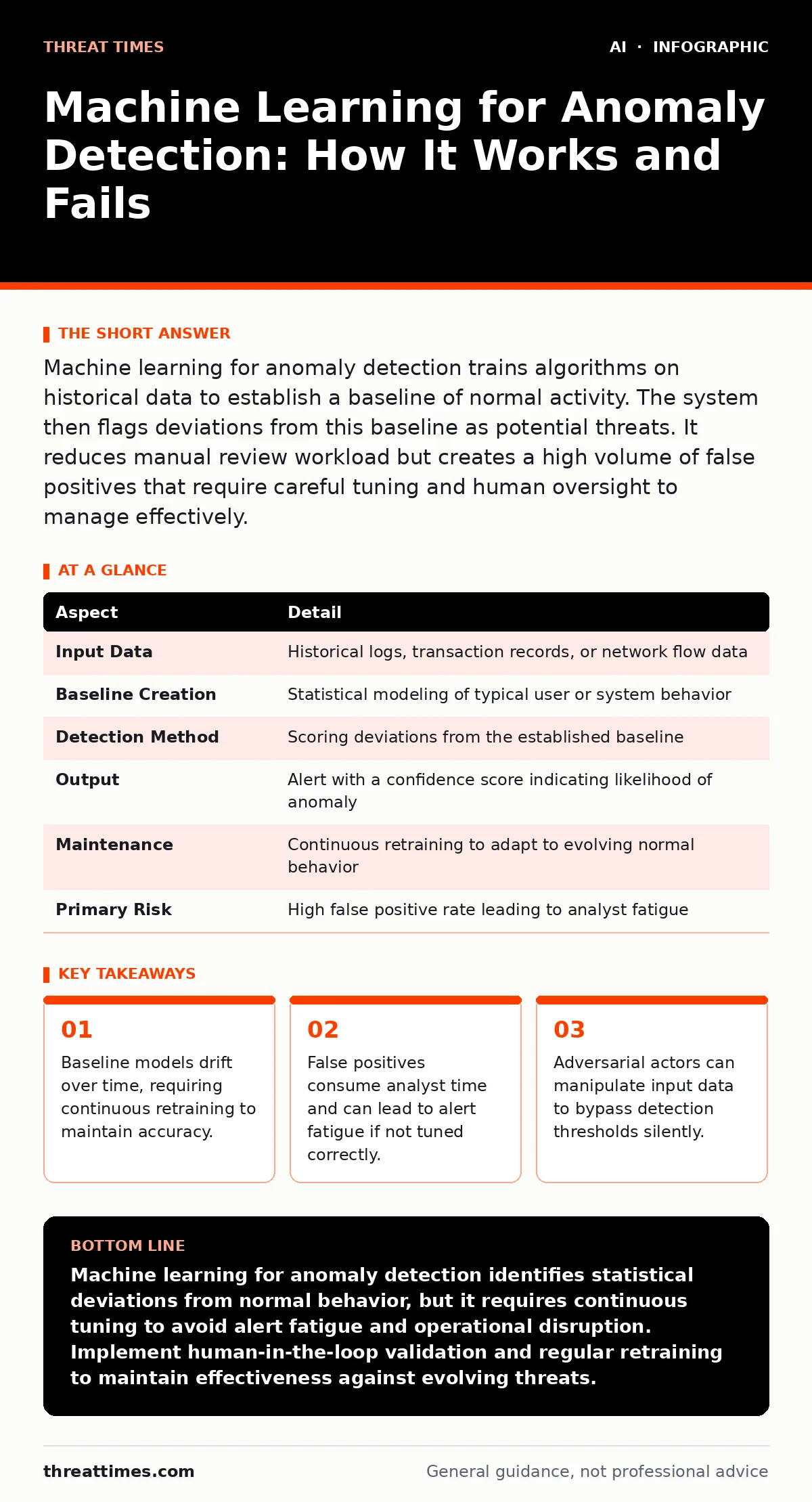
Machine learning for anomaly detection trains algorithms on historical data to establish a baseline of normal activity. The system then flags deviations from this baseline as potential threats. It reduces manual review workload but creates a high volume of false positives that require careful tuning and human oversight to manage effectively.
The Concept of Normal Behavior
Imagine a bank teller who recognizes every customer by face. When a stranger approaches, the teller pauses to verify identity. Machine learning for anomaly detection operates on this same principle of recognition through deviation. The system ingests vast amounts of historical data to construct a mathematical representation of standard operations. This baseline defines what typical user behavior, network traffic, or transaction patterns look like under normal conditions.
The algorithm does not look for known bad signatures. It looks for things that do not fit the established pattern. This approach allows the system to identify novel threats that have no previous record. It shifts the security posture from reactive signature matching to proactive behavioral analysis. The core assumption is that malicious activity will differ statistically from legitimate activity.
| Aspect | Detail |
|---|---|
| Input Data | Historical logs, transaction records, or network flow data |
| Baseline Creation | Statistical modeling of typical user or system behavior |
| Detection Method | Scoring deviations from the established baseline |
| Output | Alert with a confidence score indicating likelihood of anomaly |
| Maintenance | Continuous retraining to adapt to evolving normal behavior |
| Primary Risk | High false positive rate leading to analyst fatigue |
How Machine Learning for Anomaly Detection Works
The process begins with data collection. The system gathers raw telemetry from endpoints, servers, or applications. This data must be clean and representative of standard operations. The algorithm then applies unsupervised learning techniques to find clusters and patterns without human-labeled examples. It calculates statistical distributions for variables such as login times, data transfer volumes, and command sequences.
Once the baseline is established, the model scores new events in real time. Each event receives an anomaly score based on its distance from the mean behavior. High scores trigger alerts. The system does not claim the event is malicious; it claims the event is unusual. This distinction matters because unusual activity is not always hostile. Legitimate changes in business processes can trigger high scores just as easily as attacks.
The model updates continuously. As new data arrives, the baseline shifts to incorporate recent behavior. This adaptation prevents the system from flagging new legitimate tools or workflows as threats. However, this same adaptability allows attackers to slowly change their behavior to blend in. They perform small, incremental actions that fall within the acceptable variance, avoiding detection while achieving their goal.
Who It Affects and Where It Applies
Security operations centers rely on these models to filter noise. Without automated detection, analysts would drown in logs. The technology affects every organization that generates digital footprints. Financial institutions use it to spot unusual transaction amounts. Healthcare providers use it to monitor access to patient records. Software companies use it to detect unauthorized code commits.
The impact extends beyond security teams. Business analysts use anomaly detection to find errors in data pipelines. Operations teams use it to identify hardware failures before they cause outages. The underlying mechanism is the same across industries: find the needle in the haystack by ignoring the hay. The definition of hay changes depending on the context, but the method remains consistent.
Organizations that ignore behavioral baselines remain vulnerable to zero-day attacks. Traditional signature-based tools cannot stop threats that have never been seen before. Machine learning for anomaly detection fills this gap by focusing on intent rather than identity. It treats all actors equally, judging them by their actions relative to the norm. This neutrality is both its strength and its weakness.
What People Usually Get Wrong
Many teams assume that high accuracy means high security. This is a dangerous misconception. If an attacker learns the baseline, they can craft actions that fall within the acceptable range. This is known as model poisoning or evasion.
Another common error is treating the model as a set-and-forget tool. Baselines decay. User behavior changes with seasons, holidays, and business cycles. A model trained on January data will fail in July if not retrained. The cost of this neglect is not just missed detections; it is the erosion of trust in the system. Analysts stop investigating alerts when they see too many false positives.
Teams also overlook the data quality requirement. Garbage in, garbage out is a standard principle in data science. If the training data contains errors, biases, or incomplete records, the model will learn incorrect patterns. It will then flag legitimate activities as anomalies or ignore genuine threats. Data hygiene is a prerequisite for effective detection, not an afterthought.
The Hidden Cost of False Positives
Every alert requires human attention. When a model generates hundreds of false positives daily, analysts spend most of their time dismissing noise. This leads to alert fatigue. The brain begins to tune out warnings, increasing the chance that a real threat is missed. The cost is not just salary; it is the opportunity cost of delayed response.
False positives also disrupt business operations. If a legitimate user is flagged for suspicious activity, their account may be locked. This causes friction for employees and customers. The support team must then verify the user's identity and restore access. Each incident consumes resources and damages user experience. The security benefit is negated by the operational drag.
Balancing sensitivity and specificity is a constant trade-off. Lowering the threshold catches more threats but generates more noise. Raising the threshold reduces noise but lets threats slip through. There is no perfect setting. The optimal balance depends on the risk appetite of the organization and the criticality of the assets being protected.
Advanced Threats and Evasion Techniques
Adversaries understand how these models work. They study the baseline to find the boundaries of acceptable behavior. They then craft attacks that stay within those boundaries. This technique, known as slow-and-low, avoids triggering anomaly scores. The attacker performs small actions over a long period, ensuring each step looks normal in isolation.
Adversarial examples are inputs designed to confuse machine learning models. By adding subtle noise to the input data, attackers can cause the model to misclassify malicious activity as benign. This noise is often imperceptible to humans but significant to the algorithm. It exploits the mathematical weaknesses in the model's decision boundary.
Prompt injection attacks can also affect AI-driven detection systems. If the detection model uses a large language model to interpret logs, an attacker can embed instructions in the log data. These instructions can trick the model into ignoring certain events or generating false reassurances. The model becomes an accomplice rather than a guardian.
What To Do About It
Implement a human-in-the-loop workflow. Never let the model block actions automatically without verification. Use the model to prioritize alerts, not to execute decisions. Analysts must review high-confidence anomalies to confirm their nature. This step builds feedback data that improves the model over time. It also preserves human judgment in critical decisions.
Retrain the model regularly. Schedule updates to incorporate new data and adjust for seasonal changes. Monitor the model's performance metrics, such as precision and recall. If the false positive rate spikes, investigate the cause. It may indicate a change in user behavior or a data quality issue. Proactive maintenance keeps the model aligned with reality.
Diversify your detection methods. Do not rely solely on anomaly detection. Combine it with signature-based tools, threat intelligence feeds, and manual audits. Each method has blind spots. Using multiple layers ensures that if one method fails, another catches the threat. This defense-in-depth approach reduces the risk of total bypass.
Integrating With Broader Security Strategies
Anomaly detection does not exist in a vacuum. It must integrate with incident response procedures. When an alert fires, the response team needs context. The model should provide not just a score, but also the features that contributed to the score. This transparency helps analysts understand why the event was flagged.
Consider AI security testing to evaluate the resilience of your detection models. Regularly test the system with simulated attacks and adversarial inputs. Identify gaps in coverage and adjust the model parameters. This proactive testing reveals weaknesses before real attackers exploit them.
For organizations using generative AI, monitor for AI-generated phishing attempts. These attacks may mimic normal communication patterns closely, making them harder to detect. Anomaly detection can help by spotting subtle deviations in language style or timing, even if the content looks legitimate.
Final Considerations For Implementation
Start with a clear definition of normal. Involve subject matter experts to label initial data sets. This human input provides the ground truth needed to train the model effectively. Without accurate labels, the model learns noise instead of signal.
Monitor the model for drift. Statistical drift occurs when the underlying data distribution changes. Concept drift occurs when the relationship between inputs and outputs changes. Both require retraining. Ignoring drift leads to degraded performance and increased false positives.
Document the model's limitations. Know what it cannot detect. Use this knowledge to supplement with other controls. No single tool provides complete protection. Awareness of the tool's boundaries allows for smarter risk management.
Key takeaways
- Baseline models drift over time, requiring continuous retraining to maintain accuracy.
- False positives consume analyst time and can lead to alert fatigue if not tuned correctly.
- Adversarial actors can manipulate input data to bypass detection thresholds silently.
Machine learning for anomaly detection identifies statistical deviations from normal behavior, but it requires continuous tuning to avoid alert fatigue and operational disruption. Implement human-in-the-loop validation and regular retraining to maintain effectiveness against evolving threats.
Frequently asked questions
How do I reduce false positives in anomaly detection?
Review and whitelist known benign patterns, adjust sensitivity thresholds, and retrain the model with recent data to reflect current user behavior accurately.
How often should I retrain the anomaly detection model?
Retrain regularly, such as weekly or monthly, depending on the volatility of your environment, to ensure the baseline reflects current operational norms.
How this guide was produced: written by the Threat Times editorial team with AI assistance, checked against the public references listed below, and reviewed when the facts change. See our editorial policy or report an error.