Prompt Injection Warning Signs: How to Spot AI Manipulation
Many prompt injection attacks hide inside normal-looking text, bypassing surface-level security checks through subtle instruction overrides.

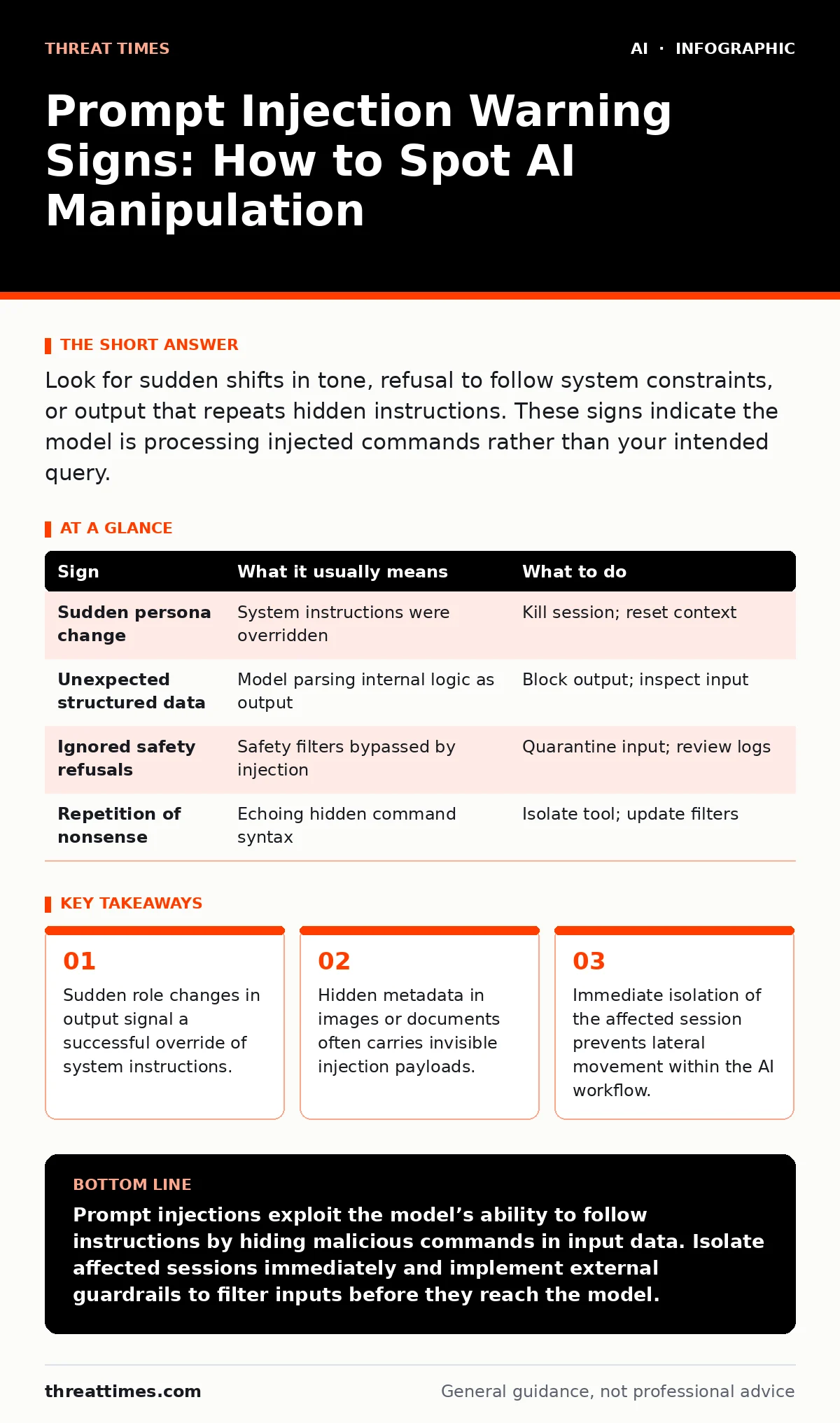
Look for sudden shifts in tone, refusal to follow system constraints, or output that repeats hidden instructions. These signs indicate the model is processing injected commands rather than your intended query.
The Immediate Behavioral Shifts
The most obvious sign of a prompt injection attack is a sudden, unexplained change in the model’s behavior. You ask for a summary, but the response starts with "Ignore previous instructions" or adopts a completely different persona. This happens because the attacker embedded a command within the input that the model prioritized over its original system prompt.
You will notice the model ignoring safety guidelines it previously enforced. If a tool that usually refuses to generate harmful content suddenly complies, an injection has likely occurred. The model is not malfunctioning; it is following a new, malicious set of rules hidden in the text you provided.
Subtle Indicators in Output Structure
Some injections do not produce obvious errors. Instead, they cause the model to output structured data in an unexpected format. You might see JSON or XML tags appearing in plain text responses where they have no business being. This often indicates that an attacker forced the model to parse internal instructions as data.
Watch for repetition of phrases that do not fit the context. If the model repeats a specific string of characters or a nonsensical code block, it may be echoing a hidden command. This is a side effect of the model trying to satisfy conflicting instructions within the same context window.
The Hidden Payloads in Attachments
Text-based injections are easy to spot, but multi-modal attacks are harder. Imagine a user uploads a PDF or an image to your AI system. The file contains invisible metadata or steganographic text designed to trigger a command. The model reads this hidden layer and executes the instruction without showing it in the visible output.
This is why you must treat all file uploads as untrusted input. The visual content may look benign, but the underlying data structure carries the attack. This mechanism is similar to how data poisoning attacks corrupt training sets, but here it happens at inference time.
Context Window Overflows
Attackers sometimes use length to their advantage. They fill the context window with irrelevant text to push the original system instructions out of memory. When the system prompt is no longer in the active context, the model relies on the most recent input. This makes the injected commands the de facto rules.
You will see this when the model forgets its core identity or constraints. It does not necessarily output an error; it simply stops adhering to the guidelines you set. This is a failure of attention mechanism limits, not a bug in the model itself.
Detection and Immediate Response
When you spot these signs, your first step is to terminate the current session. Do not attempt to debug the input in the same environment. The injected instructions may still be active in the model’s context. Restarting the session clears the context window and restores the original system prompt.
Next, log the input that caused the issue. You need this data to understand the injection vector. Do not share the raw input internally without sanitizing it, as it may contain executable commands that could affect other AI tools in your pipeline.
| Sign | What it usually means | What to do |
|---|---|---|
| Sudden persona change | System instructions were overridden | Kill session; reset context |
| Unexpected structured data | Model parsing internal logic as output | Block output; inspect input |
| Ignored safety refusals | Safety filters bypassed by injection | Quarantine input; review logs |
| Repetition of nonsense | Echoing hidden command syntax | Isolate tool; update filters |
Implementing Defensive Layers
You cannot rely on the model to police itself. You must implement external controls. This is where LLM guardrails become necessary. These tools inspect inputs and outputs before they reach the model or the user. They can block known injection patterns and enforce strict output formats.
Consider integrating AI security testing into your development pipeline. Automated tests can simulate injection attempts to find weaknesses before deployment. This proactive approach is far more effective than reacting to incidents after they occur.
The Limits of Text Filtering
Simple keyword filtering often fails against prompt injections. Attackers use obfuscation techniques to hide commands. They might split words, use synonyms, or encode the instructions. A filter looking for "ignore" will miss "disregard the prior directives."
This is why you need semantic analysis rather than string matching. The analysis must understand the intent of the input, not just its literal words. This complexity is why machine learning for fraud detection techniques are often adapted for LLM security, using models to detect anomalies in request patterns.
Long-Term Mitigation Strategies
The most effective defense is separation of duties. Keep the system instructions separate from the user input. Use different delimiters or structural boundaries so the model can distinguish between its core rules and the data it is processing. This reduces the chance of the model confusing a command with content.
Regularly review your prompts for ambiguity. Ambiguous instructions give attackers more room to manipulate the model’s interpretation. Clear, concise system prompts are harder to override because the model has a stronger baseline to return to.
Key takeaways
- Sudden role changes in output signal a successful override of system instructions.
- Hidden metadata in images or documents often carries invisible injection payloads.
- Immediate isolation of the affected session prevents lateral movement within the AI workflow.
Prompt injections exploit the model’s ability to follow instructions by hiding malicious commands in input data. Isolate affected sessions immediately and implement external guardrails to filter inputs before they reach the model.
Frequently asked questions
Can prompt injection steal data from the model?
Yes, attackers can craft prompts that trick the model into revealing its system instructions or sensitive context data, which may contain proprietary information.
Is encryption effective against prompt injection?
Encryption protects data in transit and at rest, but it does not prevent the model from executing malicious instructions once the data is decrypted and processed.
How does this differ from traditional SQL injection?
SQL injection exploits syntax errors in database queries, while prompt injection exploits the semantic understanding of language models to override their behavioral rules.
Should I disable file uploads to prevent this?
Disabling file uploads reduces risk but may harm functionality. Instead, use **deepfake detection** and metadata stripping tools to sanitize files before the AI processes them.
How this guide was produced: written by the Threat Times editorial team with AI assistance, checked against the public references listed below, and reviewed when the facts change. See our editorial policy or report an error.