Black Box vs White Box Testing: Decide Which Assessment Fits
White box testing finds hidden logic errors quickly but misses user behavior flaws that black box methods catch through external observation.

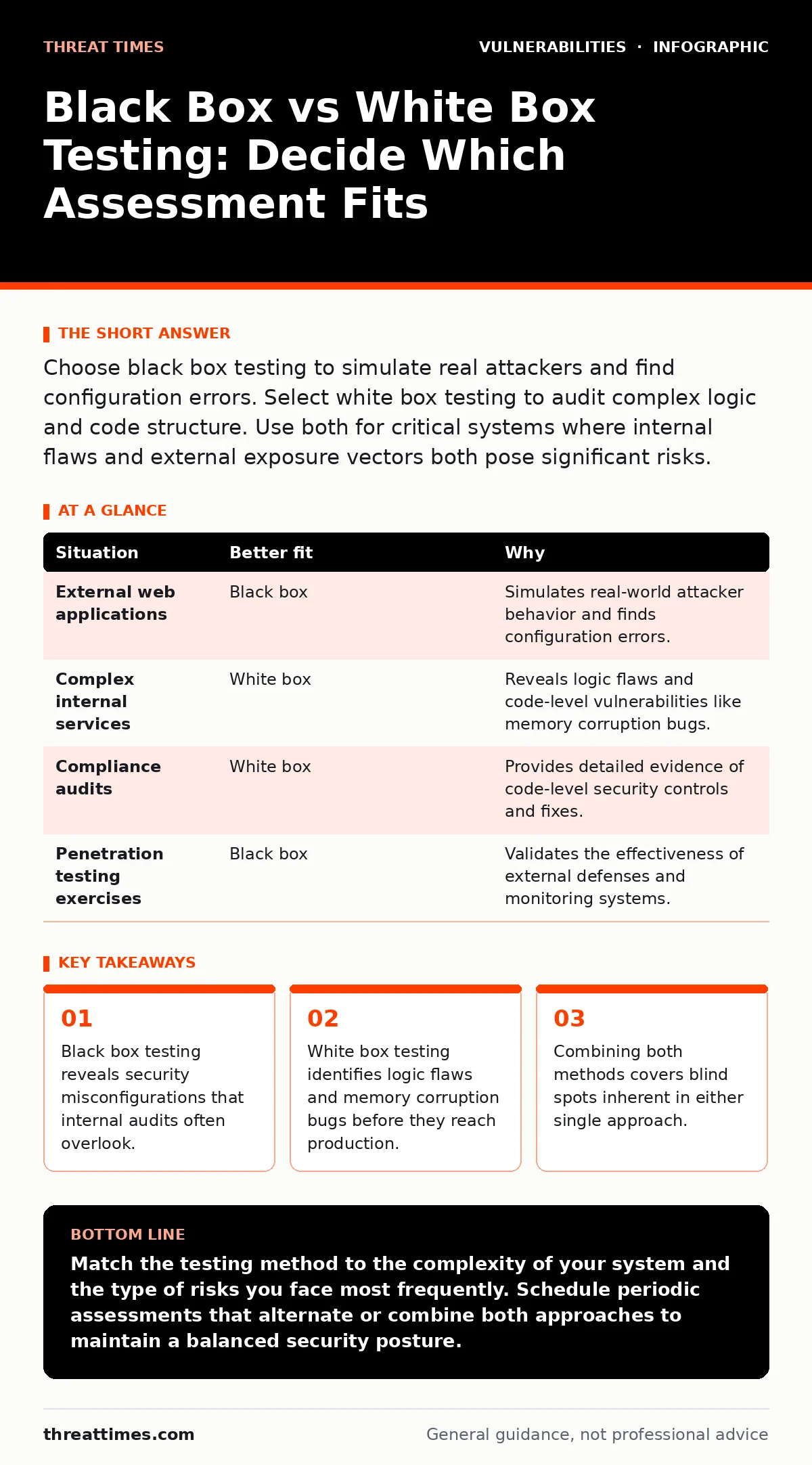
Choose black box testing to simulate real attackers and find configuration errors. Select white box testing to audit complex logic and code structure. Use both for critical systems where internal flaws and external exposure vectors both pose significant risks.
Assessing Access to Source Code
The primary distinction between black box and white box testing lies in the availability of internal information. Black box testing assumes you have no access to the source code, architecture diagrams, or internal documentation. You approach the system as an external attacker would, interacting only through the user interface or public API endpoints. This method forces testers to discover entry points independently, mirroring the uncertainty a malicious actor faces.
White box testing provides full access to the source code, internal logic, and system design. Testers can read the code to identify flaws in the logic, data flow, and error handling. This transparency allows for faster identification of complex vulnerabilities that are difficult to trigger from the outside. The trade-off is that white box testing may miss issues related to how the system behaves under real-world user conditions.
Evaluating Time and Resource Constraints
White box testing is generally faster for finding specific types of vulnerabilities because testers know where to look. Automated static analysis tools can scan code for known patterns of insecure deserialization or integer overflow vulnerabilities without executing the application. However, this speed comes with a high initial cost in setup and expertise. You need developers or security engineers who understand the codebase deeply to interpret the results correctly.
Black box testing is slower and more labor-intensive. Testers must map the application manually or use dynamic analysis tools to find valid inputs and workflows. This process can take significantly longer than code review. However, it requires less specialized knowledge of the internal architecture. The resource constraint here is human time rather than technical expertise. If you have limited time but ample budget for skilled testers, black box may be the more pragmatic choice.
Determining the Complexity of Business Logic
Simple applications with straightforward input-output relationships are often better suited for black box testing. The attack surface is smaller, and external interaction reveals most configuration errors. Complex applications with intricate business rules, multi-step workflows, and stateful sessions benefit from white box testing. Logic errors in these systems are rarely triggered by random external probing. They require a precise sequence of actions that only an internal review can easily identify.
Imagine a financial application that calculates interest based on a complex set of conditional rules. A black box tester might never trigger the specific combination of inputs that causes a calculation error. A white box tester can read the conditional statements and construct the exact scenario needed to expose the flaw. This precision is vital for systems where logical correctness is as important as data protection.
Comparing Detection Capabilities
| Situation | Better fit | Why |
|---|---|---|
| External web applications | Black box | Simulates real-world attacker behavior and finds configuration errors. |
| Complex internal services | White box | Reveals logic flaws and code-level vulnerabilities like memory corruption bugs. |
| Compliance audits | White box | Provides detailed evidence of code-level security controls and fixes. |
| Penetration testing exercises | Black box | Validates the effectiveness of external defenses and monitoring systems. |
Black box testing excels at finding security misconfigurations, such as exposed administrative interfaces or default credentials. It also identifies issues related to service account security when these accounts are exposed through improper permissions. White box testing is superior for finding structural issues, such as improper error handling or lack of output encoding in the source code. It can also detect subtle side-channel attacks that depend on timing differences in code execution, which are invisible from the outside.
Integrating Both Approaches
Using both black box and white box testing together provides the most thorough assessment. White box testing identifies potential vulnerabilities in the code, while black box testing confirms whether these vulnerabilities are exploitable in the deployed environment. This combination reduces false positives and ensures that fixes address real-world risks. Many organizations use white box testing during development and black box testing before release. This layered approach catches issues early and validates their impact later.
Consider a scenario where white box testing identifies a potential buffer overflow in a legacy module. Black box testing then attempts to exploit this module through the application’s API. If the API validates input strictly, the vulnerability may be mitigated at the boundary. This insight prevents unnecessary refactoring and focuses resources on truly exploitable flaws. Integrating findings from both methods creates a more accurate risk profile.
Making the Final Decision
The choice between black box and white box testing depends on your specific security goals and resource availability. If you need to validate external defenses and simulate real attacks, prioritize black box testing. If you need to audit complex logic and ensure code quality, prioritize white box testing. For critical systems, combine both methods to cover all potential attack vectors. Regularly reassess your testing strategy as your application evolves and new threats emerge.
Key takeaways
- Black box testing reveals security misconfigurations that internal audits often overlook.
- White box testing identifies logic flaws and memory corruption bugs before they reach production.
- Combining both methods covers blind spots inherent in either single approach.
Match the testing method to the complexity of your system and the type of risks you face most frequently. Schedule periodic assessments that alternate or combine both approaches to maintain a balanced security posture.
Frequently asked questions
Can automated tools replace black box testing?
Automated tools can scan for common vulnerabilities but cannot replicate the creative thinking and contextual understanding of a human tester in black box scenarios.
Is white box testing effective for third-party components?
White box testing requires source code access, so it is only effective for components you own or have explicit permission to audit.
How often should I perform black box testing?
Perform black box testing after significant changes to the application’s external interface or architecture to ensure new vulnerabilities have not been introduced.
Does white box testing find all logic errors?
White box testing reduces the likelihood of missing logic errors but cannot guarantee finding every subtle flaw, especially in highly complex or dynamic systems.
How this guide was produced: written by the Threat Times editorial team with AI assistance, checked against the public references listed below, and reviewed when the facts change. See our editorial policy or report an error.