Service Account Security Checklist for Cloud Infrastructure
Static credentials on long-lived service accounts create persistent backdoors that bypass human-led identity controls and survive employee turnover.

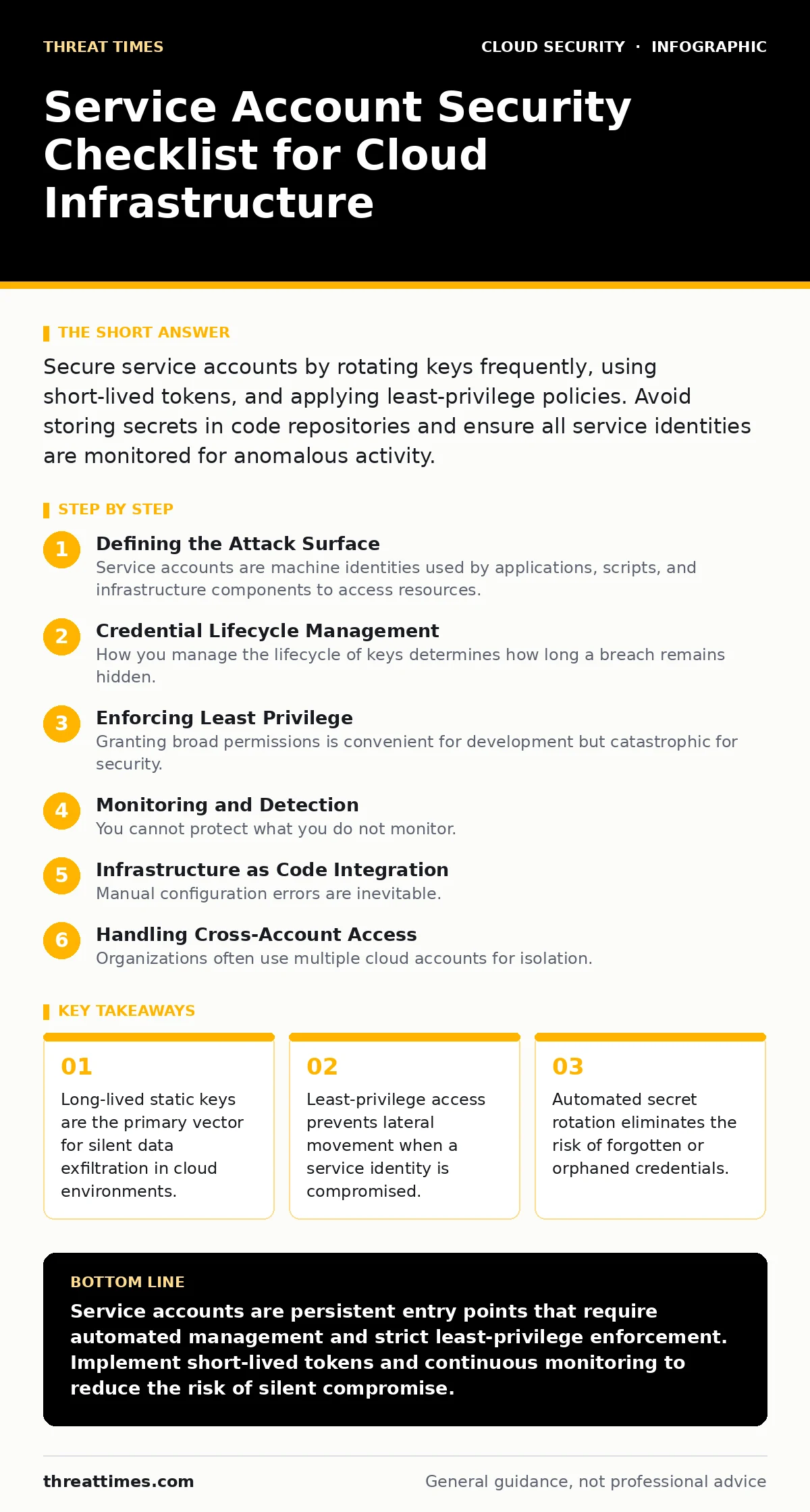
Secure service accounts by rotating keys frequently, using short-lived tokens, and applying least-privilege policies. Avoid storing secrets in code repositories and ensure all service identities are monitored for anomalous activity.
Defining the Attack Surface
Service accounts are machine identities used by applications, scripts, and infrastructure components to access resources. Unlike human users, these accounts do not log in interactively. They run continuously, often with elevated privileges. This persistence makes them attractive targets for attackers who seek automated access.
Because these accounts lack human oversight, their activity can blend into normal background noise. You must treat every service account as a potential entry point. The goal is to limit what each account can do and how long it can do it.
Credential Lifecycle Management
How you manage the lifecycle of keys determines how long a breach remains hidden. Static keys are the default in many setups, but they are dangerous. If a key is leaked, it remains valid until you manually revoke it.
- Rotate keys on a strict schedule: frequent rotation limits the window of opportunity for an attacker who has stolen a key.
- Use short-lived tokens where possible: tokens that expire in minutes reduce the value of a stolen credential.
- Disable unused keys immediately: orphaned keys are a silent risk that grows with time.
- Avoid embedding keys in source code: code repositories are often public or widely accessible, exposing secrets instantly.
- Store secrets in a dedicated vault: a centralized secret manager enforces access controls and audit logs that code repositories lack.
Enforcing Least Privilege
Granting broad permissions is convenient for development but catastrophic for security. A service account with full administrative rights can pivot to any resource in your environment. You must define the minimum permissions required for each task.
- Assign specific roles instead of broad admin rights: specific roles limit the actions an account can perform to only those necessary.
- Review permissions quarterly: permissions creep occurs as applications evolve, granting unnecessary access over time.
- Separate duties across accounts: different components should have distinct identities to limit the blast radius of a compromise.
- Use resource-based policies: resource-based policies allow you to restrict access at the object level, adding a second layer of control.
This approach aligns with principles found in cloud identity governance. By strictly defining what each identity can access, you reduce the impact of a single compromised account.
Monitoring and Detection
You cannot protect what you do not monitor. Service accounts often generate high volumes of API calls. Anomalies in these patterns can indicate misuse or compromise. Standard logging is insufficient; you need structured analysis.
- Enable detailed API logging: detailed logs provide the forensic data needed to reconstruct an attack path.
- Alert on unusual geographic access: service accounts should access resources from predictable locations; sudden changes signal compromise.
- Monitor for privilege escalation attempts: attempts to grant higher permissions to a service account are a strong indicator of malicious activity.
- Track key usage metrics: sudden spikes in API calls or data transfers can reveal exfiltration efforts.
Infrastructure as Code Integration
Manual configuration errors are inevitable. When you manage infrastructure through code, you can enforce security policies programmatically. This reduces the risk of cloud misconfigurations that often leave service accounts exposed.
- Define permissions in code: codified policies are versioned, reviewed, and reproducible.
- Use policy-as-code tools: these tools automatically reject configurations that violate security standards.
- Scan for hardcoded secrets in CI/CD pipelines: automated scans catch secrets before they reach production environments.
- Validate dependencies regularly: third-party libraries may introduce vulnerabilities or unwanted permissions.
Handling Cross-Account Access
Organizations often use multiple cloud accounts for isolation. Service accounts that need to access resources across these boundaries create complex trust relationships. These relationships are often misconfigured, leading to unintended access.
- Use external IDs for cross-account roles: external IDs prevent the confused deputy problem by ensuring the calling party is authorized.
- Limit cross-account trust to specific principals: broad trust relationships allow any identity in the source account to assume the role.
- Monitor cross-account activity closely: cross-account moves are difficult to trace and often indicate lateral movement.
This complexity is similar to challenges faced in cloud security groups management. Strict boundaries are necessary to prevent unauthorized traversal.
Remediation and Incident Response
When a service account is compromised, speed matters. You need a clear plan to contain the damage. Ad-hoc responses often fail under pressure.
- Have a key revocation plan ready: immediate revocation stops further unauthorized access.
- Document the impact assessment process: understanding what the account accessed helps determine the scope of the breach.
- Test recovery procedures regularly: untested procedures often fail during an actual incident.
Key takeaways
- Long-lived static keys are the primary vector for silent data exfiltration in cloud environments.
- Least-privilege access prevents lateral movement when a service identity is compromised.
- Automated secret rotation eliminates the risk of forgotten or orphaned credentials.
Service accounts are persistent entry points that require automated management and strict least-privilege enforcement. Implement short-lived tokens and continuous monitoring to reduce the risk of silent compromise.
Frequently asked questions
How often should service account keys be rotated?
Rotate keys at least every ninety days, or more frequently if short-lived tokens are not supported by the service.
Can I use the same service account for multiple applications?
No. Each application should have its own identity to limit the impact of a compromise and simplify auditing.
What is the confused deputy problem?
It is a vulnerability where a privileged service is tricked into performing actions on behalf of an unauthorized caller.
How do I detect compromised service accounts?
Monitor for unusual API activity, geographic anomalies, and privilege escalation attempts using automated detection tools.
How this guide was produced: written by the Threat Times editorial team with AI assistance, checked against the public references listed below, and reviewed when the facts change. See our editorial policy or report an error.