Security Culture Definition: Why Policies Fail Without Shared Behavior
Security culture is the invisible layer of shared assumptions that determines whether technical controls succeed or fail during an incident response.

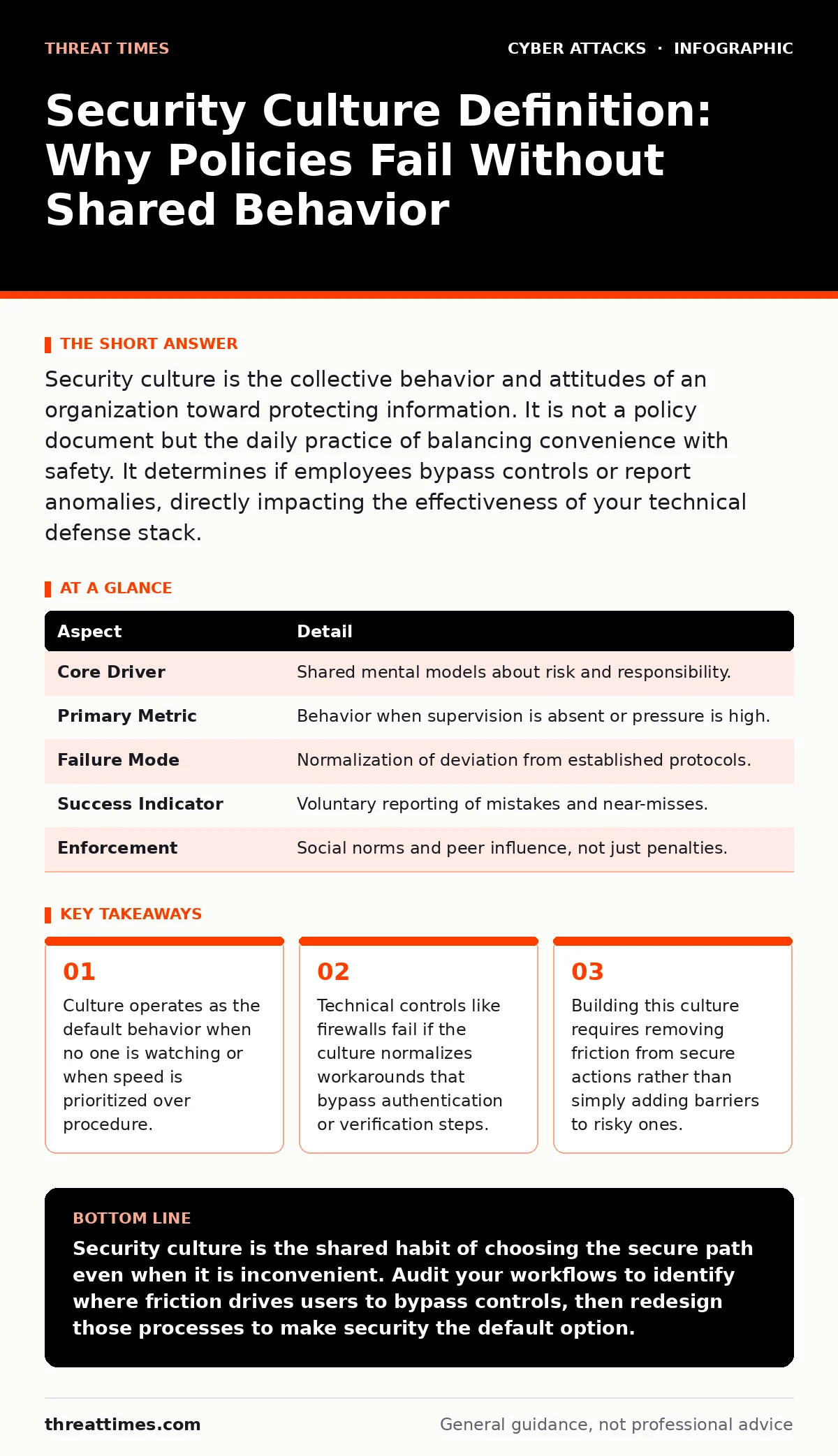
Security culture is the collective behavior and attitudes of an organization toward protecting information. It is not a policy document but the daily practice of balancing convenience with safety. It determines if employees bypass controls or report anomalies, directly impacting the effectiveness of your technical defense stack.
The Thermostat Analogy
Imagine a building with a complex heating system. The thermostat is your technical control. It is precise, programmable, and reliable. However, if every employee in that building keeps opening windows to "breeze out" the stale air, the thermostat cannot maintain the desired temperature. The system is functioning correctly, but the environment is hostile to its purpose.
Security culture is the collective tendency of that workforce to keep the windows closed. It is not the thermostat itself. It is the shared understanding that maintaining the internal environment serves a common goal. When you install new security software, you are installing a new thermostat. If the culture remains unchanged, users will find ways to bypass it, rendering the investment ineffective.
This analogy highlights a non-obvious truth: technical tools do not enforce behavior. They only enforce rules. Culture determines whether those rules are respected or circumvented.
Defining the Invisible Layer
In practice, security culture is defined by the gap between written policy and actual behavior. A policy states that you must lock your screen when leaving your desk. The culture is determined by whether you actually do it when you step away for a quick coffee. It is the sum of small, daily decisions made by thousands of individuals.
This concept originates from industrial safety research, where "safety culture" was used to predict accident rates in high-risk environments. Organizations realized that compliance checklists could not predict human error. They needed a measure of how deeply safety was embedded in routine actions. Cybersecurity adopted this framework because digital risks are equally dependent on human consistency.
You can measure this culture by observing what happens when the stakes are low. Do users report minor anomalies? Do they question unusual requests? If the answer is no, the culture is fragile, regardless of your budget for cybersecurity tools.
| Aspect | Detail |
|---|---|
| Core Driver | Shared mental models about risk and responsibility. |
| Primary Metric | Behavior when supervision is absent or pressure is high. |
| Failure Mode | Normalization of deviation from established protocols. |
| Success Indicator | Voluntary reporting of mistakes and near-misses. |
| Enforcement | Social norms and peer influence, not just penalties. |
The Cost of Convenience
Security controls introduce friction. Every extra step in a login process, every confirmation dialog, and every approval request adds time to a workflow. Human nature abhors friction. When the cost of security exceeds the perceived benefit, users will seek shortcuts.
This is where the hidden cost of poor culture emerges. It is not just a risk of breach; it is a tax on productivity. If your security tools are cumbersome, employees will disable them. They will write passwords on sticky notes. They will share accounts to avoid the hassle of individual credentials. These behaviors are rational responses to a poorly designed environment.
You cannot solve this by issuing stern warnings. You must redesign the workflow to make the secure path the easy path. If multi-factor authentication is too slow, users will ignore it. If file sharing is blocked, they will use unauthorized cloud services. The culture shifts when the organization aligns security with efficiency.
Where Advice Usually Fails
Many organizations believe that training is the solution to cultural issues. They send annual emails about social engineering or host quarterly webinars. This approach assumes that knowledge gaps are the root cause of insecure behavior. They rarely are.
Most professionals know that they should not click suspicious links. They know that they should verify sender identities. The failure occurs when urgency overrides caution. If a message appears to come from the CEO and demands immediate action, the social pressure to comply often outweighs the abstract knowledge of risk.
This is why technical controls like email authentication standards matter. They reduce the reliance on human judgment for initial filtering. However, they do not replace the need for a culture that questions authority. If the culture rewards blind obedience, even perfect technical controls will be bypassed by sophisticated social engineering attacks.
Consider the impact of AI-generated phishing. These attacks are highly personalized and grammatically perfect. They exploit the cultural norm of trusting polished communication. A culture that encourages skepticism, even of high-status senders, is more resilient than one that relies on detection tools alone.
The Role of Leadership
Culture flows downward. If leadership bypasses security controls for convenience, the rest of the organization will follow. If the CEO receives a suspicious email and replies without checking, the implicit message is that security is optional for the powerful.
This does not mean leadership must be security experts. It means they must model the behavior they expect. If they lock their screens, verify identities, and report mistakes, they signal that these actions are valued. If they complain about security tools, they signal that these tools are an obstacle.
You can observe this by looking at incident reports. If incidents involving executives are hidden or treated differently, the culture is fractured. A unified culture treats all data and all users with the same level of scrutiny.
Building Through Feedback Loops
A healthy security culture relies on feedback. When something goes wrong, the response must be analytical, not punitive. If an employee falls for a phishing scam, the immediate reaction should be to understand why the scam worked. Was the message too convincing? Was the reporting process too difficult?
Punishing honest mistakes drives behavior underground. Employees will hide breaches rather than report them. This delays containment and increases damage. Instead, create channels for anonymous reporting and near-miss analysis. Celebrate the discovery of flaws, not just the prevention of incidents.
This approach mirrors the concept of prompt injection attacks in AI systems. Just as you need to test how an AI model responds to adversarial inputs, you need to test how your organization responds to human error. The goal is resilience, not perfection. Resilience comes from learning quickly and adapting.
Integrating With Technical Defenses
Security culture does not exist in a vacuum. It must work in tandem with technical measures. Firewalls, intrusion detection systems, and encryption are the hard barriers. Culture is the soft barrier that prevents those hard barriers from being undermined.
For instance, DNS amplification attacks exploit misconfigured servers. A strong culture ensures that network administrators configure these servers correctly from the start. Vendor email compromise attacks exploit trust in business processes. A strong culture ensures that financial staff verify unusual payment requests through secondary channels.
The synergy is critical. Technical tools can block known threats, but they cannot predict novel human behavior. Culture fills that gap by creating a workforce that is alert, skeptical, and proactive. It turns every employee into a sensor for anomalous activity.
Key takeaways
- Culture operates as the default behavior when no one is watching or when speed is prioritized over procedure.
- Technical controls like firewalls fail if the culture normalizes workarounds that bypass authentication or verification steps.
- Building this culture requires removing friction from secure actions rather than simply adding barriers to risky ones.
Security culture is the shared habit of choosing the secure path even when it is inconvenient. Audit your workflows to identify where friction drives users to bypass controls, then redesign those processes to make security the default option.
Frequently asked questions
How do I measure security culture in my organization?
Measure the rate of voluntary incident reporting and the time taken to report suspected threats. High reporting rates indicate trust and awareness. Low rates suggest fear or apathy.
Can training improve security culture?
Training can raise awareness, but it rarely changes behavior on its own. Culture changes when the environment rewards secure behavior and removes friction from safe actions.
What is the biggest threat to security culture?
Inconsistency from leadership. If executives bypass rules, it signals that the rules are not important, undermining the entire framework.
How does API abuse relate to culture?
API abuse often results from developers prioritizing speed over security. A strong culture embeds security checks into the development lifecycle, preventing insecure APIs from reaching production.
How this guide was produced: written by the Threat Times editorial team with AI assistance, checked against the public references listed below, and reviewed when the facts change. See our editorial policy or report an error.