How Intrusion Prevention Systems Work: Mechanisms and Blind Spots
IPS engines drop packets before they reach your servers, but signature updates and false positives often create new attack surfaces for determined adversaries.

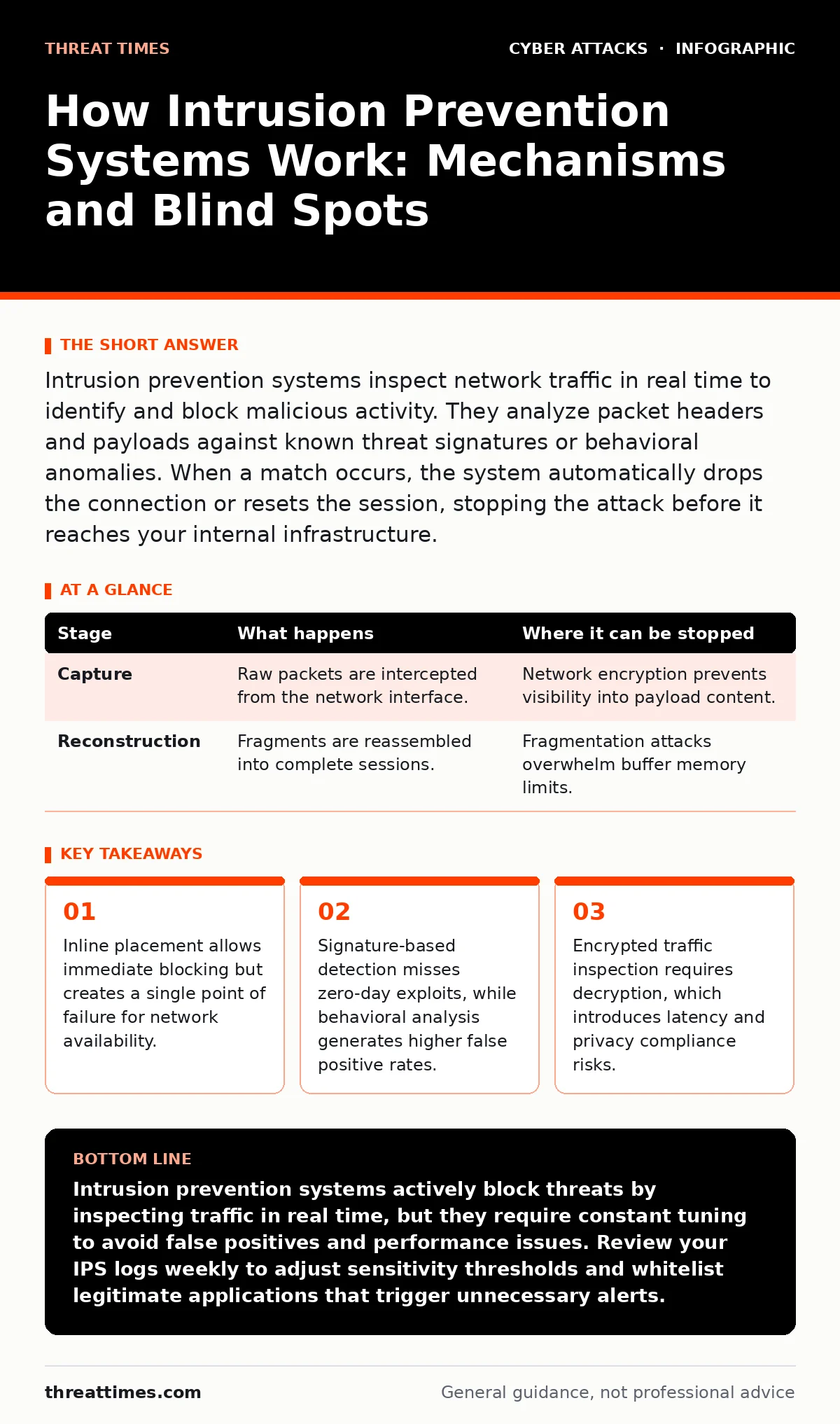
Intrusion prevention systems inspect network traffic in real time to identify and block malicious activity. They analyze packet headers and payloads against known threat signatures or behavioral anomalies. When a match occurs, the system automatically drops the connection or resets the session, stopping the attack before it reaches your internal infrastructure.
How Intrusion Prevention Systems Work
Intrusion prevention systems (IPS) operate as active gatekeepers within your network architecture. Unlike passive monitoring tools, an IPS sits directly in the traffic path. It examines every packet that crosses its sensors. The device decides whether to allow, block, or modify the data stream based on predefined security rules. This inline position enables immediate intervention. The system does not merely alert administrators to potential threats. It takes automated action to disrupt malicious activity. Understanding this mechanism requires looking at the specific stages of packet processing.
Stage 1: Packet Capture and Reconstruction
The IPS intercepts raw network traffic at the wire level. It captures individual packets as they arrive from the network interface. The system must reassemble fragmented packets to view the complete data stream. Network protocols often split large files into smaller fragments for transmission. The IPS reconstructs these fragments in memory to analyze the full payload. This step ensures the device sees the actual content, not just scattered data pieces. Without reconstruction, an attacker could hide malicious code across multiple small packets. The IPS maintains state information to track which fragments belong together.
| Stage | What happens | Where it can be stopped |
|---|---|---|
| Capture | Raw packets are intercepted from the network interface. | Network encryption prevents visibility into payload content. |
| Reconstruction | Fragments are reassembled into complete sessions. | Fragmentation attacks overwhelm buffer memory limits. |
Stage 2: Protocol Analysis and Normalization
The IPS determines the protocol used in each session. It checks headers to identify HTTP, DNS, or FTP traffic. The system normalizes the data to a standard format. This process strips away unnecessary padding or unusual encoding. Normalization prevents attackers from disguising malicious payloads using non-standard formatting. The IPS compares the normalized stream against protocol specifications. It flags deviations from expected behavior. For example, an HTTP request with invalid headers triggers a review. This stage reduces noise by filtering out malformed traffic that serves no legitimate purpose. It ensures the detection engine analyzes clean, standardized data.
Stage 3: Signature Matching
The IPS compares the normalized payload against a database of known threats. These signatures represent patterns associated with specific malware, exploits, or attack vectors. Each signature defines a sequence of bytes or commands that indicate malicious intent. The engine scans the traffic for these exact matches. If the payload contains a known exploit string, the IPS identifies it as a threat. This method is highly accurate for known threats. It relies on up-to-date signature databases. Outdated signatures fail to detect new variants of existing malware. The system must balance the size of the signature database with processing speed. Large databases increase inspection latency.
Stage 4: Behavioral Analysis
Signature matching fails against novel attacks. The IPS uses behavioral analysis to detect anomalies. It establishes a baseline of normal network activity for each user or device. The system monitors for deviations from this baseline. Unusual data volumes, strange timing, or unexpected protocol usage trigger alerts. Behavioral analysis detects zero-day exploits that lack known signatures. It identifies lateral movement or data exfiltration attempts. This method requires machine learning algorithms to adapt to changing environments. It generates more false positives than signature matching. Administrators must tune the sensitivity to avoid blocking legitimate business operations.
Stage 5: Action and Response
When the IPS identifies a threat, it executes a predefined action. The most common response is dropping the packet. This silently discards the malicious data without notifying the sender. The system may also reset the TCP connection. This sends a reset signal to both ends of the communication. The sender believes the connection was closed normally. Logging records the event for forensic analysis. The IPS updates its internal state to reflect the blocked activity. Some systems can quarantine the source IP address temporarily. This prevents further attacks from the same origin. The action occurs in microseconds, ensuring minimal impact on legitimate traffic flow.
Stage 6: Reporting and Tuning
The IPS generates detailed logs for every blocked event. These logs include source and destination IPs, timestamps, and threat descriptions. Security teams review these logs to refine detection rules. Tuning reduces false positives by adjusting sensitivity thresholds. Administrators whitelist trusted applications that trigger unnecessary alerts. Regular tuning ensures the IPS protects against real threats without disrupting operations. The system integrates with security information and event management platforms. This provides a centralized view of network security events. Continuous improvement relies on accurate logging and responsive tuning.
Limitations and Failure Points
Intrusion prevention systems have inherent limitations. Encrypted traffic hides payloads from inspection. The IPS cannot see inside TLS-encrypted streams without decryption. Decryption requires computational resources and raises privacy concerns. High-volume traffic can overwhelm the IPS processing capacity. This leads to dropped legitimate packets or reduced inspection depth. Attackers may use polymorphic code to evade signature detection. They change the appearance of malware while keeping its function. Behavioral analysis struggles with slow-and-low attacks that mimic normal behavior. The IPS also creates a single point of failure. If the device fails, network connectivity may be lost.
Integrating with Other Security Layers
An IPS works best as part of a layered defense strategy. It complements firewalls that control access based on ports and protocols. Firewalls block unauthorized access, while IPS blocks malicious content within allowed traffic. Combining these tools provides deeper visibility. Organizations should also implement privileged access management to limit internal damage.
Social engineering remains a primary vector for initial compromise. An IPS cannot stop a user from clicking a malicious link in a business email compromise attempt. Security culture training reduces this human risk. DNS amplification attacks can flood an IPS with traffic, causing denial of service. Rate limiting at the network edge mitigates this risk.
Conclusion on IPS Effectiveness
Intrusion prevention systems provide critical real-time protection. They stop known threats and detect anomalous behavior. However, they are not a silver bullet. Encryption, resource constraints, and sophisticated evasion techniques limit their effectiveness. Regular tuning and integration with other security controls are necessary. Organizations must accept the trade-off between security and performance. The goal is to reduce risk, not eliminate it entirely. Continuous monitoring and adaptation ensure the IPS remains effective against evolving threats.
Key takeaways
- Inline placement allows immediate blocking but creates a single point of failure for network availability.
- Signature-based detection misses zero-day exploits, while behavioral analysis generates higher false positive rates.
- Encrypted traffic inspection requires decryption, which introduces latency and privacy compliance risks.
Intrusion prevention systems actively block threats by inspecting traffic in real time, but they require constant tuning to avoid false positives and performance issues. Review your IPS logs weekly to adjust sensitivity thresholds and whitelist legitimate applications that trigger unnecessary alerts.
Frequently asked questions
What is the difference between IPS and IDS?
An intrusion detection system monitors traffic and alerts administrators, while an intrusion prevention system sits inline and automatically blocks malicious traffic.
Can IPS detect zero-day attacks?
IPS can detect zero-day attacks using behavioral analysis and anomaly detection, but they are less reliable than signature-based detection for known threats.
Does IPS slow down the network?
Yes, IPS introduces latency because it inspects every packet. The impact depends on traffic volume and the complexity of the inspection rules.
How do I reduce false positives from IPS?
Tune the sensitivity settings, whitelist trusted applications, and update signature databases regularly to improve accuracy and reduce unnecessary blocks.
How this guide was produced: written by the Threat Times editorial team with AI assistance, checked against the public references listed below, and reviewed when the facts change. See our editorial policy or report an error.