WPA3 Benefits and Limitations: What Wi-Fi Security Actually Gains
WPA3 stops offline password attacks but forces older devices off secure networks, creating a management trade-off you must accept.
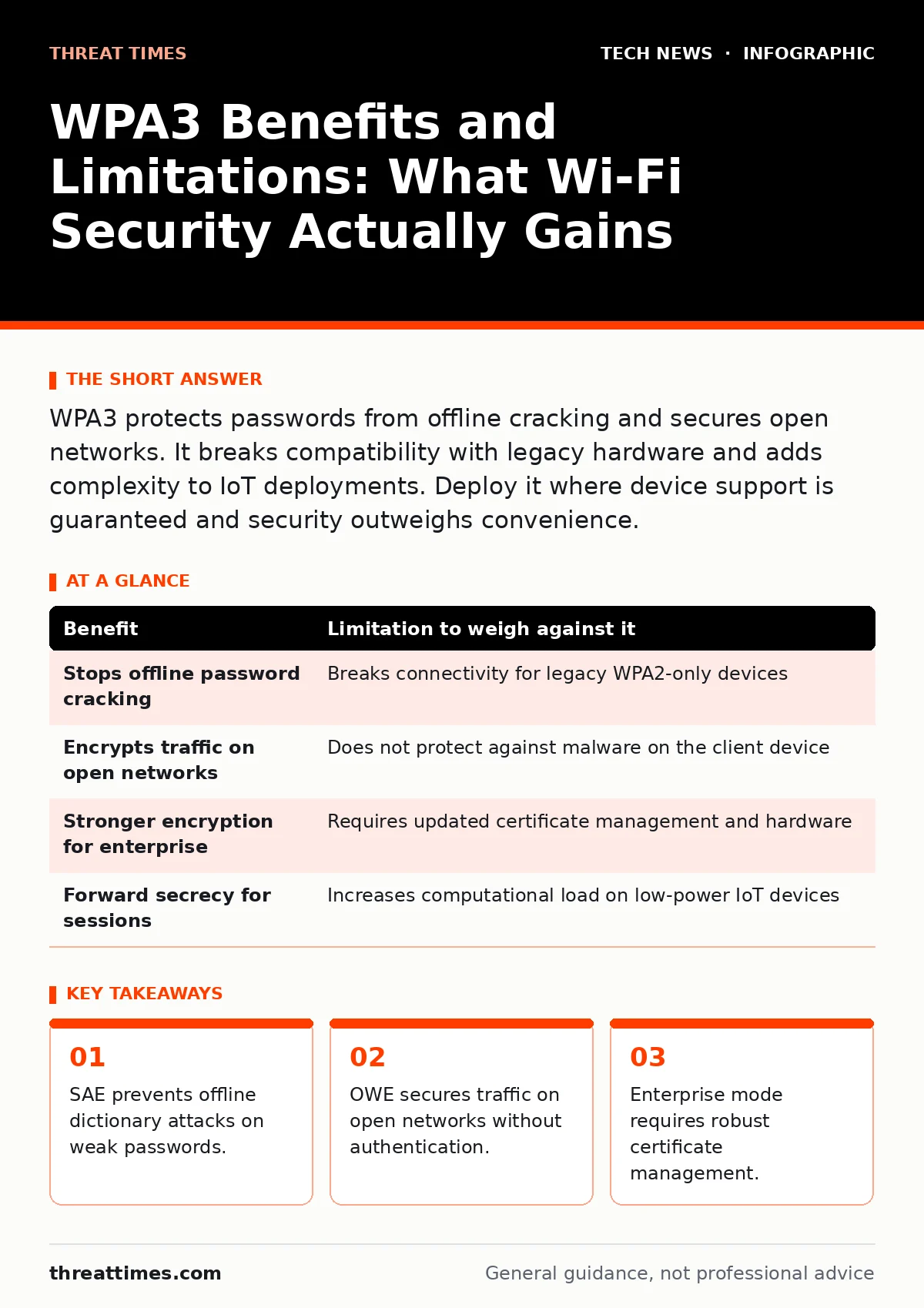
WPA3 protects passwords from offline cracking and secures open networks. It breaks compatibility with legacy hardware and adds complexity to IoT deployments. Deploy it where device support is guaranteed and security outweighs convenience.
The Password Attack Surface
Wireless networks rely on passwords for access. WPA2 allowed attackers to capture the handshake between a client and an access point. They could then try billions of passwords offline, at any speed their hardware allowed. This made weak passwords a critical vulnerability. WPA3 changes this dynamic by introducing Simultaneous Authentication of Equals. This protocol ensures that each password guess requires an online interaction with the network.
An attacker cannot download the handshake and crack it later. They must attempt each guess in real time, allowing the network to detect and block brute force attempts. This raises the cost of attacking poor passwords significantly. However, it does not make weak passwords safe. A simple password can still be guessed if the attacker has physical access to the network and patience.
Open Network Protection
Public Wi-Fi networks historically offered no encryption. Anyone on the same network could intercept traffic between your device and the internet. WPA2 did not solve this for open networks. WPA3 introduces Opportunity for Wireless Encryption. This feature provides individualized encryption for each client, even on open networks. It uses forward secrecy to ensure that compromising one session key does not reveal past or future traffic.
This protects casual users from local eavesdropping. It is particularly useful in environments where requiring a password is impractical, like airports or cafes. You do not need to manage credentials for users. The encryption happens automatically when the device connects. This closes a long-standing gap in Wi-Fi security standards. It prevents passive attackers from reading unencrypted data streams.
Enterprise Security Requirements
For organizations using 802.1X authentication, WPA3 enhances the security baseline. It mandates stronger cipher suites and removes support for weaker algorithms. This aligns wireless security with modern cryptographic standards. However, this shift impacts how you handle digital identities. You must ensure your certificate management practices are rigorous.
Expired or misconfigured certificates can lock users out of the network. WPA3-Enterprise 192-bit mode offers the highest level of security. It requires specific hardware support for 256-bit cryptography. Not all enterprise gear supports this mode yet. You must audit your infrastructure before enabling it. The transition from WPA2 to WPA3 in enterprise settings is not just a switch. It is an infrastructure upgrade.
The Compatibility Trap
The most significant limitation of WPA3 is device compatibility. Older devices that only support WPA2 cannot connect to a WPA3-only network. This includes many Internet of Things devices, older laptops, and legacy printers. You face a choice between security and connectivity. Mixed mode allows both WPA2 and WPA3 devices to connect. This preserves compatibility but reopens the door to offline password attacks.
If one WPA2 device connects, the entire network is vulnerable to handshake capture. You cannot have it both ways on a single SSID. Segregating legacy devices onto a separate network is the only way to maintain WPA3 security. This adds administrative overhead. You must manage two wireless profiles. It complicates roaming for mobile users.
IoT and Edge Challenges
Smart home security relies heavily on Wi-Fi. Many consumer IoT devices ship with fixed, weak passwords. They do not support WPA3. Upgrading these devices is often impossible due to firmware limitations. You cannot simply force WPA3 on a smart thermostat from five years ago. This creates a permanent gap in your home network. You must isolate these devices on a guest network or a separate VLAN.
This isolation limits their functionality if they need to communicate with other devices. Edge computing security principles apply here. Devices at the edge often lack the processing power for strong encryption. Forcing WPA3 on low-power sensors can cause performance issues or battery drain. You must weigh the security benefit against the operational cost. Sometimes, physical security is a better control for these devices.
Migration Complexity
Moving to WPA3 is not a one-time task. It requires planning and testing. You must verify that all client devices support the protocol. You must update access point firmware to support the new features. You must test for interoperability issues. Some devices support WPA3 but have buggy implementations. These bugs can cause connection drops or authentication failures. You may need to blacklist problematic devices.
This adds to the management burden. Virtualization security practices can help test these changes before deployment. Spin up virtual clients to test the new configuration. Verify that certificate revocation lists are distributed correctly. Ensure that roaming between access points works smoothly. The migration is a process, not an event. Rushing it leads to user support tickets and security gaps.
| Benefit | Limitation to weigh against it |
|---|---|
| Stops offline password cracking | Breaks connectivity for legacy WPA2-only devices |
| Encrypts traffic on open networks | Does not protect against malware on the client device |
| Stronger encryption for enterprise | Requires updated certificate management and hardware |
| Forward secrecy for sessions | Increases computational load on low-power IoT devices |
When It Is Worth It
Deploy WPA3 when you control the client devices. Corporate environments are ideal. You can mandate device standards and update firmware centrally. You can enforce strong passphrases and monitor for anomalies. In these cases, the security gain is clear. You eliminate the risk of offline password attacks. You protect sensitive data in transit. You meet compliance requirements for modern encryption. The cost of migration is offset by the reduction in risk. You also protect against future attacks on WPA2 vulnerabilities. Newer exploits against WPA2 may emerge. WPA3 provides a stronger baseline. It is worth the effort when data sensitivity is high.
When It Is Not
Avoid WPA3-only mode in mixed environments. Public venues with many unknown devices will struggle. Users will complain about connectivity issues. The administrative cost of troubleshooting outweighs the security benefit for casual browsing. Legacy IoT deployments are another case. If you cannot replace the devices, you must keep them on WPA2. Isolating them adds complexity. If you cannot isolate them, WPA3 offers no protection. The weak link determines the strength of the chain. Do not deploy WPA3 if you cannot manage the exceptions. It creates a false sense of security. You think you are protected, but the legacy device is still vulnerable.
Key takeaways
- SAE prevents offline dictionary attacks on weak passwords.
- OWE secures traffic on open networks without authentication.
- Enterprise mode requires robust certificate management.
Frequently asked questions
Does WPA3 protect against hackers on the same network?
It protects against eavesdropping on the wireless link. It does not stop malware on your device or attacks on open ports in your applications.
Is WPA3 slower than WPA2?
The handshake process is slightly more complex. You may notice a slight delay when connecting, but data transfer speeds remain the same.
Can I mix WPA2 and WPA3 on one network?
Yes, but it compromises security. If a WPA2 device connects, attackers can target that connection to bypass WPA3 protections. BOTTOM LINE: WPA3 stops offline password attacks but requires you to abandon or isolate older devices. Audit your hardware inventory before enabling WPA3-only mode.
How this guide was produced: written by the Threat Times editorial team with AI assistance, checked against the public references listed below, and reviewed when the facts change. See our editorial policy or report an error.