Deception Technology Mistakes That Create False Sense of Security
Poorly deployed deception assets generate alert fatigue and blind spots, turning security tools into noise generators rather than detection engines.

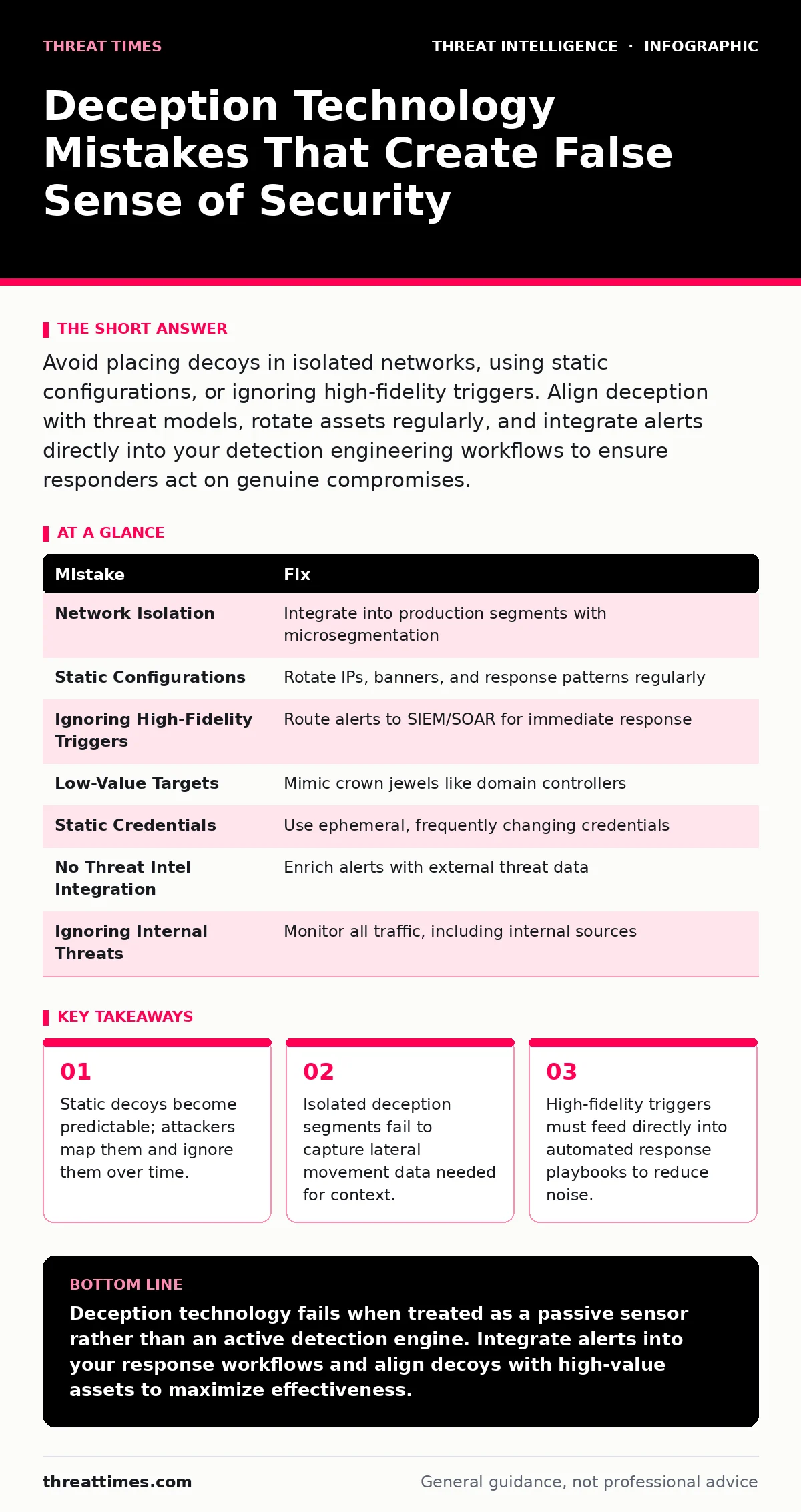
Avoid placing decoys in isolated networks, using static configurations, or ignoring high-fidelity triggers. Align deception with threat models, rotate assets regularly, and integrate alerts directly into your detection engineering workflows to ensure responders act on genuine compromises.
Deception technology places fake assets, credentials, and data within your infrastructure to lure adversaries. When an attacker interacts with these honeypots, the system generates high-fidelity alerts. This approach shifts the burden of proof from the defender to the attacker. However, deploying these tools incorrectly creates operational risks that outweigh the benefits. The following mistakes are common in mature security programs that treat deception as a set-and-forget solution.
Mistake 1: Deploying Decoys in Network Isolation
Many teams place deception assets in segregated VLANs or DMZs to contain potential compromise. This separation prevents the decoy from interacting with production systems. If an attacker compromises a real server and then moves laterally, they may never touch the isolated decoy. You miss the critical signal of lateral movement.
Why it hurts:
Isolation breaks the narrative of the attack. You detect the initial breach but lose visibility into the attacker's next steps. The deception tool becomes a blind spot rather than a sensor.
The fix:
Integrate deception assets into the same network segments as high-value targets. Use microsegmentation to limit blast radius without isolating the sensor. This allows the decoy to observe lateral movement attempts that traditional IDS might miss.
Mistake 2: Using Static Configurations
Some administrators configure a decoy web server once and leave it unchanged for years. Attackers use automated reconnaissance tools to fingerprint services. If the decoy always returns the same banner, version, and response time, it becomes recognizable. Attackers learn to ignore static patterns.
Why it hurts:
Predictability reduces engagement rates. Sophisticated adversaries will map the static decoys and bypass them, focusing their efforts on real assets. Your deception layer becomes invisible noise.
The fix:
Implement dynamic configuration changes. Rotate IP addresses, MAC addresses, and service banners regularly. Randomize response times and error messages to mimic human-driven variability. This forces attackers to re-evaluate each interaction as potentially real.
Mistake 3: Ignoring High-Fidelity Triggers
Deception tools generate alerts when specific actions occur, such as accessing a fake database. Some teams treat these alerts as low-priority informational logs. They do not integrate them into their primary SIEM or SOAR platforms. This creates a siloed alert stream that analysts rarely check.
Why it hurts:
Delayed response allows attackers to escalate privileges. A high-fidelity trigger indicates active compromise, not just scanning. Ignoring it wastes the primary advantage of deception technology: immediate confirmation of malicious intent.
The fix:
Route deception alerts directly into your incident response workflow. Treat any interaction with a decoy as a confirmed breach. Automate containment actions, such as isolating the source IP, to reduce manual triage time.
Mistake 4: Mimicking Low-Value Targets
Teams often deploy decoys that resemble standard workstations or generic file servers. These assets generate high volumes of background noise from legitimate users or automated scans. Attackers prioritize high-value targets like domain controllers or financial databases.
Why it hurts:
Low-value decoys produce false positives and alert fatigue. Analysts become desensitized to the noise, potentially missing genuine threats. The deception layer fails to attract the attention of sophisticated adversaries.
The fix:
Align deception assets with your crown jewels. Create high-fidelity decoys that mimic domain controllers, Active Directory schemas, or sensitive data repositories. This ensures that engagement signals indicate a targeted, high-impact attack.
Mistake 5: Failing to Rotate Credentials
Some deception platforms use static credentials for fake services. If these credentials are exposed or guessed, attackers can authenticate without triggering an alert. They may use these credentials to move laterally, believing they have legitimate access.
Why it hurts:
Static credentials provide a false sense of security. Attackers can use compromised decoy credentials to mask their true activities. This complicates forensic analysis and threat hunting efforts.
The fix:
Use ephemeral credentials that change frequently. Integrate your deception platform with your identity provider to generate temporary tokens. Ensure that any authentication attempt against a decoy triggers an immediate alert, regardless of success.
Mistake 6: Neglecting Threat Intelligence Integration
Deception tools operate in a vacuum if they do not share data with other security systems. You may detect an attack but lack context about the adversary's tactics, techniques, and procedures. This limits your ability to correlate events across your environment.
Why it hurts:
Lack of context slows down investigation. You know someone touched a decoy, but you do not know who they are or what else they have accessed. This hinders effective containment and eradication.
The fix:
Integrate deception alerts with your threat intelligence platforms. Enrich alerts with external data to identify known threat actors. Use this context to update your detection engineering rules and improve overall visibility.
Mistake 7: Overlooking Internal Threats
Most deception deployments focus on external attackers. However, insider threats or compromised accounts may interact with decoys. If the system only flags external IPs, you miss malicious activity from within.
Why it hurts:
Internal threats are harder to detect. They have legitimate access and may not trigger perimeter-based alerts. Deception assets can reveal anomalous behavior from trusted users.
The fix:
Configure deception tools to monitor all traffic, regardless of source. Alert on any interaction with decoys from internal endpoints. This helps identify compromised accounts or malicious insiders early.
| Mistake | Fix |
|---|---|
| Network Isolation | Integrate into production segments with microsegmentation |
| Static Configurations | Rotate IPs, banners, and response patterns regularly |
| Ignoring High-Fidelity Triggers | Route alerts to SIEM/SOAR for immediate response |
| Low-Value Targets | Mimic crown jewels like domain controllers |
| Static Credentials | Use ephemeral, frequently changing credentials |
| No Threat Intel Integration | Enrich alerts with external threat data |
| Ignoring Internal Threats | Monitor all traffic, including internal sources |
Key takeaways
- Static decoys become predictable; attackers map them and ignore them over time.
- Isolated deception segments fail to capture lateral movement data needed for context.
- High-fidelity triggers must feed directly into automated response playbooks to reduce noise.
Deception technology fails when treated as a passive sensor rather than an active detection engine. Integrate alerts into your response workflows and align decoys with high-value assets to maximize effectiveness.
Frequently asked questions
How does deception technology differ from honeypots?
Deception technology is a broader category that includes honeypots, honeynets, and decoy files. It often involves automated deployment and management across large environments, whereas honeypots are typically standalone systems.
Can deception technology detect zero-day attacks?
Yes, because it relies on behavior rather than signatures. If an attacker interacts with a decoy, the system alerts regardless of the exploit used. This makes it effective against unknown threats.
Is deception technology suitable for small organizations?
It can be, but complexity varies. Small teams should start with simple decoy files or credentials before deploying complex network-based deception. Focus on high-value targets to manage alert volume.
How do I avoid alert fatigue from deception tools?
Tune your triggers to only alert on high-fidelity actions, such as authentication or data access. Integrate alerts into your SIEM to correlate with other events and filter out noise.
How this guide was produced: written by the Threat Times editorial team with AI assistance, checked against the public references listed below, and reviewed when the facts change. See our editorial policy or report an error.