Why Neural Networks Matter for Security Operations
Neural networks detect subtle behavioral shifts that rule-based systems miss, allowing teams to stop attacks before they execute.

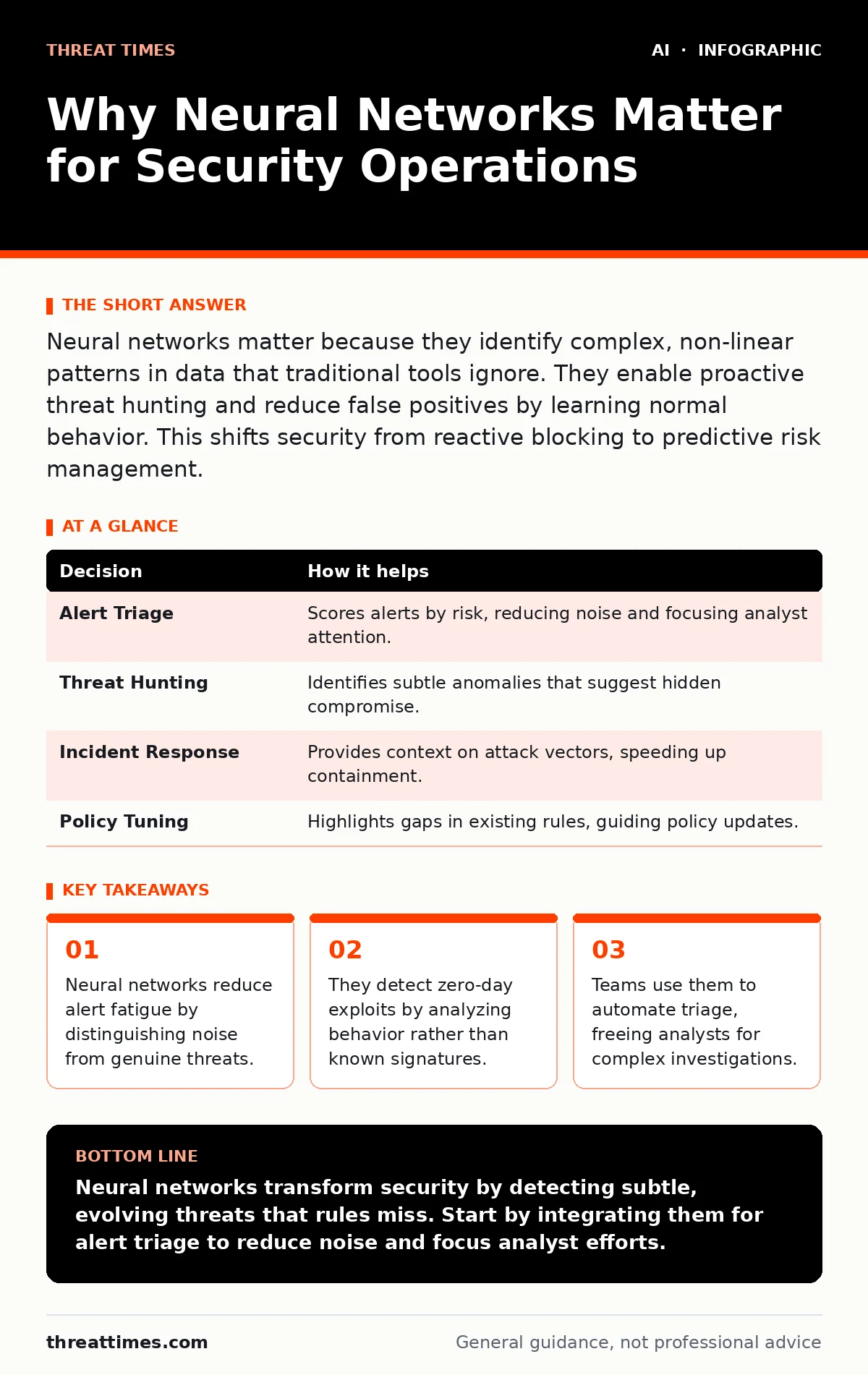
Neural networks matter because they identify complex, non-linear patterns in data that traditional tools ignore. They enable proactive threat hunting and reduce false positives by learning normal behavior. This shifts security from reactive blocking to predictive risk management.
The Limitation of Static Rules
Traditional security tools rely on static rules. A rule states that if an event matches specific criteria, it is a threat. This approach works for known malware with fixed signatures. It fails when attackers modify their code slightly.
Imagine a script that changes its variable names every time it runs. A signature-based scanner sees a new file each time. It cannot match the file to its database of known threats. The attack proceeds undetected because the underlying behavior remains identical.
Neural networks solve this by learning patterns rather than memorizing signatures. They analyze the structure and intent of the data. This allows them to recognize malicious activity even when the surface details change.
Pattern Recognition at Scale
A neural network is a computational model inspired by the human brain. It consists of layers of interconnected nodes that process data. Each node applies a mathematical function to its inputs. The network learns by adjusting these functions during training.
This structure allows the model to capture non-linear relationships. In security data, threats often manifest as subtle correlations across multiple signals. A single log entry might look benign. However, when combined with network flow data and user behavior, it reveals an anomaly.
Neural networks process these high-dimensional inputs simultaneously. They identify clusters of activity that deviate from the baseline. This capability is critical for detecting sophisticated attacks that span multiple systems.
Decision Support for Analysts
Security teams face an overwhelming volume of alerts. Most of these alerts are false positives. Analysts spend significant time investigating benign events. This leads to fatigue and missed threats.
Neural networks help by scoring the likelihood of an alert being true. They prioritize high-risk events for human review. This triage process ensures that analysts focus on the most dangerous incidents.
The model also provides context. It highlights the specific features that triggered the alert. This reduces the time required to understand the root cause. Teams can make faster, more informed decisions about containment and remediation.
| Decision | How it helps |
|---|---|
| Alert Triage | Scores alerts by risk, reducing noise and focusing analyst attention. |
| Threat Hunting | Identifies subtle anomalies that suggest hidden compromise. |
| Incident Response | Provides context on attack vectors, speeding up containment. |
| Policy Tuning | Highlights gaps in existing rules, guiding policy updates. |
The Hidden Cost of Complexity
Neural networks are not magic. They require significant computational resources. Training large models demands powerful hardware. Running inference in real-time adds latency to network traffic.
There is also a maintenance cost. Models drift over time as user behavior changes. They require periodic retraining with fresh data. Without this, their accuracy degrades. Teams must balance model performance with operational overhead.
Another cost is interpretability. Neural networks are often black boxes. It can be difficult to explain why a model flagged a specific event. This lack of transparency can hinder incident response. Analysts may struggle to justify actions to stakeholders.
Defending the Model Itself
Neural networks introduce new attack surfaces. Adversaries can manipulate input data to deceive the model. This is known as adversarial machine learning. A small, imperceptible change in data can cause the model to misclassify a threat.
Imagine an attacker adding noise to a malicious file. The file remains functional, but the neural network sees it as benign. The attack bypasses the defense because the model’s decision boundary was shifted.
Teams must implement defenses against these attacks. This includes validating input data and monitoring model performance. Regularly testing the model with adversarial examples helps identify weaknesses. See the guide on data poisoning attacks for more on corrupting training data.
Integration with Existing Tools
Neural networks do not replace existing security tools. They complement them. Signature-based scanners catch known threats quickly. Neural networks catch unknown threats that bypass signatures.
Integrating these tools requires careful architecture. The neural network should sit behind the initial filters. It analyzes the traffic that passes through the first layer. This reduces the load on the model.
Teams must also ensure data quality. The model is only as good as the data it receives. Incomplete or noisy data leads to poor predictions. Standardizing data formats and ensuring consistency is vital. Refer to AI security testing for methods to validate these integrations.
The Human Element Remains
Automation cannot replace human judgment. Neural networks provide probabilities, not certainties. False positives still occur. False negatives are possible. Analysts must verify the model’s output.
The role of the security professional shifts. Less time is spent on manual triage. More time is spent on strategy and complex investigations. Teams must upskill their staff to work with AI tools.
Understanding the limitations of the model is key. Analysts should know when to trust the model and when to override it. This balance ensures that security operations remain effective and resilient. Check machine learning for fraud detection for examples of human-AI collaboration.
Looking Beyond Immediate Threats
Neural networks also help identify long-term trends. They can predict potential vulnerabilities based on historical data. This allows teams to patch systems before they are exploited.
They also aid in compliance. By monitoring behavior continuously, they provide evidence of security posture. This helps teams demonstrate adherence to standards.
The technology continues to evolve. New architectures offer better accuracy and efficiency. Teams must stay informed about these developments. See deepfake detection for how neural networks adapt to new media threats.
Key takeaways
- Neural networks reduce alert fatigue by distinguishing noise from genuine threats.
- They detect zero-day exploits by analyzing behavior rather than known signatures.
- Teams use them to automate triage, freeing analysts for complex investigations.
Neural networks transform security by detecting subtle, evolving threats that rules miss. Start by integrating them for alert triage to reduce noise and focus analyst efforts.
Frequently asked questions
Do neural networks replace firewalls?
No, they complement firewalls by analyzing traffic patterns that static rules cannot catch.
How much data is needed to train a model?
Large datasets are required to ensure the model learns accurate patterns and avoids bias.
Can neural networks detect insider threats?
Yes, by identifying deviations from normal user behavior, they can flag suspicious insider activity.
Is it expensive to implement neural networks?
Initial costs are high due to hardware and expertise, but long-term efficiency gains can offset these expenses.
How this guide was produced: written by the Threat Times editorial team with AI assistance, checked against the public references listed below, and reviewed when the facts change. See our editorial policy or report an error.