Digital Forensics: Real Benefits and Hard Limitations
Forensic analysis reveals attacker movement but often fails to identify the initial entry point due to log retention limits.

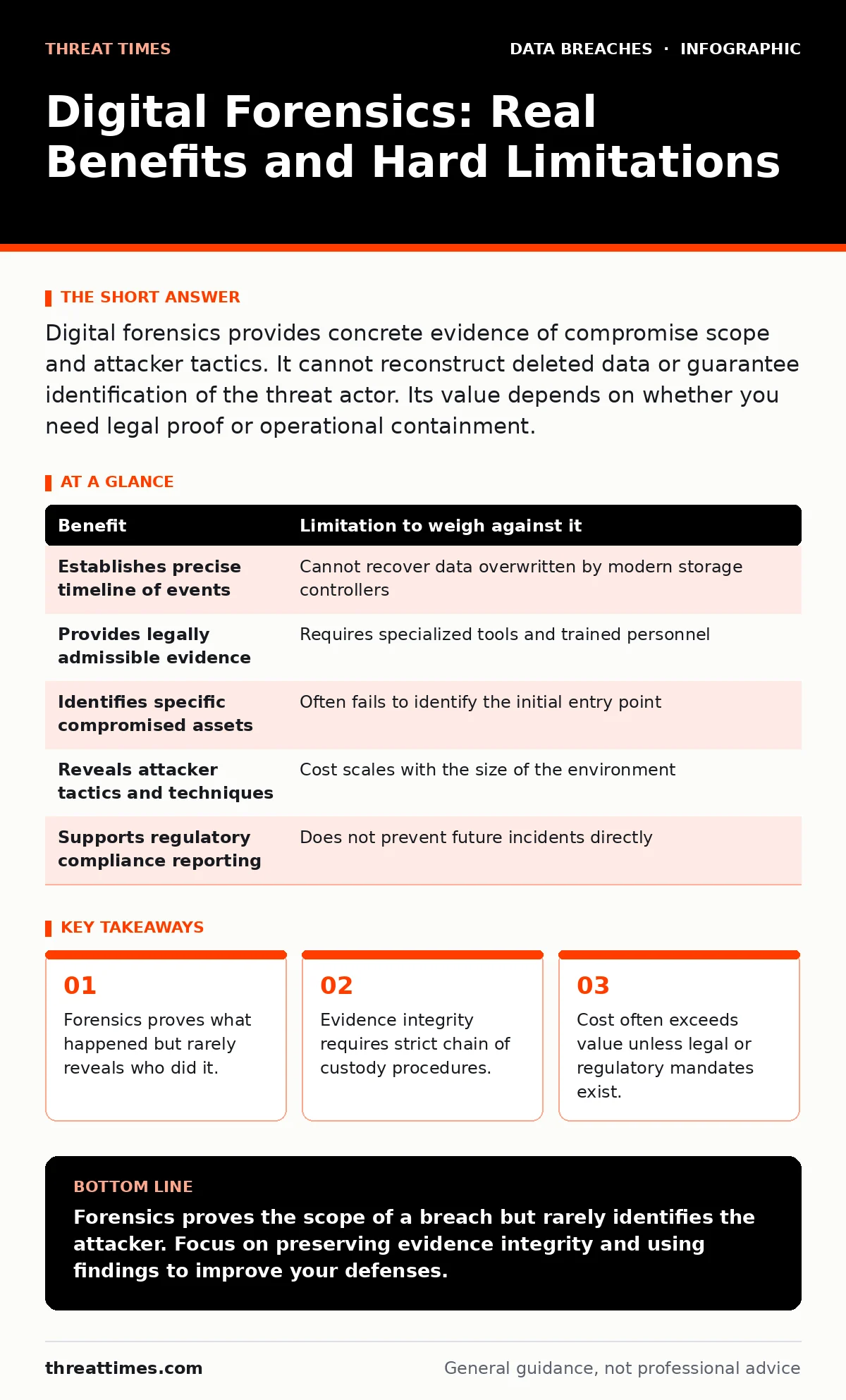
Digital forensics provides concrete evidence of compromise scope and attacker tactics. It cannot reconstruct deleted data or guarantee identification of the threat actor. Its value depends on whether you need legal proof or operational containment.
The Purpose of Forensic Analysis
Digital forensics is the process of recovering and investigating material found in digital devices. You use it to answer specific questions about a security incident. The goal is not just to fix the problem, but to understand how it occurred. This understanding helps you prevent recurrence.
Imagine a scenario where an insider steals customer data. You need to know which files were accessed and when. Forensic analysis of endpoint logs and network traffic can provide this timeline. It turns ambiguous alerts into a clear narrative of events.
However, this process is distinct from incident response. Incident response focuses on containment and recovery. Forensics focuses on evidence and attribution. You often perform them simultaneously, but their objectives differ.
Concrete Benefits of Investigation
The primary benefit is establishing a factual timeline. You can map the attacker’s lateral movement across your network. This reveals which systems were compromised and for how long. It also identifies the specific data exfiltrated.
Forensics provides admissible evidence for legal proceedings. If you sue for damages or face criminal charges, you need verified data. Hash values and chain of custody records support this. Without them, your claims may be dismissed.
It also improves your defensive posture. By analyzing the attack vector, you find gaps in your controls. Perhaps your firewalls allowed unexpected outbound traffic. Or your user access provisioning granted excessive privileges. These insights drive targeted improvements.
| Benefit | Limitation to weigh against it |
|---|---|
| Establishes precise timeline of events | Cannot recover data overwritten by modern storage controllers |
| Provides legally admissible evidence | Requires specialized tools and trained personnel |
| Identifies specific compromised assets | Often fails to identify the initial entry point |
| Reveals attacker tactics and techniques | Cost scales with the size of the environment |
| Supports regulatory compliance reporting | Does not prevent future incidents directly |
The Hidden Costs and Limits
Forensics is resource-intensive. You must preserve evidence without altering it. This often requires taking systems offline, which impacts business operations. Downtime costs money and frustrates users.
You face the limit of log retention. Most organizations delete logs after a set period. If the attack started before this window, you lose the initial context. You can see the aftermath, but not the trigger. This gap makes attribution nearly impossible.
Modern encryption complicates analysis. If you rely on full disk encryption, you cannot read the drive without the key. If the attacker encrypted their tools or data, you hit a wall. You can see that encryption occurred, but not what was inside.
When Forensics Is Worth It
You should pursue deep forensic analysis when legal liability is high. If customer data was breached, regulators may demand an investigation. Your obligations as data controllers and data processors require transparency. A superficial report may not satisfy these requirements.
It is also worth it when the attacker is persistent. Advanced threats often hide in plain sight. Surface-level scanning misses their persistence mechanisms. Only deep forensics can find hidden backdoors or modified system files.
Suppose you suspect insider threat. Employees may delete logs to cover their tracks. Forensic analysis of backup media or shadow copies can recover this deleted history. It provides the proof needed for termination or prosecution.
When It Is Not Worth It
Do not perform deep forensics for every alert. Many alerts are false positives or low-risk events. The cost of investigation exceeds the potential loss. Focus your resources on high-impact incidents.
If the system is already rebuilt, forensics is moot. You cannot analyze a drive that no longer exists. In these cases, focus on prevention. Update your password rotation policies or patch vulnerabilities.
Imagine a simple phishing click that was immediately isolated. The malware did not execute or spread. A quick review of logs may suffice. Deep disk imaging adds no value here. You know what happened, and the damage is contained.
Integration with Broader Security
Forensics does not exist in a vacuum. It relies on the quality of your logs and backups. If you do not collect sufficient data, forensics fails. Ensure your logging strategy covers critical events.
It also informs your access controls. If forensics reveals that an account was hijacked, review your credential dumps risk. Did the attacker use stolen hashes? This insight drives changes to your authentication methods.
Consider how cloud misconfigurations might have aided the attacker. Forensics can show if data was copied to an unauthorized cloud bucket. This connects the technical evidence to administrative failures.
Practical Steps for Implementation
Start by defining your forensic readiness. What data do you keep? How long? Ensure you have the tools to analyze it. Do not wait for an incident to buy software.
Train your staff on evidence handling. One mistake can invalidate your findings. Document every step you take. Use write-blockers when imaging drives. This prevents accidental modification of evidence.
Finally, integrate forensics into your incident response plan. Define when to trigger a deep investigation. Clarify roles and responsibilities. This reduces confusion during a crisis.
The Reality of Attribution
You rarely identify the attacker by name. Forensics shows what happened, not who did it. IP addresses can be spoofed or routed through proxies. Digital fingerprints are often misleading.
Focus on the impact and the method. This is more useful for defense. Knowing the technique allows you to block similar attacks. Knowing the name often provides little operational value.
Accept this limitation. Do not waste resources chasing attribution. Use forensics to secure your environment. This is the most reliable outcome.
Key takeaways
- Forensics proves what happened but rarely reveals who did it.
- Evidence integrity requires strict chain of custody procedures.
- Cost often exceeds value unless legal or regulatory mandates exist.
Forensics proves the scope of a breach but rarely identifies the attacker. Focus on preserving evidence integrity and using findings to improve your defenses.
Frequently asked questions
Can forensics recover deleted files?
It can recover files that have not been overwritten. Modern storage controllers often overwrite data quickly, making recovery unlikely.
How long does a forensic investigation take?
It varies from days to months. Simple incidents may take a week. Complex breaches with large data sets can take much longer.
Do I need a lawyer for forensics?
If legal action is possible, involve counsel early. They ensure privilege protection and proper chain of custody.
Can I do forensics myself?
You can perform basic analysis. For legal cases, use certified experts. Their findings are more likely to be accepted in court.
How this guide was produced: written by the Threat Times editorial team with AI assistance, checked against the public references listed below, and reviewed when the facts change. See our editorial policy or report an error.