Token Theft Response: Containment, Revocation, and Recovery Steps
Rotating credentials fails if the stolen token remains valid, requiring immediate session invalidation and scope reduction to stop lateral movement.

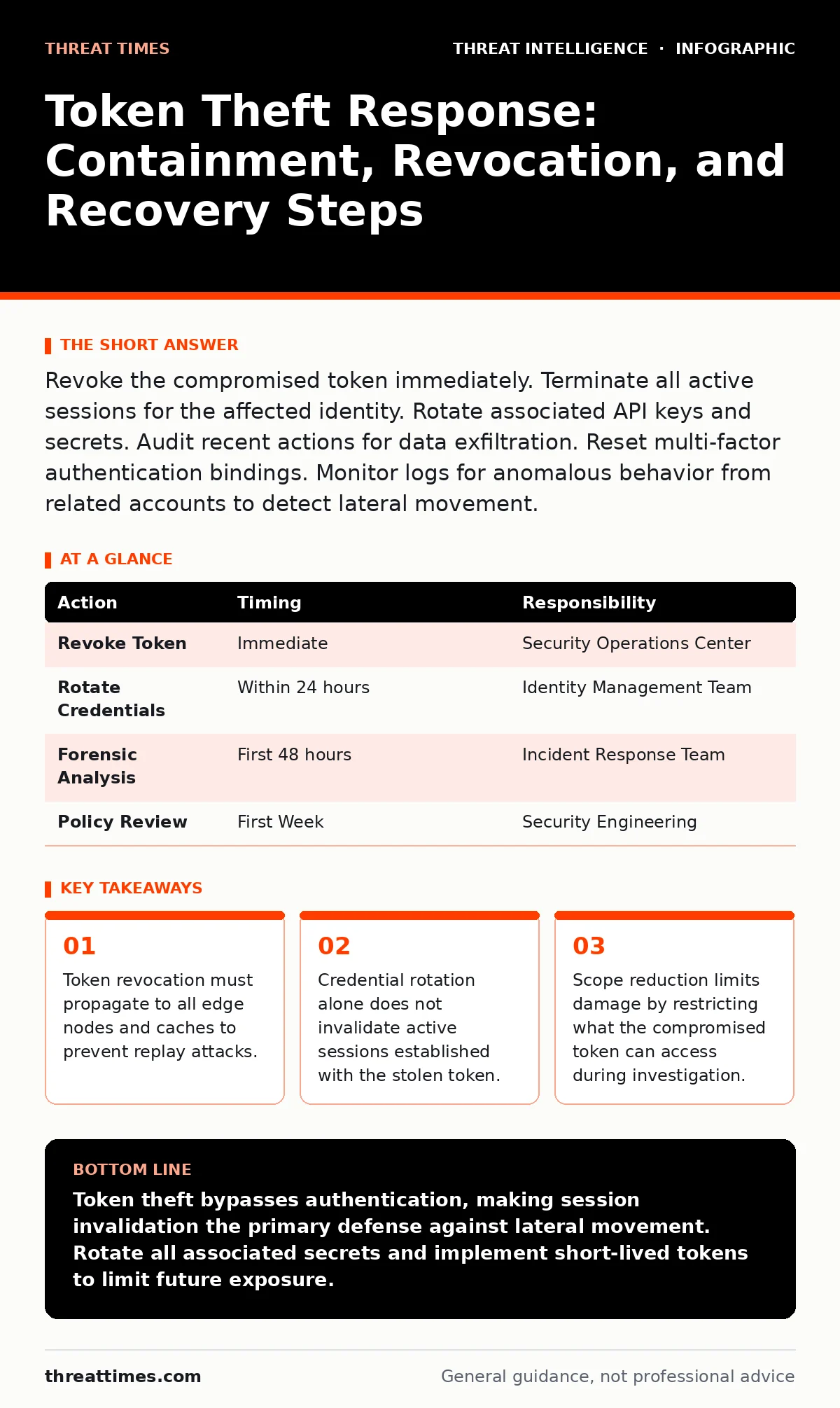
Revoke the compromised token immediately. Terminate all active sessions for the affected identity. Rotate associated API keys and secrets. Audit recent actions for data exfiltration. Reset multi-factor authentication bindings. Monitor logs for anomalous behavior from related accounts to detect lateral movement.
The Mechanics of Token Persistence
An access token is a digital ticket that grants a user or application permission to access specific resources. Unlike a password, which is used to obtain access, the token itself is the proof of authorization. When an attacker steals a token, they bypass the initial authentication step entirely. They do not need your password or your multi-factor authentication code. They simply present the valid token to the service, and the service grants access.
This creates a stealthy threat. The login event already occurred, so standard intrusion detection systems that watch for failed login attempts or unusual login locations may remain silent. The attacker appears as a legitimate user continuing an existing session. Understanding this distinction is the foundation of your response. You are not fighting a brute-force attack; you are fighting a valid credential being used by an unauthorized entity.
First hour
The first sixty minutes determine whether the breach remains contained or spreads laterally. Speed matters more than perfection in this phase. Your goal is to stop the attacker from using the stolen token to access other systems or exfiltrate data.
Immediate Containment Checklist
- Revoke the specific compromised token.
- Invalidate all active sessions for the compromised identity.
- Disable the user account or service principal.
- Block outbound traffic to known attacker infrastructure if identified.
- Capture memory dumps from the affected host.
- Notify the identity and access management team.
Revocation and Session Termination
Revoking a token is not always instantaneous. In distributed systems, tokens are cached at edge nodes, load balancers, and application servers. When you revoke a token in the central identity provider, that change must propagate to every node that validates tokens. There is a window of latency where the token remains valid.
To close this window, you must invalidate all sessions associated with the identity, not just the single token. This forces every device and browser using that identity to re-authenticate. The attacker, who cannot re-authenticate without the multi-factor device, is locked out. This step is critical because token theft often involves stealing a refresh token, which can generate new access tokens indefinitely. You must break this chain.
First day
Once the immediate bleeding stops, you must determine the extent of the damage. The attacker may have used the token to escalate privileges or move to other accounts. This phase requires careful log analysis and correlation of events.
Forensic Analysis and Scope Determination
Review the audit logs for the compromised identity. Look for actions that deviate from normal behavior. Did the user access sensitive databases? Did they export large volumes of data? Did they create new administrative accounts? These actions may have occurred hours or days before you detected the theft.
Use IOC enrichment to check if the IP addresses or user agents associated with the stolen token have been seen in other threat intelligence platforms. This helps you determine if the attacker is part of a broader campaign. If you find similar patterns in other accounts, you must expand your investigation. The stolen token may be just one piece of a larger intrusion.
Credential and Key Rotation
Rotate all credentials associated with the compromised identity. This includes API keys, SSH keys, and service account secrets. Even if the attacker did not steal these items, they may have had access to them through the compromised token. Assume everything is exposed.
Do not forget about secondary systems. If the compromised identity had access to a cloud storage bucket, rotate the keys for that bucket as well. If it had access to a database, change the database passwords. The principle of least privilege should guide your rotation. Only rotate what the attacker could have accessed, but err on the side of caution.
First week
The final phase focuses on recovery and hardening. You must restore normal operations while ensuring the attacker cannot return. This involves updating detection rules, improving monitoring, and reviewing access policies.
Detection Engineering and Monitoring
Update your detection rules to catch similar attacks in the future. Detection engineering involves creating rules that identify anomalous behavior, such as a user accessing a resource they have never touched before. Sigma rules can help you standardize these detections across your log management platform.
Consider implementing deception technology to trap attackers who return. Honeytokens are fake credentials or tokens that serve no legitimate purpose. If an attacker uses a honeytoken, you receive an immediate alert. This allows you to detect intrusion even if the attacker bypasses your perimeter defenses.
Access Policy Review
Review the permissions granted to the compromised identity. Did it have more access than necessary? Excessive permissions increase the impact of a token theft. Reduce the scope of access for all similar accounts. Implement just-in-time access, where privileges are granted only when needed and expire automatically.
This reduces the window of opportunity for an attacker. If they steal a token with limited scope, they can do less damage. If they steal a token with broad administrative rights, they can take over the entire environment.
Who to Tell
Internal communication must be clear and concise. Inform the incident response team, legal counsel, and executive leadership. Each group needs different information. The technical team needs logs and timelines. Legal needs to know if customer data was exposed. Leadership needs to know the business impact.
External notification depends on the severity of the breach. If customer data was compromised, you may be required to notify regulators and affected individuals. Follow your organization’s incident response plan. Do not speculate or provide unverified details. Stick to the facts.
How to Stop a Repeat
Prevention requires a shift in how you manage tokens and access. Shorten the lifespan of access tokens. Use refresh tokens sparingly and store them securely. Implement continuous monitoring for anomalous token usage.
Adopt a zero-trust architecture. Never trust a token implicitly. Validate permissions at every request. Use encrypted messaging apps for secure communication during incident response to prevent eavesdropping. Ensure that your smart home security devices are on a separate network segment to reduce the attack surface.
| Action | Timing | Responsibility |
|---|---|---|
| Revoke Token | Immediate | Security Operations Center |
| Rotate Credentials | Within 24 hours | Identity Management Team |
| Forensic Analysis | First 48 hours | Incident Response Team |
| Policy Review | First Week | Security Engineering |
Key takeaways
- Token revocation must propagate to all edge nodes and caches to prevent replay attacks.
- Credential rotation alone does not invalidate active sessions established with the stolen token.
- Scope reduction limits damage by restricting what the compromised token can access during investigation.
Token theft bypasses authentication, making session invalidation the primary defense against lateral movement. Rotate all associated secrets and implement short-lived tokens to limit future exposure.
Frequently asked questions
How long does it take for a revoked token to become invalid?
Propagation time varies by architecture, ranging from seconds to minutes. Invalidate all sessions to close the latency window.
Can I detect token theft without endpoint agents?
Yes, by monitoring for anomalous access patterns and impossible travel in identity logs.
Should I change my password after a token theft?
Yes, if the token was obtained through a compromised session, the password may also be exposed.
Do refresh tokens pose a greater risk than access tokens?
Yes, because they can generate new access tokens indefinitely, extending the attacker’s access.
How this guide was produced: written by the Threat Times editorial team with AI assistance, checked against the public references listed below, and reviewed when the facts change. See our editorial policy or report an error.