Generative AI vs Agentic AI: Architectural Differences and Security Risks
Agentic AI executes multi-step workflows autonomously, creating attack surfaces that generative models do not present to network defenders.

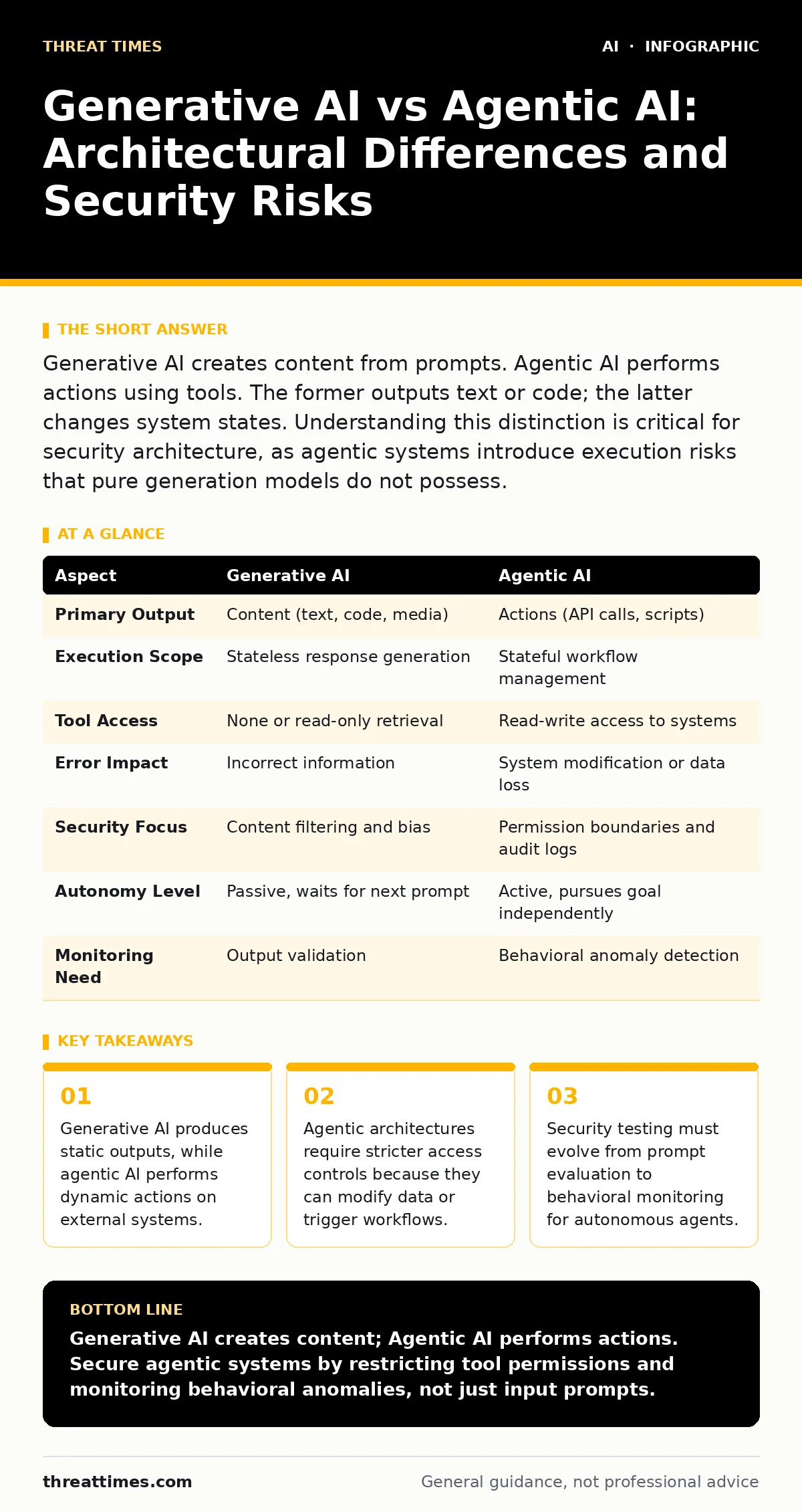
Generative AI creates content from prompts. Agentic AI performs actions using tools. The former outputs text or code; the latter changes system states. Understanding this distinction is critical for security architecture, as agentic systems introduce execution risks that pure generation models do not possess.
The Core Difference Between Generative AI and Agentic AI
Generative AI vs Agentic AI is a debate about output versus action. Generative artificial intelligence takes an input and produces a new artifact, such as text, code, or an image. It stops once the content is created. Agentic artificial intelligence takes an input, plans a sequence of steps, uses tools to execute those steps, and achieves a goal. The generative model is a writer; the agentic model is a worker. This distinction dictates how you secure them. A writer cannot delete your database. A worker with the right permissions can. The security perimeter expands when the model gains agency.
What Generative AI Actually Does
Generative AI relies on statistical patterns learned during training to predict the next likely token in a sequence. These systems, often built on large language models, excel at synthesis. You provide a prompt, and the model returns a response. The model does not access live data unless explicitly connected to a retrieval system. It does not run commands. It does not send emails. It generates probabilities shaped into coherent language. This limits its blast radius. If the model hallucinates, the error remains in the text. It does not propagate through your infrastructure.
What Agentic AI Actually Does
Agentic AI adds a reasoning loop and tool integration to the generation capability. The model receives a goal, breaks it into sub-tasks, and selects functions to execute. It might query a database, run a script, or call an API. It then evaluates the result and decides the next step. This creates a feedback loop. The system acts on the world. This capability introduces AI model theft risks if the agent exposes sensitive data during its reasoning process. It also creates opportunities for prompt injection attacks where an attacker manipulates the agent’s tool usage. The agent is no longer just talking; it is doing.
Point-by-Point Comparison
| Aspect | Generative AI | Agentic AI |
|---|---|---|
| Primary Output | Content (text, code, media) | Actions (API calls, scripts) |
| Execution Scope | Stateless response generation | Stateful workflow management |
| Tool Access | None or read-only retrieval | Read-write access to systems |
| Error Impact | Incorrect information | System modification or data loss |
| Security Focus | Content filtering and bias | Permission boundaries and audit logs |
| Autonomy Level | Passive, waits for next prompt | Active, pursues goal independently |
| Monitoring Need | Output validation | Behavioral anomaly detection |
When to Choose Generative AI
Choose generative AI when your goal is augmentation, not automation. You need the model to draft documents, summarize reports, or write boilerplate code. The human remains in the loop for every critical decision. This approach minimizes risk. You can apply standard content safety filters. You do not need to worry about the model accidentally deleting a production database. The output is inert until a human acts on it. This architecture is simpler to secure. You focus on the quality of the text and the privacy of the input data. It is the safer starting point for most organizations.
When to Choose Agentic AI
Choose agentic AI when you need to automate complex, multi-step workflows that require tool usage. Suppose you want a system that automatically provisions cloud resources based on a ticket. An agent can parse the request, check quotas, call the cloud API, and confirm completion. This requires granting the agent permissions to your systems. You must implement strict least-privilege access. You need robust logging to track every action the agent takes. The security burden shifts from content review to access control and behavioral monitoring. This is where AI security testing becomes mandatory before deployment.
Where They Overlap and Collide
The line blurs when generative models are embedded within agentic frameworks. The agent uses a generative model for its reasoning engine. This means the agent inherits the generative model’s weaknesses. It can still hallucinate facts. It can still be tricked by AI-generated phishing attempts in its input stream. You must secure both layers. The generative layer needs prompt safety. The agentic layer needs execution safety. Deepfake detection may be relevant if the agent generates media as part of its workflow. The combination increases complexity. A flaw in the reasoning can lead to a catastrophic action. You cannot treat them as separate security domains.
Security Implications for Defenders
Defending agentic systems requires a shift in mindset. Traditional firewalls look at network traffic. They cannot see the intent behind an API call made by an agent. You need to monitor for anomalous behavior patterns. Is the agent accessing files it never touched before? Is it making calls at unusual times? Neural networks used for anomaly detection can help here, but they require clean baseline data.
You must also consider MITRE ATLAS, the framework for adversary tactics and techniques in AI. It helps you map potential attack vectors against your agent’s capabilities. Assume the agent will be tricked. Design your permissions so that trickery leads to failure, not compromise.
Key takeaways
- Generative AI produces static outputs, while agentic AI performs dynamic actions on external systems.
- Agentic architectures require stricter access controls because they can modify data or trigger workflows.
- Security testing must evolve from prompt evaluation to behavioral monitoring for autonomous agents.
Generative AI creates content; Agentic AI performs actions. Secure agentic systems by restricting tool permissions and monitoring behavioral anomalies, not just input prompts.
Frequently asked questions
Can generative AI become agentic on its own?
No, a generative model requires explicit architectural changes to gain agency. It needs tool integrations and a planning loop to execute actions, which are not inherent to the base model.
Is agentic AI more vulnerable to prompt injection?
Yes, because the injection can manipulate the agent’s tool usage. An attacker can trick the agent into performing unauthorized actions, whereas with generative AI, the worst outcome is usually misinformation.
How do I audit an agentic AI system?
Audit the permissions granted to the agent’s tools. Review logs for every action taken. Verify that the agent’s reasoning aligns with the expected workflow. Check for deviations from standard operating procedures.
Does agentic AI replace human workers?
It automates specific workflows, not entire roles. Humans remain necessary for oversight, exception handling, and defining the goals. The agent executes the steps; the human defines the intent and verifies the outcome.
How this guide was produced: written by the Threat Times editorial team with AI assistance, checked against the public references listed below, and reviewed when the facts change. See our editorial policy or report an error.