Large Language Models vs Generative AI: The Distinction and Security Implications
Large language models are specific neural network architectures, while generative AI is the broader category of systems that create new data, creating distinct attack surfaces.

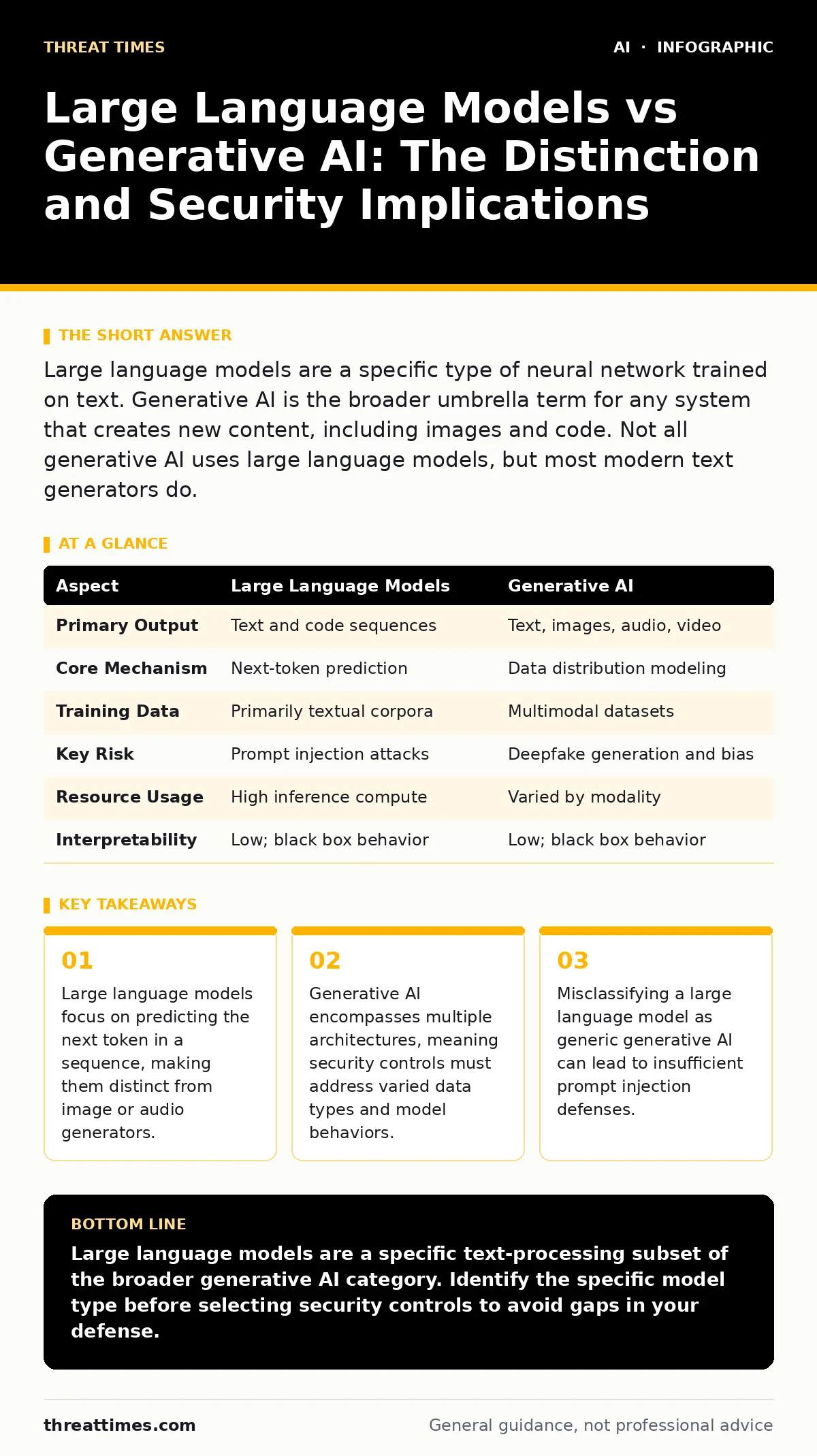
Large language models are a specific type of neural network trained on text. Generative AI is the broader umbrella term for any system that creates new content, including images and code. Not all generative AI uses large language models, but most modern text generators do.
Large Language Models vs Generative AI
The distinction between large language models and generative AI lies in scope and architecture. Large language models are specific neural networks trained on vast text corpora to predict the next word or token in a sequence. Generative AI is the broader category of artificial intelligence systems capable of creating new data, including images, audio, and synthetic text.
While large language models are a subset of generative AI, not all generative systems use language modeling techniques. This difference matters because the security risks and operational constraints vary significantly between text-based prediction engines and multimodal content generators. Understanding this boundary prevents applying text-specific defenses to image generation tasks, which have entirely different failure modes.
What Is a Large Language Model?
A large language model is an artificial intelligence system built on transformer architecture that processes natural language. It ingests massive datasets of text to learn statistical patterns of human communication. The model does not "understand" meaning in the human sense; it calculates the probability of the next token based on prior context. This mechanism allows it to summarize, translate, and generate coherent paragraphs.
The primary vulnerability in large language models is prompt injection, where malicious input manipulates the model’s behavior. Because these models rely on pattern matching, they can hallucinate facts or reveal training data if constrained improperly. Security teams must treat the input vector as untrusted, similar to how they treat web application inputs.
What Is Generative AI?
Generative AI refers to any algorithm that produces original content rather than merely classifying existing data. This category includes large language models, but also diffusion models for images, variational autoencoders for data synthesis, and generative adversarial networks. The common thread is the creation of novel outputs that mimic training data distributions.
Generative AI systems often require different compute resources and data pipelines than standard machine learning models. For example, image generation requires handling pixel-level data, while text generation handles discrete tokens. This diversity means that a single security framework cannot cover all generative AI use cases. Teams must evaluate the specific generative technique to identify relevant risks, such as model inversion or training data leakage.
Point-by-Point Comparison
| Aspect | Large Language Models | Generative AI |
|---|---|---|
| Primary Output | Text and code sequences | Text, images, audio, video |
| Core Mechanism | Next-token prediction | Data distribution modeling |
| Training Data | Primarily textual corpora | Multimodal datasets |
| Key Risk | Prompt injection attacks | Deepfake generation and bias |
| Resource Usage | High inference compute | Varied by modality |
| Interpretability | Low; black box behavior | Low; black box behavior |
When To Choose Large Language Models
Choose large language models when your workflow requires nuanced understanding of human language. These models excel at tasks that involve reasoning, summarization, and code generation. They are the standard for chatbots, document analysis, and automated coding assistants. The precision of large language models in handling syntax and semantics makes them superior for text-heavy environments.
However, you must implement strict output validation. Large language models can generate plausible but incorrect information, a phenomenon known as hallucination. Integrating large language models into critical decision-making pipelines requires human-in-the-loop verification. Refer to our guide on prompt injection attacks to understand how adversaries manipulate these text-specific vulnerabilities.
When To Choose Generative AI Systems
Choose broader generative AI systems when you need to create synthetic media or augment datasets. Diffusion models are ideal for generating realistic images for training computer vision systems. Audio generators can create synthetic voices for accessibility tools. These systems are not suitable for logical reasoning or complex text manipulation.
The primary value lies in data augmentation and creative content production. Security considerations shift from text manipulation to media integrity. You must detect synthetic media to prevent misinformation campaigns. Our deepfake detection guide outlines methods for verifying the authenticity of generated images and audio. Using the wrong generative technique for a task leads to poor performance and wasted resources.
Where The Categories Overlap
The overlap occurs when large language models are used as part of a larger generative AI pipeline. Multimodal systems often use a large language model to interpret text prompts before generating an image. This hybrid approach combines the strengths of both categories. It also combines their risks. An attacker might inject malicious instructions into the text prompt to influence the image generation process.
Defending these hybrid systems requires securing both the text interface and the media output. You cannot assume that securing the large language model component protects the entire system. The boundary between text and media becomes porous in multimodal environments. This complexity demands a layered security strategy that addresses both textual and visual attack vectors.
Security Implications of the Distinction
Recognizing the difference informs your security architecture. Large language models require input sanitization and output filtering. Generative AI systems require provenance tracking and watermarking. Misidentifying a system leads to inadequate controls. For instance, applying only text filters to an image generator leaves it vulnerable to adversarial examples.
Conversely, applying image detection to a text model is ineffective. You must classify the model type before selecting controls. This classification drives the selection of testing frameworks and monitoring tools. Our AI security testing guide provides methodologies for evaluating different model types. Proper classification ensures that you address the specific threat model of the technology in use.
Key takeaways
- Large language models focus on predicting the next token in a sequence, making them distinct from image or audio generators.
- Generative AI encompasses multiple architectures, meaning security controls must address varied data types and model behaviors.
- Misclassifying a large language model as generic generative AI can lead to insufficient prompt injection defenses.
Large language models are a specific text-processing subset of the broader generative AI category. Identify the specific model type before selecting security controls to avoid gaps in your defense.
Frequently asked questions
Are all large language models considered generative AI?
Yes, because they generate new text sequences based on learned patterns, fitting the definition of generative systems.
Can generative AI be used without large language models?
Yes, image and audio generators often use different architectures like diffusion models that do not rely on language modeling.
How does this distinction affect data privacy?
Large language models risk leaking training data through text outputs, while image generators risk reconstructing individual faces from datasets.
What is the biggest risk of confusing the two?
Applying text-only security controls to multimodal systems leaves image and audio channels vulnerable to manipulation and abuse.
How this guide was produced: written by the Threat Times editorial team with AI assistance, checked against the public references listed below, and reviewed when the facts change. See our editorial policy or report an error.