How Deepfake Detection Works: The Hidden Mechanics
Most detection tools fail because they hunt for artifacts that modern synthesis engines no longer produce, shifting the burden to provenance.

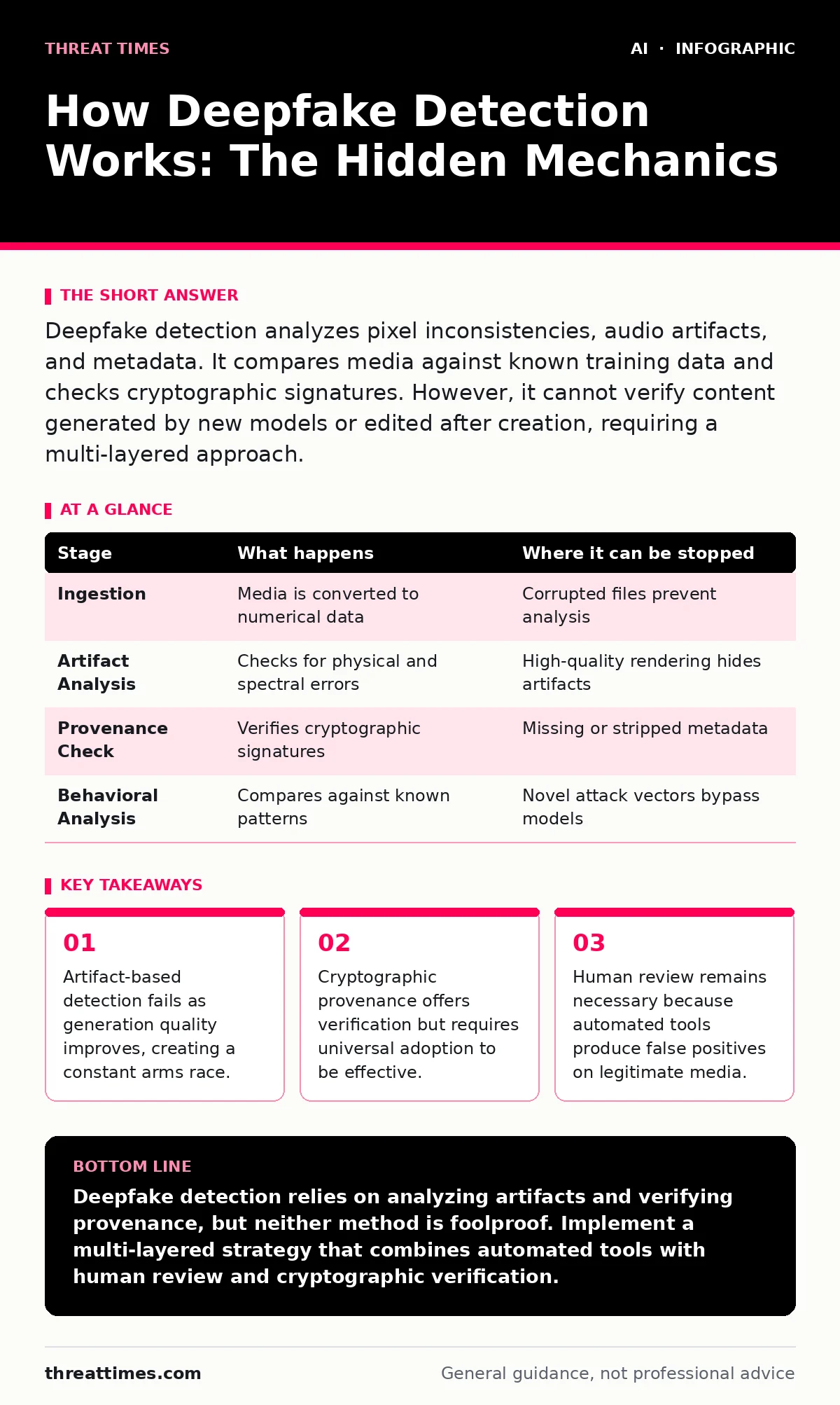
Deepfake detection analyzes pixel inconsistencies, audio artifacts, and metadata. It compares media against known training data and checks cryptographic signatures. However, it cannot verify content generated by new models or edited after creation, requiring a multi-layered approach.
The Illusion of Perfection
Deepfake technology relies on neural networks to map one identity onto another. These systems learn facial structures, voice patterns, and movement dynamics from vast datasets. The result is media that appears authentic to the human eye and ear. Detection must therefore look for subtle deviations that escape casual observation.
You cannot rely on visual inspection alone. Modern synthesis engines produce high-fidelity output that mimics natural skin texture and lighting. Detection systems must analyze the data at a level invisible to viewers. This requires understanding how the media was constructed, not just how it looks.
### Stage 1: Ingestion and Preprocessing
The detection pipeline begins with ingesting the media file. The system strips away superficial layers to examine the raw data. It converts video frames into numerical tensors, which are multidimensional arrays of data. This allows mathematical analysis of pixel relationships and temporal consistency.
Audio files undergo similar processing. The system isolates frequency bands and separates voice from background noise. This separation is critical because many deepfake artifacts appear in the non-voice frequencies. The preprocessing stage standardizes the input, ensuring the detection model receives consistent data regardless of the source format.
### Stage 2: Artifact Analysis
This stage searches for physical impossibilities in the media. Neural networks often struggle with peripheral details. Detection algorithms check for irregularities in eye blinking, lip synchronization, and hair movement. They also analyze skin texture for unnatural smoothness or repetitive patterns.
Audio analysis looks for spectral inconsistencies. Real voices have specific harmonic structures. Synthetic voices may lack these harmonics or exhibit unnatural pauses. The system compares the audio waveform against known characteristics of human speech. Any deviation flags the media for further review.
| Stage | What happens | Where it can be stopped |
|---|---|---|
| Ingestion | Media is converted to numerical data | Corrupted files prevent analysis |
| Artifact Analysis | Checks for physical and spectral errors | High-quality rendering hides artifacts |
| Provenance Check | Verifies cryptographic signatures | Missing or stripped metadata |
| Behavioral Analysis | Compares against known patterns | Novel attack vectors bypass models |
### Stage 3: Provenance Verification
Artifact analysis is becoming less reliable as generation quality improves. Provenance verification offers a more stable alternative. This method checks for cryptographic signatures embedded in the media file. These signatures prove the content originated from a trusted source.
Systems like Content Authenticity Initiative (CAI) standards allow creators to sign their work. The detection tool verifies the signature against a public key infrastructure. If the signature is valid, the media is trusted. If it is missing or invalid, the system flags it as unverified. This does not prove the content is fake, only that its origin is unknown.
### Stage 4: Behavioral and Contextual Analysis
This stage examines the content for logical inconsistencies. It checks if the subject’s behavior matches their known history. For example, a person who is known to be in one location cannot appear in another. The system cross-references the media with available public records and previous content.
It also analyzes the context of the media’s distribution. Sudden spikes in identical content across multiple platforms may indicate a coordinated campaign. The system looks for patterns in how the media spreads. This helps identify synthetic content that passes technical checks but lacks contextual validity.
### Stage 5: Model Comparison and Training
Detection models are trained on datasets of real and fake media. They learn to distinguish between the two by identifying common patterns. However, these models degrade over time. New generation techniques introduce artifacts that the model has never seen. This requires continuous retraining with fresh data.
The process involves feeding new examples of deepfakes into the model. The model adjusts its weights to recognize these new patterns. This creates a cycle of improvement and obsolescence. The detection system must stay ahead of the generation capabilities to remain effective.
### Stage 6: Human-in-the-Loop Review
Automated systems produce false positives and negatives. Human reviewers examine flagged content to confirm the results. They look for contextual clues that algorithms miss. They also assess the severity of the potential harm. This step ensures that legitimate media is not incorrectly labeled as fake.
Human review is slower and more expensive than automated analysis. However, it provides a necessary layer of judgment. It bridges the gap between technical detection and real-world impact. Without this step, detection systems risk causing more harm than good through incorrect flagging.
The Limits of Current Technology
Deepfake detection is not a silver bullet. It cannot verify content generated by models it has not seen. It cannot detect media that has been edited after creation. It relies on the integrity of the source and the metadata. As generation tools become more accessible, the volume of synthetic media will increase.
The cost of detection rises as the quality of fakes improves. Organizations must invest in continuous monitoring and retraining. They must also educate users on the limitations of automated tools. Trust cannot be outsourced entirely to algorithms. A combination of technical controls and human judgment is required.
Integrating Detection into Security
Detection must be part of a broader security strategy. It should work alongside other controls. For example, understanding AI hallucinations helps explain why generated content may contain factual errors. Recognizing these errors can serve as an additional signal for detection.
Organizations should also consider AI security testing to evaluate their own systems against synthetic attacks. This includes testing voice verification systems against voice cloning scams. By simulating attacks, you can identify weaknesses in your detection pipeline. This proactive approach strengthens your overall security posture.
Furthermore, prompt injection attacks can manipulate AI systems to generate or bypass detection. Understanding these attack vectors helps you harden your systems. You must ensure that your detection models are not easily fooled by adversarial inputs. This requires ongoing vigilance and adaptation.
The Future of Verification
The future of deepfake detection lies in provenance and standards. Widespread adoption of cryptographic signing will make verification easier. However, this requires cooperation across the industry. Without universal adoption, gaps will remain.
Detection tools will become more sophisticated. They will use larger datasets and more advanced models. However, the arms race will continue. Attackers will find new ways to bypass detection. You must prepare for a future where verification is complex and ongoing.
Key takeaways
- Artifact-based detection fails as generation quality improves, creating a constant arms race.
- Cryptographic provenance offers verification but requires universal adoption to be effective.
- Human review remains necessary because automated tools produce false positives on legitimate media.
Deepfake detection relies on analyzing artifacts and verifying provenance, but neither method is foolproof. Implement a multi-layered strategy that combines automated tools with human review and cryptographic verification.
Frequently asked questions
Can deepfake detection tools identify all types of synthetic media?
No. Detection tools struggle with novel generation techniques and media that has been edited after creation. They are most effective against known artifact patterns.
What is the role of cryptographic signatures in deepfake detection?
Cryptographic signatures verify the origin of the media. They do not prove the content is real, but they confirm it has not been altered since signing.
How often should detection models be retrained?
Detection models should be retrained continuously. As new generation techniques emerge, models must be updated to recognize new artifact patterns.
Is human review necessary for deepfake detection?
Yes. Human review is necessary to handle false positives and negatives. It provides contextual judgment that automated systems cannot replicate.
How this guide was produced: written by the Threat Times editorial team with AI assistance, checked against the public references listed below, and reviewed when the facts change. See our editorial policy or report an error.