How AI Security Testing Works: The Mechanics Behind the Checks
Automated testing reveals that model weights often leak training data more easily than application code exposes memory buffers.

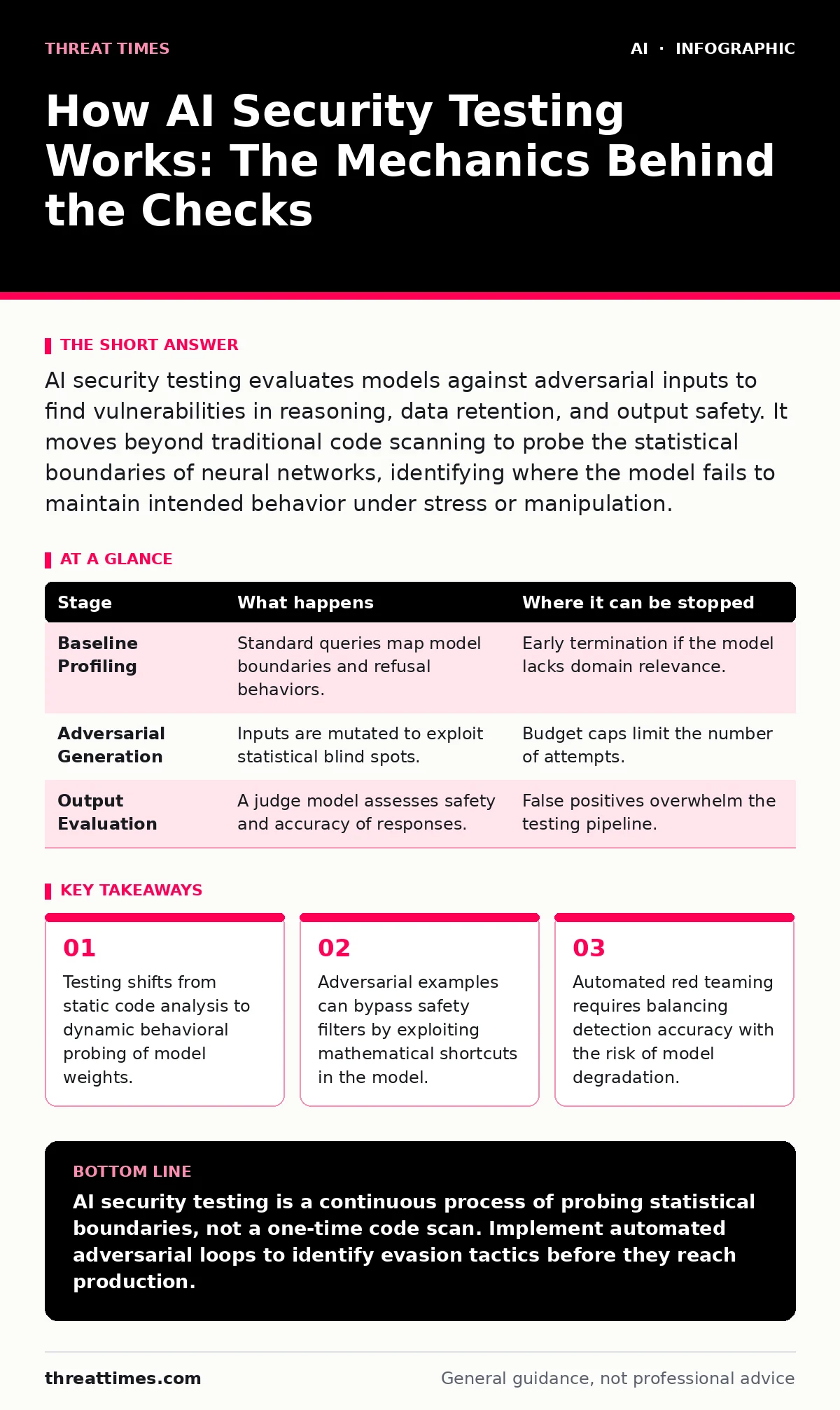
AI security testing evaluates models against adversarial inputs to find vulnerabilities in reasoning, data retention, and output safety. It moves beyond traditional code scanning to probe the statistical boundaries of neural networks, identifying where the model fails to maintain intended behavior under stress or manipulation.
The Shift from Code to Behavior
Traditional software security relies on finding syntax errors, buffer overflows, or logic flaws in source code. You scan the instructions the computer executes. AI security testing operates on a different premise. You are not scanning instructions; you are probing a statistical approximation. The model does not follow if-then rules. It predicts the next likely token based on patterns learned during training.
This fundamental difference changes the attack surface. Instead of looking for a missing semicolon, you look for inputs that cause the model to deviate from its intended behavior. The goal is to identify where the model’s internal representation of reality diverges from the safety constraints applied to it.
The Architecture of the Test Loop
The testing process is iterative and automated. You generate inputs, feed them to the model, evaluate the output, and refine the inputs based on the result. This loop continues until the model either behaves safely or reveals a vulnerability. The complexity lies in the evaluation step. Determining whether an output is malicious requires its own model, often called a judge or evaluator.
This creates a nested system. One model generates the attack, another executes it, and a third assesses the damage. Each layer introduces potential failure points. If the judge model is too lenient, it misses real vulnerabilities. If it is too strict, it flags benign outputs as dangerous, creating noise that obscures real issues.
### Stage 1: Baseline Behavioral Profiling
Before attempting to break the model, you must understand how it behaves under normal conditions. This stage involves feeding the model standard queries across its intended domain. You map the boundaries of its capabilities. You note where it refuses to answer, where it provides vague responses, and where it offers detailed information.
This baseline serves two purposes. It establishes a reference point for detecting anomalies. It also identifies areas of high confidence where the model is most likely to engage with complex inputs. Attackers often target these high-confidence areas because the model’s internal logic is most active there.
| Stage | What happens | Where it can be stopped |
|---|---|---|
| Baseline Profiling | Standard queries map model boundaries and refusal behaviors. | Early termination if the model lacks domain relevance. |
| Adversarial Generation | Inputs are mutated to exploit statistical blind spots. | Budget caps limit the number of attempts. |
| Output Evaluation | A judge model assesses safety and accuracy of responses. | False positives overwhelm the testing pipeline. |
### Stage 2: Adversarial Input Generation
This is the core of the testing mechanism. You create inputs designed to trick the model. These inputs may appear benign to a human but cause the model to misinterpret the intent. Techniques include obfuscation, where keywords are hidden in complex sentence structures, or jailbreaking, where the user frames the request as a hypothetical scenario or role-play.
The generator uses its own understanding of language to craft these inputs. It iterates rapidly, trying thousands of variations. The goal is to find the specific combination of words that bypasses the safety filters. This is not random guessing. It is a directed search through the space of possible inputs, guided by the model’s previous responses.
### Stage 3: Output Evaluation and Judgement
Once the model responds, you must determine if the response is safe. This is where the judge model comes in. The judge evaluates the output against a set of predefined rules. It checks for hate speech, dangerous instructions, or private data leakage. The judge does not just look at the final answer. It analyzes the reasoning path the model took to get there.
This evaluation is difficult because language is nuanced. A model might refuse a direct request to create malware but provide detailed instructions when asked to write a fictional story about a hacker. The judge must recognize that the underlying intent is the same. Context matters. The judge must understand the semantic meaning, not just the surface-level words.
The Hidden Cost of Safety Filters
Adding safety filters introduces a new vulnerability: evasion. Attackers study the filters to learn their boundaries. They then craft inputs that sit just outside the filter’s detection range. This is known as adversarial evasion. The more complex the filter, the more opportunities there are to find loopholes.
This creates a trade-off. Tighter filters reduce the risk of harmful output but increase the risk of false positives. Users may find the model overly restrictive, refusing legitimate requests. This degradation in usability can lead to users bypassing the system entirely or using workarounds that are less secure.
Limits of Automated Testing
Automated testing cannot cover every possible input. The space of natural language is infinite. You can only test a sample. This means some vulnerabilities will remain hidden. Additionally, models can change their behavior over time as they are updated or fine-tuned. A vulnerability that is closed today may reappear tomorrow if the update changes the underlying weights.
Testing also struggles with novel attack vectors. If an attacker discovers a new method of manipulation, the automated tests may not recognize it until the detection rules are updated. This lag between discovery and detection is a persistent risk. Human oversight remains necessary to catch attacks that fall outside the automated parameters.
Integration with Defense Layers
Testing does not happen in isolation. It feeds into the broader security architecture. Findings from testing inform the development of LLM guardrails. These guardrails act as pre-processing and post-processing layers. They filter inputs before they reach the model and sanitize outputs before they reach the user.
This integration is critical. Testing identifies the weaknesses; guardrails address them. However, guardrails themselves can be bypassed. This is why continuous testing is necessary. As attackers develop new techniques, the guardrules must evolve. This creates a cycle of improvement. The system becomes more secure, but the attacks become more sophisticated.
Understanding the Model Internals
To test effectively, you must understand how the model works. Neural networks process input through multiple layers of abstraction. Each layer extracts different features. Early layers recognize basic syntax. Later layers understand semantics and context. Attacks often target specific layers.
For instance, an attack might target the attention mechanism, which determines which parts of the input are most relevant. By manipulating the attention weights, an attacker can cause the model to focus on irrelevant information, leading to incorrect or unsafe outputs. Understanding these internals allows you to craft more effective tests.
Data Integrity and Poisoning
Security testing also extends to the training data. If the data is compromised, the model learns malicious behaviors. This is known as data poisoning. Testing for this involves analyzing the training dataset for anomalies. You look for inputs that seem out of place or designed to influence specific outcomes.
This is a proactive measure. Once a model is trained, it is difficult to remove the influence of poisoned data. Testing the data before training is more effective than testing the model after. This requires rigorous data validation pipelines. You must verify the source and integrity of every piece of data.
Key takeaways
- Testing shifts from static code analysis to dynamic behavioral probing of model weights.
- Adversarial examples can bypass safety filters by exploiting mathematical shortcuts in the model.
- Automated red teaming requires balancing detection accuracy with the risk of model degradation.
AI security testing is a continuous process of probing statistical boundaries, not a one-time code scan. Implement automated adversarial loops to identify evasion tactics before they reach production.
Frequently asked questions
How does AI security testing differ from traditional penetration testing?
Traditional testing exploits code vulnerabilities like buffer overflows. AI testing exploits statistical weaknesses in pattern recognition, requiring adversarial inputs rather than exploit code.
Can automated testing replace human red teamers?
No. Automated tools can scale testing but lack the creativity and contextual understanding of humans. They work best when combined with human oversight to catch novel attack vectors.
What is the role of LLM guardrails in security testing?
Guardrails act as filters for inputs and outputs. Testing evaluates their effectiveness by attempting to bypass them with adversarial inputs, ensuring they catch malicious intent without blocking legitimate use.
How do you test for data poisoning attacks?
You analyze training datasets for anomalies and outliers before training. This proactive approach prevents the model from learning malicious behaviors embedded in compromised data sources.
How this guide was produced: written by the Threat Times editorial team with AI assistance, checked against the public references listed below, and reviewed when the facts change. See our editorial policy or report an error.