Service Mesh Security: Answers to Eight Critical Questions
A service mesh encrypts traffic between services but cannot verify the integrity of the application code running inside those services.

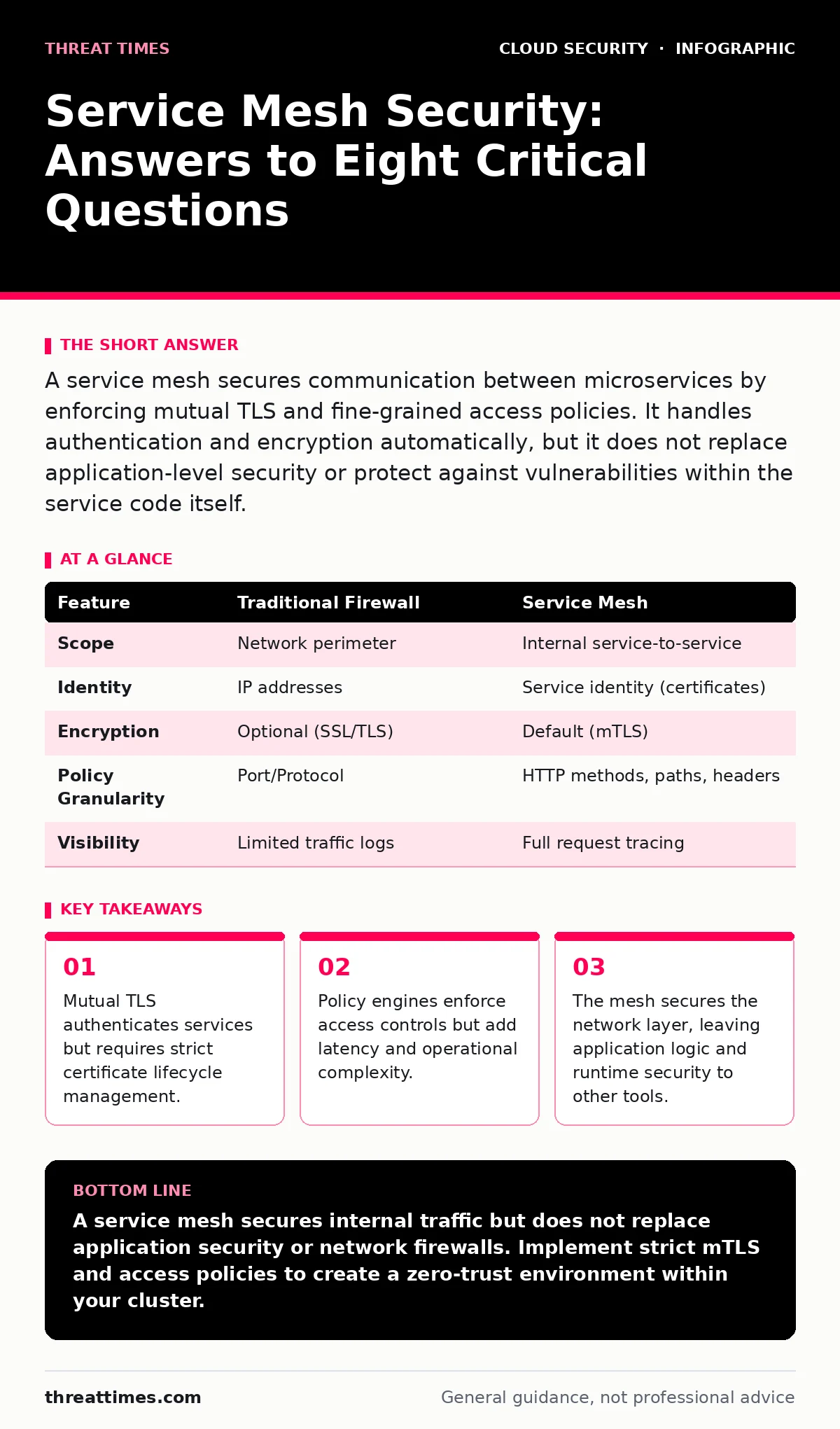
A service mesh secures communication between microservices by enforcing mutual TLS and fine-grained access policies. It handles authentication and encryption automatically, but it does not replace application-level security or protect against vulnerabilities within the service code itself.
Does a service mesh replace traditional firewalls?
A service mesh does not replace traditional firewalls because it operates at a different layer of the stack. Firewalls filter traffic based on IP addresses and ports at the network perimeter, while a service mesh manages traffic between individual microservices within the cluster. You use a mesh to enforce policies between services that trust each other, whereas firewalls protect the boundary of your infrastructure. Relying solely on a mesh leaves your external ingress points vulnerable to broad network attacks.
How does mutual TLS work in a service mesh?
Mutual TLS, or mTLS, requires both the client and the server to present digital certificates to prove their identity before data is exchanged. The service mesh sidecar proxy, which runs alongside each application container, automatically handles the generation, rotation, and validation of these certificates. This ensures that every service communicating with another is verified and that all traffic is encrypted in transit. This mechanism prevents eavesdropping and man-in-the-middle attacks within your internal network.
Can a service mesh prevent unauthorized service access?
A service mesh can enforce strict access controls by integrating with policy engines that define which services are allowed to talk to each other. You configure rules that specify source and destination services, along with the HTTP methods and paths they can access. If a service attempts to communicate with a forbidden target, the sidecar proxy blocks the request. This creates a zero-trust environment where no service is trusted by default, even if it is compromised.
What performance impact does a service mesh have?
Every request passing through a service mesh incurs a small latency penalty because the sidecar proxy must intercept, inspect, and forward the traffic. The proxy also consumes CPU and memory resources, which reduces the capacity available for your actual application logic. The overhead varies depending on the mesh implementation and the volume of traffic, but it is generally measurable in milliseconds. You must account for this cost when designing high-throughput applications that require sub-millisecond response times.
How does a service mesh handle service discovery?
The service mesh maintains a real-time view of all services and their current network locations, allowing it to route traffic dynamically. It queries the underlying platform, such as Kubernetes, to find the IP addresses and ports of available service instances. This abstraction means your applications do not need to hardcode network details or manage connection state manually. If a service instance fails or scales up, the mesh automatically updates its routing tables without requiring application changes.
Is a service mesh sufficient for securing external APIs?
A service mesh primarily secures internal traffic between microservices and is not designed to handle external API security directly. External traffic typically enters through an API gateway or ingress controller, which handles public-facing authentication, rate limiting, and SSL termination. You should use the mesh to secure the path from the gateway to the backend services, ensuring end-to-end encryption. Combining an API gateway with a service mesh provides layered defense for both external and internal communication.
How does a service mesh support observability?
The sidecar proxies collect detailed telemetry data for every request, including latency, error rates, and traffic volume. This data is aggregated and sent to monitoring tools, providing deep visibility into the health and performance of your microservices. You can trace a single request as it hops across multiple services, identifying bottlenecks or failures in complex dependencies. This level of granularity is difficult to achieve with traditional monitoring tools that only observe network endpoints.
What are the operational challenges of running a service mesh?
Managing a service mesh adds complexity to your deployment pipeline and requires expertise in distributed systems. You must configure and maintain the control plane, which manages the sidecar proxies and enforces policies across the cluster. Troubleshooting issues can be difficult because errors may originate from the application, the proxy, or the network configuration. Teams must adopt rigorous testing and monitoring practices to avoid introducing instability or security gaps during updates.
| Feature | Traditional Firewall | Service Mesh |
|---|---|---|
| Scope | Network perimeter | Internal service-to-service |
| Identity | IP addresses | Service identity (certificates) |
| Encryption | Optional (SSL/TLS) | Default (mTLS) |
| Policy Granularity | Port/Protocol | HTTP methods, paths, headers |
| Visibility | Limited traffic logs | Full request tracing |
How does a service mesh interact with container security?
A service mesh secures the communication between containers but does not protect the container images or runtime environment. You still need to scan images for vulnerabilities, limit container privileges, and enforce least-privilege access for service accounts. The mesh assumes that the services themselves are trusted, so a compromised container can still exploit the application logic. Integrating the mesh with broader cloud security groups ensures that network policies align with identity and access controls.
Can a service mesh help with compliance requirements?
A service mesh provides the technical controls needed to meet many compliance standards by enforcing encryption and access logging. It generates audit trails for service interactions, which helps demonstrate adherence to policies regarding data protection and least privilege. However, compliance also requires proper configuration management and regular reviews of access policies. You must combine mesh capabilities with cloud identity governance to ensure that human and service accounts are properly vetted.
Key takeaways
- Mutual TLS authenticates services but requires strict certificate lifecycle management.
- Policy engines enforce access controls but add latency and operational complexity.
- The mesh secures the network layer, leaving application logic and runtime security to other tools.
A service mesh secures internal traffic but does not replace application security or network firewalls. Implement strict mTLS and access policies to create a zero-trust environment within your cluster.
Frequently asked questions
Does a service mesh protect against DDoS attacks?
A service mesh can help mitigate some internal DDoS attacks by enforcing rate limits and blocking unauthorized traffic, but it does not replace dedicated DDoS protection services for external threats.
How do I choose between sidecar and proxyless service mesh?
Sidecar meshes offer broader compatibility and easier policy enforcement but add overhead, while proxyless meshes reduce latency and resource usage but require deeper integration with your application frameworks.
Can a service mesh enforce data loss prevention policies?
A service mesh can block traffic based on policies but cannot inspect the content of the data for sensitive information. You need additional tools like API gateways or specialized DLP solutions to scan payload content.
What happens to traffic if the sidecar proxy crashes?
If the sidecar proxy crashes, the application may lose connectivity to other services, depending on the mesh configuration. Most meshes implement health checks and automatic restarts to minimize downtime, but your application should handle connection timeouts gracefully.
How this guide was produced: written by the Threat Times editorial team with AI assistance, checked against the public references listed below, and reviewed when the facts change. See our editorial policy or report an error.