Generative AI Examples: Mechanisms, Risks and Control
Generative systems learn statistical patterns from training data to create novel outputs, creating new attack surfaces for data exfiltration and prompt injection.

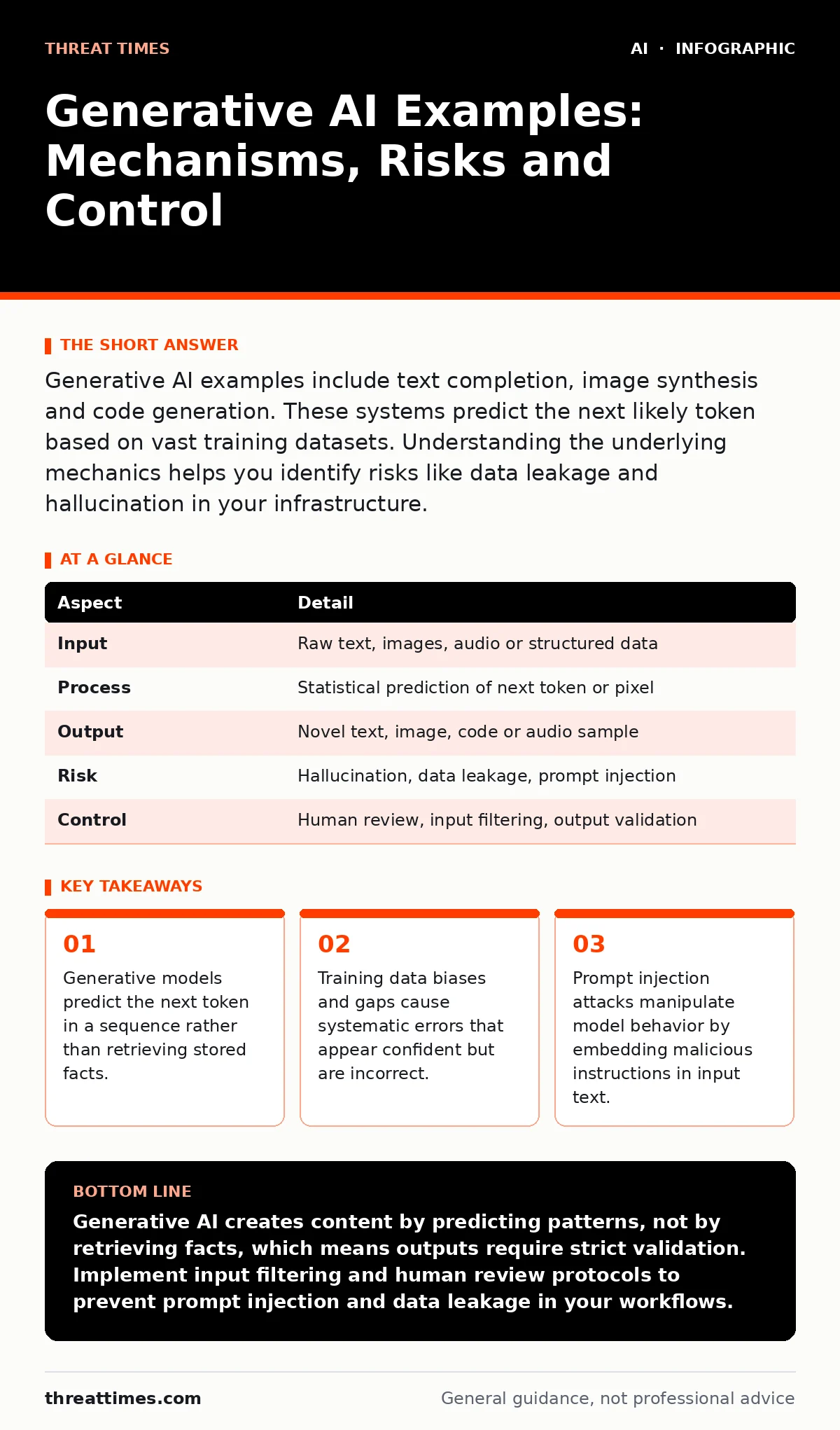
Generative AI examples include text completion, image synthesis and code generation. These systems predict the next likely token based on vast training datasets. Understanding the underlying mechanics helps you identify risks like data leakage and hallucination in your infrastructure.
Generative AI Examples in Practice
Generative AI examples range from drafting technical documentation to synthesizing realistic images from text descriptions. These systems do not store copies of their training data. Instead, they learn statistical relationships between inputs and outputs to produce novel content that matches the patterns in their training set.
Consider a software development team using a model to generate boilerplate code. The system produces syntactically correct functions that handle common edge cases. This output saves time but introduces a dependency on the model’s internal logic. You must verify that the generated code does not contain subtle vulnerabilities or licensing issues inherited from the training corpus.
Another common generative AI example is automated report writing. A security analyst inputs raw log data and receives a narrative summary of anomalies. The model structures the information clearly but may misinterpret the severity of specific events. The output provides a starting point for analysis, not a final determination of risk.
| Aspect | Detail |
|---|---|
| Input | Raw text, images, audio or structured data |
| Process | Statistical prediction of next token or pixel |
| Output | Novel text, image, code or audio sample |
| Risk | Hallucination, data leakage, prompt injection |
| Control | Human review, input filtering, output validation |
How Generative Systems Work
The core mechanism behind generative AI is probabilistic prediction. The system processes input through multiple layers of artificial neural networks, which are computational structures inspired by biological brains. Each layer extracts features from the input, transforming raw data into abstract representations.
The final layer predicts the most likely next element in a sequence. For text, this element is a word or a sub-word token. For images, it is a pixel or a block of pixels. The model selects the next element based on weights learned during training. These weights represent the strength of associations between different features in the training data.
This process creates a chain of dependencies. Each prediction influences the next one. If the model makes an early error, subsequent predictions may drift further from the intended meaning. This compounding effect explains why long outputs often contain inconsistencies or factual errors, even when the initial prompt was precise.
Who Is Affected by Generative AI
Every organization that uses digital communication is affected by generative AI. The technology changes the cost and speed of creating both benign and malicious content. Attackers use these tools to craft highly personalized phishing emails that mimic the writing style of trusted colleagues. This reduces the effectiveness of traditional signature-based email filters.
Defense teams use similar tools to automate threat hunting and analyze large volumes of log data. The balance of power shifts toward those who can verify authenticity. You must assume that any digital content, including images and voice recordings, could be synthetically generated. This assumption changes how you design verification processes for high-value transactions and access requests.
Supply chains face new risks when developers use AI to write code. If the training data contains vulnerable code patterns, the model may reproduce those vulnerabilities. This creates a widespread propagation of known security flaws. You need to integrate static analysis and dynamic testing into your development pipeline to catch these inherited weaknesses.
What People Usually Get Wrong
Many users believe that generative models retrieve information from a database. This misconception leads to overconfidence in the factual accuracy of the output. The model generates text based on likelihood, not truth. It can construct a coherent sentence that is entirely fabricated. This phenomenon is known as hallucination.
Another common error is assuming that the model understands context. The model processes tokens sequentially without a global understanding of the document. It may miss subtle contradictions or logical errors that span multiple paragraphs. You cannot rely on the model to catch logical inconsistencies in complex documents without explicit instruction.
Users often neglect the security of the model interface. They treat the API endpoint as a trusted service. This ignores the risk of prompt injection attacks, where an attacker embeds malicious instructions in the input data. The model follows these instructions, potentially leaking sensitive data or performing unauthorized actions. You must sanitize all inputs and monitor outputs for anomalous behavior.
Mitigating Generative AI Risks
Start by treating generative output as untrusted input. Never pass AI-generated content directly to production systems without human review or automated validation. Implement strict input filtering to remove potential prompt injection payloads. This includes checking for hidden characters, unusual formatting and embedded commands.
Use output validation to catch hallucinations and policy violations. Compare generated text against known facts where possible. Flag outputs that contain specific keywords or patterns associated with sensitive data. This adds a layer of defense against accidental data leakage. You should also log all interactions with the model for audit purposes.
Consider the trade-offs between convenience and security. Allowing unrestricted access to public generative models increases the risk of data exfiltration. Employees may paste confidential information into the prompt, assuming it is private. Many public models use user inputs to improve their training data. This creates a permanent record of your confidential information.
Advanced Threat Vectors
Prompt injection attacks represent a significant evolution in social engineering. An attacker embeds instructions within the data that the model processes. For example, a malicious website might contain hidden text that instructs the browser’s AI assistant to ignore previous commands. This allows the attacker to take control of the AI’s behavior.
Model theft is another emerging threat. Attackers query a model extensively to reconstruct its weights or training data. This is difficult but not impossible for large models. If you expose an API endpoint for your proprietary model, you must rate-limit queries and monitor for unusual patterns. Exposed AI model servers are prime targets for this type of extraction.
Deepfake detection remains an arms race. As generation quality improves, detection methods must adapt. Current techniques rely on analyzing artifacts in the generated content, such as inconsistencies in lighting or texture. These artifacts become harder to detect as models improve. You should not rely solely on technical detection. Multi-factor authentication and out-of-band verification are more reliable controls.
Operational Best Practices
Define clear policies for using generative AI within your organization. Specify which data can be processed by which models. Prohibit the use of public models for sensitive data. Provide approved internal tools that do not retain user inputs. This reduces the risk of accidental data leakage while allowing employees to benefit from the technology.
Train your staff to recognize the limitations of AI. They should understand that the model can be wrong, biased or manipulated. Encourage a culture of verification. When using AI for code generation, developers must review the code for security flaws and licensing issues. When using AI for communication, staff must verify facts before publishing.
Monitor for AI-generated phishing attacks. Traditional filters look for known malicious URLs or attachments. AI-generated phishing relies on social engineering and convincing text. You need to train users to scrutinize the content of emails, even if they appear to come from trusted sources. Look for subtle inconsistencies in tone or context.
Key takeaways
- Generative models predict the next token in a sequence rather than retrieving stored facts.
- Training data biases and gaps cause systematic errors that appear confident but are incorrect.
- Prompt injection attacks manipulate model behavior by embedding malicious instructions in input text.
Generative AI creates content by predicting patterns, not by retrieving facts, which means outputs require strict validation. Implement input filtering and human review protocols to prevent prompt injection and data leakage in your workflows.
Frequently asked questions
Can generative AI access my private files?
The model itself does not have access to your local files unless you explicitly upload them. However, if you paste file contents into a public AI tool, that data may be processed by the service provider and potentially used for training future models.
How do I detect if an image is AI-generated?
Look for inconsistencies in lighting, shadows, and texture, especially in complex areas like hands or text. AI models often struggle with these details, leaving subtle artifacts that indicate synthetic origin. Technical analysis tools can also identify statistical patterns unique to generative models.
Is prompt injection a real security threat?
Yes, prompt injection is a real threat that allows attackers to manipulate AI behavior. By embedding malicious instructions in input data, attackers can bypass safety filters, extract sensitive information or force the model to perform unauthorized actions. You must sanitize all inputs to mitigate this risk.
Should I use public or private AI models?
Use private or on-premises models for sensitive data to prevent leakage. Public models are convenient but often use user inputs for training, which can expose confidential information. If you use public models, never input sensitive data and verify all outputs carefully.
How this guide was produced: written by the Threat Times editorial team with AI assistance, checked against the public references listed below, and reviewed when the facts change. See our editorial policy or report an error.