Exposed AI Model Servers Prevention Checklist
Unprotected inference endpoints allow attackers to extract proprietary model weights without triggering traditional firewall alerts.

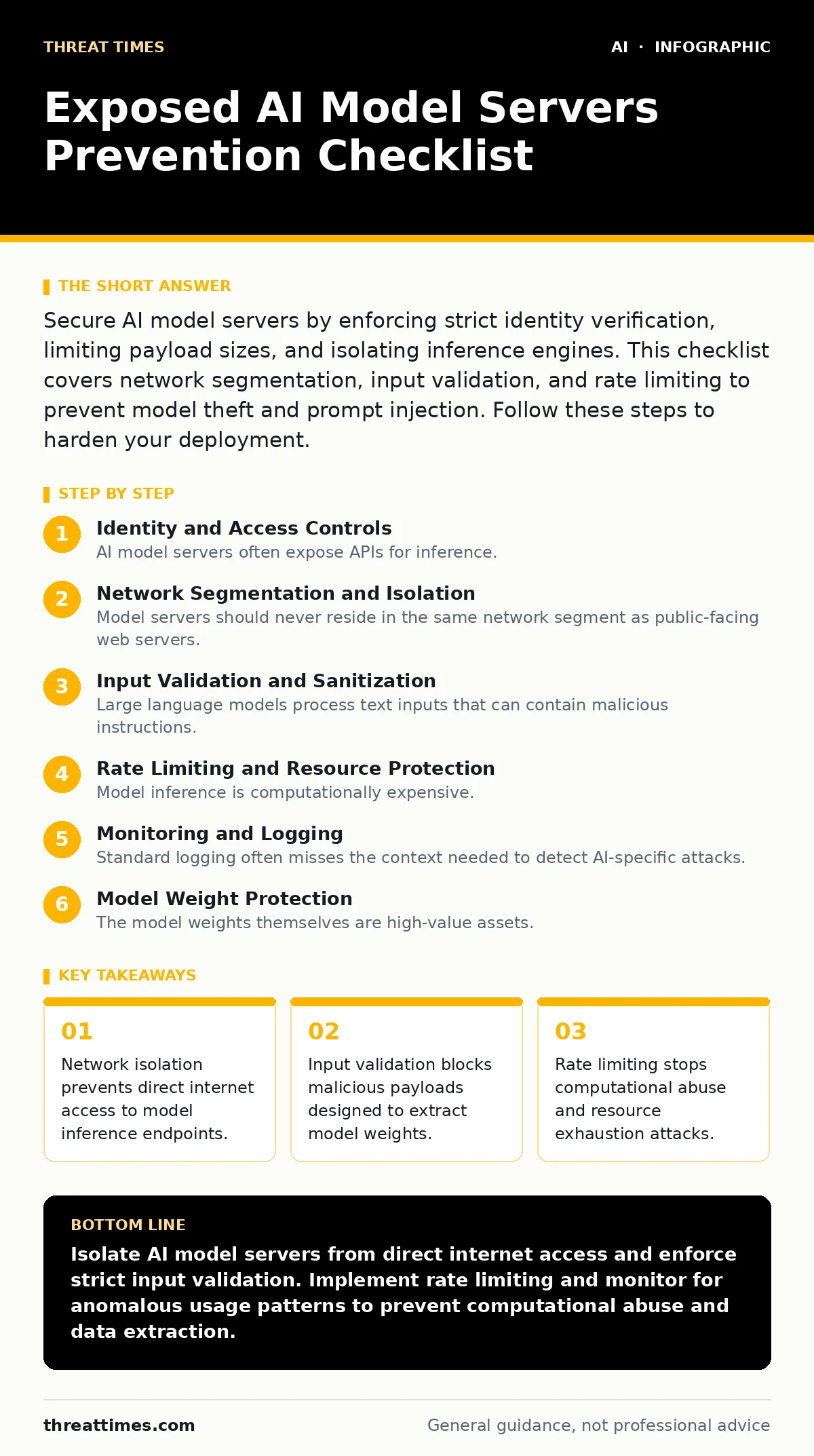
Secure AI model servers by enforcing strict identity verification, limiting payload sizes, and isolating inference engines. This checklist covers network segmentation, input validation, and rate limiting to prevent model theft and prompt injection. Follow these steps to harden your deployment.
Identity and Access Controls
AI model servers often expose APIs for inference. These endpoints require strict identity verification to prevent unauthorized access. Standard web authentication is insufficient because attackers can automate requests at scale. You must implement mutual transport layer security (mTLS) to verify both the client and server. This prevents man-in-the-middle attacks during data transmission.
- Enforce mTLS: Verify client certificates before processing any inference request to ensure only authorized services connect.
- Rotate API keys frequently: Short-lived keys limit the window of opportunity if a credential leaks to an attacker.
- Disable default endpoints: Remove or rename standard health check and debug endpoints that reveal server configuration details.
Network Segmentation and Isolation
Model servers should never reside in the same network segment as public-facing web servers. Attackers who compromise a web application can pivot to adjacent systems if network boundaries are weak. Place inference engines in a private subnet with no direct internet route. Use a reverse proxy to handle external traffic and forward only validated requests to the model server. This creates a barrier between the public internet and your core AI infrastructure.
- Place models in private subnets: Deny direct inbound traffic from the internet to the server hosting the model weights.
- Use a reverse proxy: Terminate SSL connections at the proxy layer and inspect headers before forwarding requests to the backend.
- Restrict outbound connections: Prevent the model server from initiating connections to external domains to stop data exfiltration.
Input Validation and Sanitization
Large language models process text inputs that can contain malicious instructions. Attackers use prompt injection to trick the model into revealing system prompts or sensitive data. You must validate all inputs for length, structure, and content. Strip out any unexpected metadata or control characters before the input reaches the model. This reduces the attack surface for injection techniques.
- Limit token count: Enforce a maximum length for user inputs to prevent resource exhaustion and buffer overflow attempts.
- Sanitize structured data: Remove XML tags, JSON structures, or other code-like patterns from plain text inputs destined for the model.
- Block system prompts: Detect and reject inputs that attempt to override the model's system instructions or context.
Rate Limiting and Resource Protection
Model inference is computationally expensive. Attackers can abuse exposed endpoints to perform denial-of-service attacks or extract model weights through careful querying. Implement rate limiting at the application layer to control request volume. Tie these limits to user identity or API key rather than IP address, as IP addresses are easily spoofed. This protects your infrastructure from both accidental overload and deliberate abuse.
- Set request quotas: Define a maximum number of requests per minute per user to prevent computational abuse.
- Implement circuit breakers: Automatically shut down the endpoint if error rates spike, protecting the server from cascading failures.
- Monitor token usage: Track the total tokens consumed per user to detect anomalies that suggest model extraction attempts.
Monitoring and Logging
Standard logging often misses the context needed to detect AI-specific attacks. You must log input hashes, not the raw text, to maintain privacy while enabling forensic analysis. Record response times and error codes to identify performance degradation caused by malicious queries. Integrate these logs with your security information and event management system. This allows for real-time detection of suspicious activities targeting your AI infrastructure.
- Log input hashes: Store cryptographic hashes of user inputs to correlate events without exposing sensitive data in logs.
- Track model performance: Monitor latency spikes that may indicate complex adversarial inputs or extraction attempts.
- Alert on anomalous behavior: Set thresholds for unusual request patterns that deviate from normal user behavior.
For deeper insights into adversarial techniques, review the MITRE ATLAS framework. Understanding these tactics helps you prioritize which controls to implement first.
Model Weight Protection
The model weights themselves are high-value assets. If an attacker gains read access to the file system, they can copy the weights and replicate your model. Encrypt model files at rest and ensure that the inference engine loads them into memory without writing them to disk. Restrict file permissions to the least privilege necessary. This prevents local privilege escalation from leading to model theft.
- Encrypt files at rest: Use strong encryption standards for stored model weights to protect them if the disk is compromised.
- Run as non-root: Execute the inference service with minimal privileges to limit the impact of a successful exploit.
- Disable debug modes: Ensure that diagnostic interfaces are disabled in production environments to prevent information leakage.
Refer to our guide on AI model theft for strategies on detecting and responding to weight exfiltration. Protecting the underlying asset is as important as securing the API.
Key takeaways
- Network isolation prevents direct internet access to model inference endpoints.
- Input validation blocks malicious payloads designed to extract model weights.
- Rate limiting stops computational abuse and resource exhaustion attacks.
Isolate AI model servers from direct internet access and enforce strict input validation. Implement rate limiting and monitor for anomalous usage patterns to prevent computational abuse and data extraction.
Frequently asked questions
How do I detect prompt injection attacks?
Monitor for outputs that deviate from expected formats or contain system-level instructions. Use behavioral analytics to flag unusual request patterns.
What is mutual TLS in this context?
Mutual TLS requires both the client and server to present certificates. This ensures that only authorized, verified clients can communicate with the model server.
How this guide was produced: written by the Threat Times editorial team with AI assistance, checked against the public references listed below, and reviewed when the facts change. See our editorial policy or report an error.