Stop AI Model Theft: Practical Controls to Protect Intellectual Property
Watermarking fails against extraction attacks, while input validation and output limiting provide measurable barriers to unauthorized model replication.

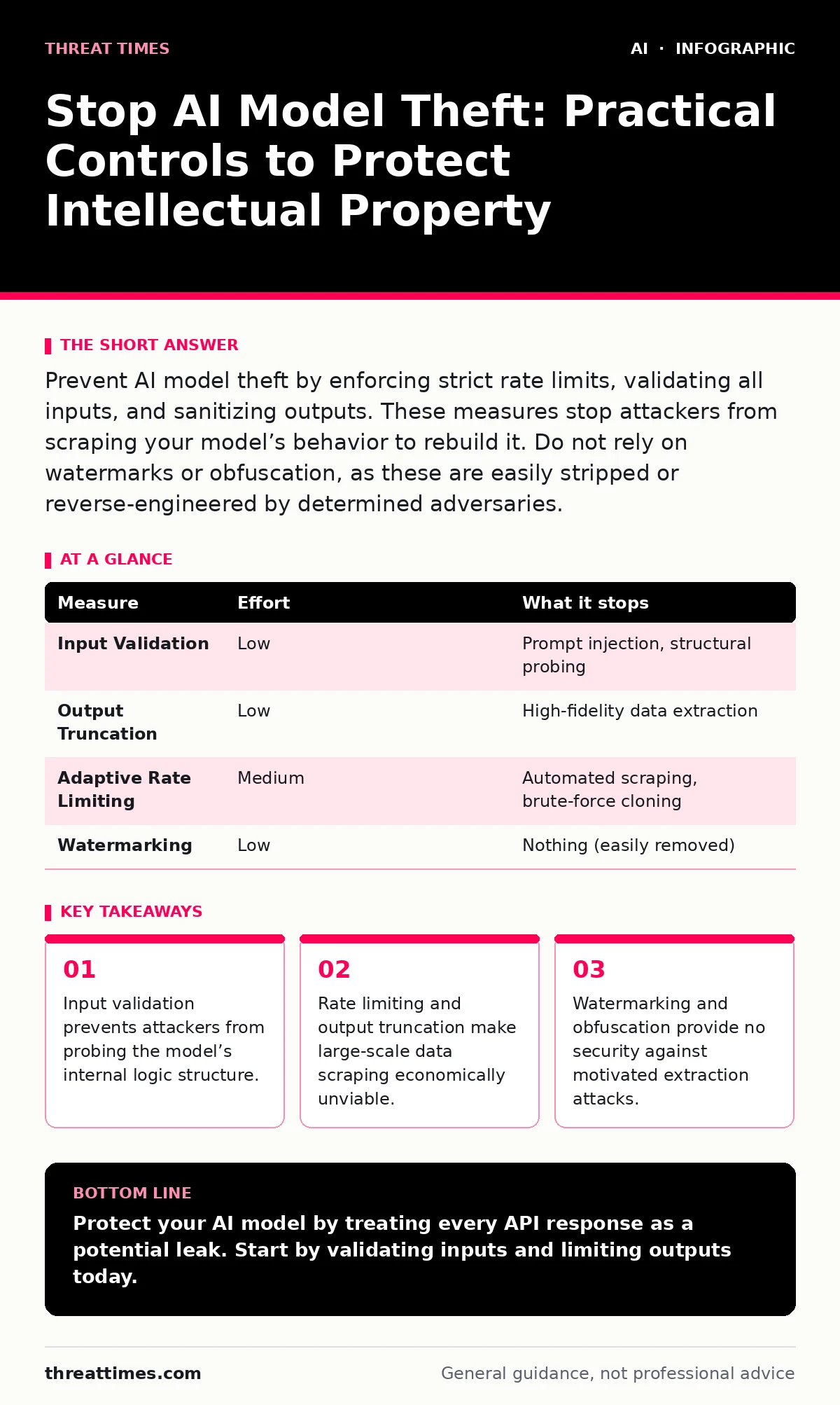
Prevent AI model theft by enforcing strict rate limits, validating all inputs, and sanitizing outputs. These measures stop attackers from scraping your model’s behavior to rebuild it. Do not rely on watermarks or obfuscation, as these are easily stripped or reverse-engineered by determined adversaries.
The Mechanics of Model Extraction
Model theft rarely involves breaking into your server and copying files. Instead, attackers treat your AI as a black box oracle. They send thousands of queries, record the responses, and use that data to train a smaller, cheaper copy of your model. This process, known as model inversion or extraction, replicates your intellectual property without ever touching your infrastructure.
Suppose you offer a premium code-completion service. An attacker writes a script to submit every possible code snippet, records your model’s completions, and trains a local clone. They now offer the same service for free, undercutting your business. This theft relies entirely on your willingness to return detailed outputs to unverified requests.
Understanding this vector changes how you design defenses. You cannot secure the model file if the attacker never sees it. You must secure the interface between the user and the model. The goal is to make the cost of extraction higher than the value of the stolen model.
Input Validation as a Defense Layer
Standard web application security focuses on stopping injection attacks. In AI systems, input validation serves a dual purpose. It prevents prompt injection attacks, where users trick the model into revealing instructions or hidden data. It also limits the attack surface for extraction attempts.
By restricting inputs to specific formats, lengths, and vocabularies, you reduce the diversity of data an attacker can harvest. If your model only accepts structured JSON for financial queries, an attacker cannot send arbitrary text to probe for edge cases. This constraint forces the attacker to work within a narrow band of possibilities, making it harder to map the full decision boundary of your model.
Implement strict schema validation before any request reaches the inference engine. Reject requests that deviate from expected patterns. This is not just about data quality; it is a security control that limits the information leakage inherent in every API call.
Limiting Output Exposure
The more detail your model returns, the easier it is to clone. Long, nuanced, or highly specific responses contain the fingerprint of your model’s training and architecture. Attackers use these details to fine-tune their replicas. Truncating outputs or providing only high-level summaries reduces the signal-to-noise ratio for the attacker.
Consider a medical diagnosis tool. Returning a detailed differential diagnosis with confidence scores for every condition provides rich data for an extractor. Returning only a recommended treatment plan or a binary "refer to specialist" flag removes much of that utility. You lose some user convenience, but you gain significant protection against reverse engineering.
Define the minimum viable output for each use case. Strip metadata, confidence intervals, and internal reasoning steps from the response. If the user does not need to know why the model made a decision, do not tell them. This principle of least privilege applies to model outputs just as it does to database records.
Rate Limiting and Anomaly Detection
Extraction requires volume. To build a faithful copy, an attacker needs thousands or millions of query-response pairs. Your primary defense against this volume is rate limiting. Standard API rate limiting stops casual scrapers, but sophisticated attackers use distributed networks to bypass simple counters.
Implement adaptive rate limiting that detects behavioral anomalies. A single user querying the same topic with slight variations is suspicious. A user querying every possible category in a short time is malicious. Machine learning models can analyze request patterns in real-time to flag and throttle abusive sessions.
This approach has a trade-off. Aggressive throttling can impact legitimate users with high usage needs. You must balance security with usability. Define clear tiers for your API, where higher access requires stricter identity verification and monitoring. Treat high-volume access as a privilege, not a default right.
| Measure | Effort | What it stops |
|---|---|---|
| Input Validation | Low | Prompt injection, structural probing |
| Output Truncation | Low | High-fidelity data extraction |
| Adaptive Rate Limiting | Medium | Automated scraping, brute-force cloning |
| Watermarking | Low | Nothing (easily removed) |
The Illusion of Obfuscation
Many teams believe that hiding the model architecture or encrypting the weights prevents theft. This is a misconception. In a black-box attack, the attacker does not need to see the weights. They only need to observe the input-output relationship. Encrypting the model file is good for data-at-rest security, but it does nothing to stop someone who is querying your live API.
Similarly, adding noise to outputs or using proxy servers does not stop extraction. Attackers can average out noise or route around proxies. The only way to protect the model is to limit the information it leaks through its behavior. Focus on the interface, not the implementation.
This distinction is vital for teams accustomed to traditional software security. In traditional code, you secure the binary. In AI, you secure the conversation. The model is the secret, but the conversation is the leak.
Integrating with Broader AI Security
Preventing model theft is one part of a larger strategy. You must also consider data poisoning attacks, where adversaries corrupt the training data to weaken the model or create backdoors. While this is a different threat vector, the defensive posture is similar: strict validation and monitoring.
You should also be aware of AI-generated phishing, which uses stolen models to create highly convincing social engineering attacks. If your model is stolen, it can be used to attack your customers. This makes theft a third-party risk, not just an intellectual property issue.
For a deeper look at these threats, see our guides on AI hallucinations and deepfake detection. Understanding how models fail helps you understand how they can be abused. Similarly, AI security testing methods can help you identify vulnerabilities in your model’s behavior before attackers do.
Immediate Action Steps
You do not need a major architecture overhaul to start protecting your models. Begin with the controls that are easiest to implement and provide the most immediate risk reduction. These steps address the most common and successful extraction techniques.
- Implement strict input validation schemas for all public-facing AI endpoints.
- Configure adaptive rate limiting to detect and throttle repetitive or diverse probing queries.
- Review API responses and remove unnecessary details, confidence scores, or reasoning traces.
These measures reduce the value of your model to an attacker by making extraction costly and incomplete. They are not perfect, but they raise the barrier to entry significantly. Combine them with regular AI security testing to ensure they remain effective as attack techniques evolve.
Key takeaways
- Input validation prevents attackers from probing the model’s internal logic structure.
- Rate limiting and output truncation make large-scale data scraping economically unviable.
- Watermarking and obfuscation provide no security against motivated extraction attacks.
Protect your AI model by treating every API response as a potential leak. Start by validating inputs and limiting outputs today.
Frequently asked questions
Can encryption prevent AI model theft?
Encryption protects the model file at rest, but it does not prevent attackers from cloning the model by querying the live API and recording responses.
Is watermarking effective for stopping model theft?
No, watermarking is designed for attribution after the fact. It does not prevent attackers from extracting and copying the model’s behavior.
How do I detect if my model is being extracted?
Look for unusual patterns in API logs, such as high-volume requests with diverse inputs or systematic probing of edge cases.
Does rate limiting impact legitimate users?
Yes, aggressive rate limiting can affect high-volume legitimate users. Use adaptive limiting and tiered access to balance security and usability.
How this guide was produced: written by the Threat Times editorial team with AI assistance, checked against the public references listed below, and reviewed when the facts change. See our editorial policy or report an error.