SASE vs SSE: How to Choose the Right Cloud Security Architecture
Secure Access Service Edge includes network functions while Secure Service Edge focuses only on application security, creating distinct operational costs.
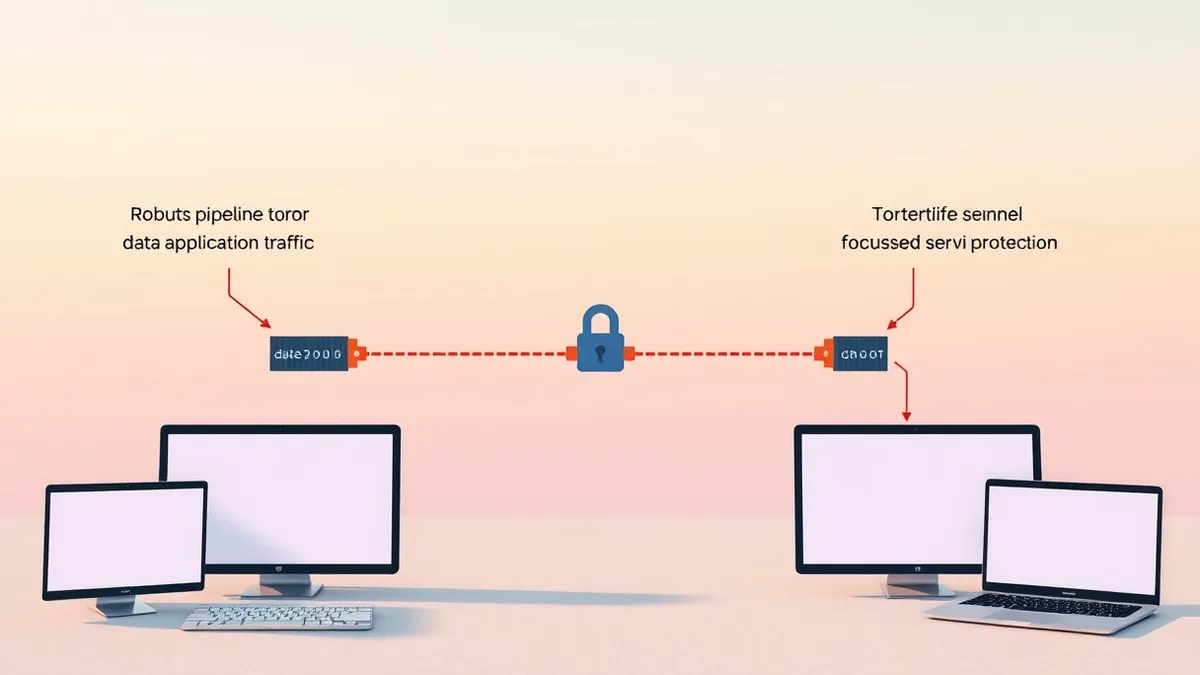
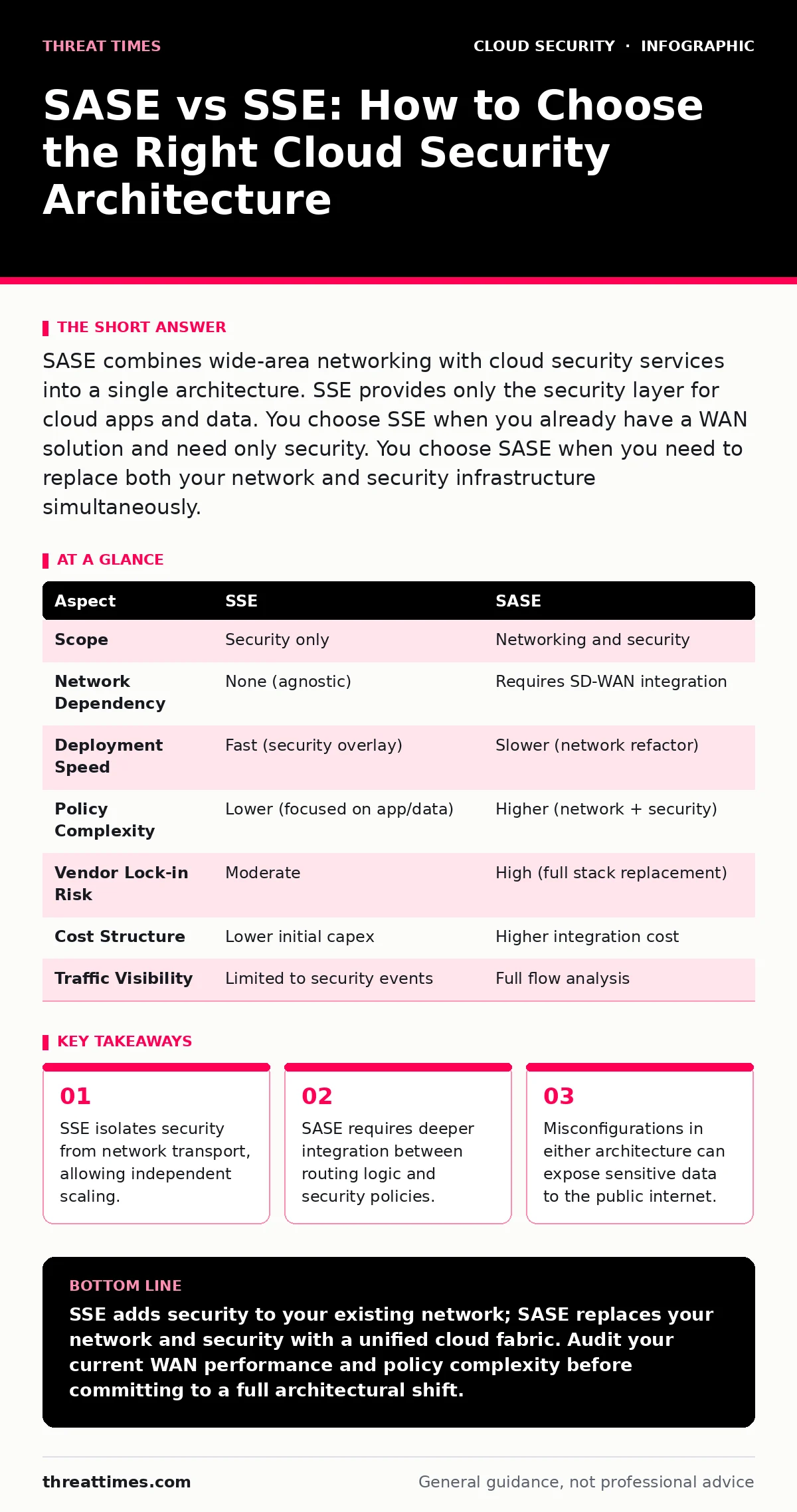
SASE combines wide-area networking with cloud security services into a single architecture. SSE provides only the security layer for cloud apps and data. You choose SSE when you already have a WAN solution and need only security. You choose SASE when you need to replace both your network and security infrastructure simultaneously.
The Core Architectural Divergence
The difference between Secure Access Service Edge (SASE) and Secure Service Edge (SSE) lies in the scope of network functions they manage. SASE merges wide-area networking (WAN) capabilities with cloud-native security services. SSE strips away the networking layer, leaving only the security controls that protect applications, data, and identity. Imagine you have a well-maintained fiber network connecting your offices. Adding SSE secures the traffic moving through that existing pipe without touching the pipes themselves. If your network infrastructure is outdated, SASE replaces both the pipes and the security filters.
This distinction dictates how you manage traffic flow and policy enforcement. In a SASE model, the firewall, intrusion prevention, and DNS filtering sit inside the same cloud platform that routes your internet and private traffic. In SSE, those same security functions exist as a separate layer that sits above whatever network you use to reach the cloud.
What Is Secure Service Edge?
SSE is a modular cloud security framework. It delivers security services directly to the user, regardless of where they connect from. The model consists of three core components: Cloud Access Security Broker (CASB), Secure Web Gateway (SWG), and Zero Trust Network Access (ZTNA). CASB monitors activity in cloud applications to detect unauthorized use. SWG filters web traffic for malware and inappropriate content. ZTNA ensures that users only access specific applications after strict identity verification.
Because SSE ignores the underlying network, it works equally well over 5G, public Wi-Fi, or a dedicated leased line. This neutrality allows organizations to keep their current networking contracts while upgrading security posture. You do not need to refactor how your devices talk to each other to implement SSE. You only need to redirect security-relevant traffic to the SSE provider’s cloud endpoints.
What Is Secure Access Service Edge?
SASE is a broader architecture that converges networking and security. It integrates Software-Defined Wide Area Network (SD-WAN) capabilities with the security functions found in SSE. SD-WAN optimizes traffic routing by selecting the best path for data based on real-time network conditions. By combining this with security, SASE creates a single pane of glass for managing both connectivity and protection.
This convergence simplifies operations for organizations that want to retire on-premises hardware. Instead of maintaining separate appliances for firewalls, WAN optimization, and intrusion detection, you route all traffic through the SASE cloud fabric. The trade-off is complexity in policy mapping. You must align network routing rules with security policies, which can create hidden dependencies. If the SD-WAN component fails to classify traffic correctly, the security engines may never see the data that needs inspection.
Point-by-Point Comparison
The table below outlines the structural and operational differences between the two models.
| Aspect | SSE | SASE |
|---|---|---|
| Scope | Security only | Networking and security |
| Network Dependency | None (agnostic) | Requires SD-WAN integration |
| Deployment Speed | Fast (security overlay) | Slower (network refactor) |
| Policy Complexity | Lower (focused on app/data) | Higher (network + security) |
| Vendor Lock-in Risk | Moderate | High (full stack replacement) |
| Cost Structure | Lower initial capex | Higher integration cost |
| Traffic Visibility | Limited to security events | Full flow analysis |
Where the Architectures Overlap
Both models rely on cloud-native delivery. They push security services to the edge, close to the user, rather than backhauling traffic to a central data center. This reduces latency and improves performance for remote users. Both SSE and SASE use identity as the primary control point. Network perimeter is no longer the security boundary; the user’s identity is.
The overlap creates a critical intersection with cloud misconfigurations. In both models, if you misconfigure the access policies, you grant unauthorized entry regardless of the network path. Understanding cloud security groups becomes relevant here, as they define the baseline traffic permissions that SSE or SASE policies must respect. If your underlying cloud network allows open access, your SSE or SASE layer becomes the sole barrier. This concentration of risk demands rigorous cloud identity governance to ensure that least-privilege principles are enforced consistently.
Choosing the Right Path
Select SSE when your wide-area network is stable and performant. If you have recently upgraded your SD-WAN or have a robust carrier-grade connection, adding SSE gives you modern security without disrupting connectivity. This approach is also suitable when you want to avoid vendor lock-in for your network infrastructure. You can switch security providers without ripping out your routers and switches.
Choose SASE when your network infrastructure is fragmented or outdated. If you struggle with managing multiple WAN links, legacy firewalls, and inconsistent security policies, SASE consolidates these functions. This is the right path if you are undergoing a major digital transformation and want to simplify your entire IT stack. However, be aware that SASE requires a deeper commitment to a single vendor’s ecosystem.
Hidden Costs and Edge Cases
The most common mistake is assuming SASE is always superior because it is more comprehensive. The hidden cost of SASE is operational friction. Troubleshooting a connectivity issue becomes difficult when you cannot easily separate network routing problems from security policy blocks. In SSE, if a user cannot connect, you know the security layer is not the bottleneck for the network path itself.
Another edge case involves legacy applications that require specific network protocols. SASE providers may struggle to support non-standard traffic flows through their unified fabric. SSE avoids this by leaving the network transport alone. It only inspects the security-relevant layers. This makes SSE more compatible with older systems that do not support modern authentication methods or encrypted tunnels.
Key takeaways
- SSE isolates security from network transport, allowing independent scaling.
- SASE requires deeper integration between routing logic and security policies.
- Misconfigurations in either architecture can expose sensitive data to the public internet.
SSE adds security to your existing network; SASE replaces your network and security with a unified cloud fabric. Audit your current WAN performance and policy complexity before committing to a full architectural shift.
Frequently asked questions
Can I use SSE and SASE together?
Yes, many organizations use SSE components within a broader SASE architecture, but pure SSE is distinct from full SASE implementations that include SD-WAN.
Does SSE protect against endpoint threats?
No, SSE focuses on application and data security. It does not replace endpoint detection and response (EDR) solutions that protect the device itself.
Is SASE only for large enterprises?
No, SASE is scalable, but smaller organizations with simple network needs may find the complexity and cost of full SASE unnecessary compared to modular SSE.
How does SSE handle internal traffic?
SSE typically focuses on internet-bound and cloud-bound traffic. Internal east-west traffic usually requires separate controls like a **service mesh security** layer or traditional firewalling.
How this guide was produced: written by the Threat Times editorial team with AI assistance, checked against the public references listed below, and reviewed when the facts change. See our editorial policy or report an error.