Build an Emergency Stop for AI Systems: A Technical Implementation Plan
Most AI emergency stops fail because they interrupt data flow rather than halting the execution engine, leaving residual processes active.

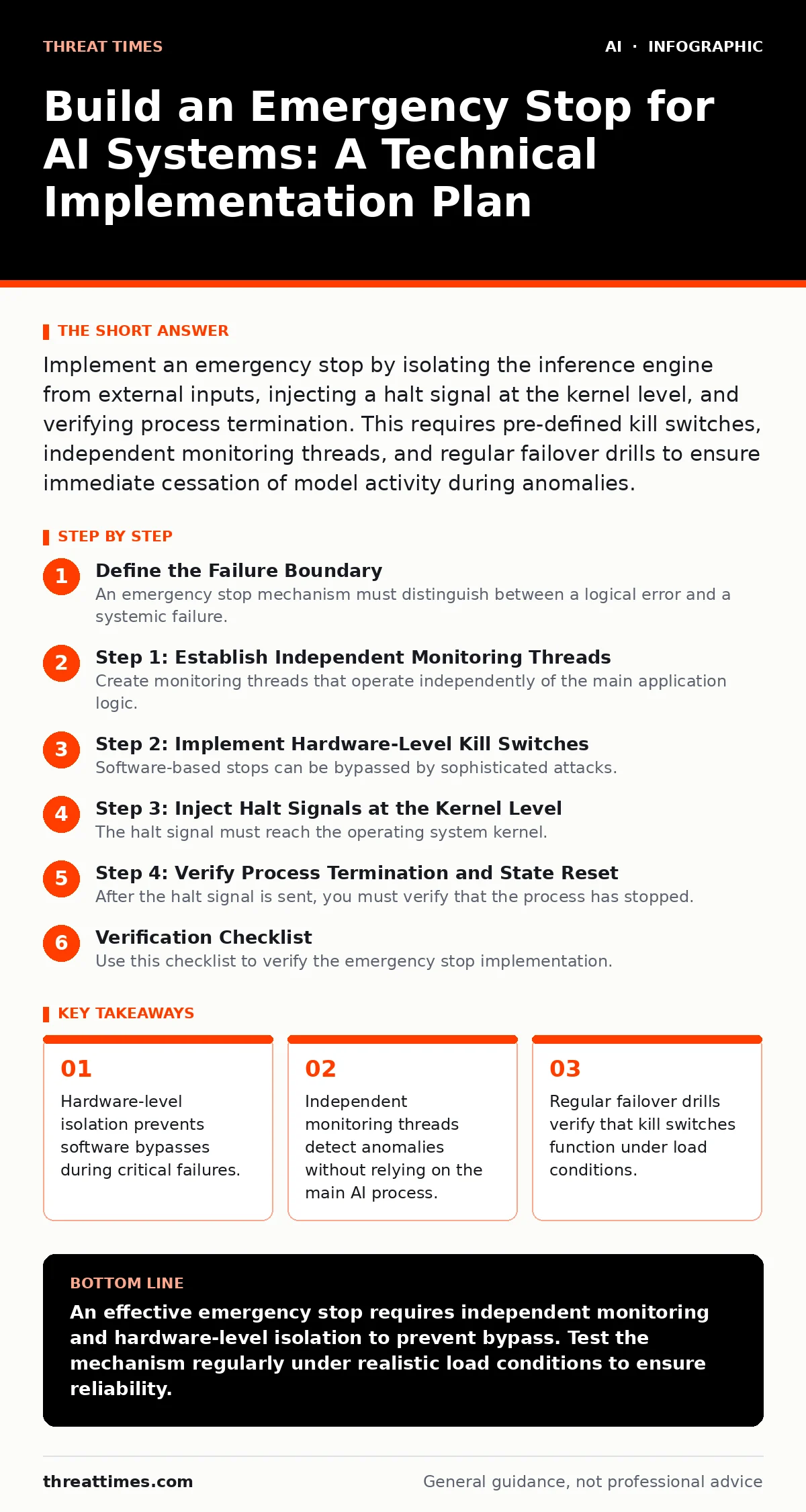
Implement an emergency stop by isolating the inference engine from external inputs, injecting a halt signal at the kernel level, and verifying process termination. This requires pre-defined kill switches, independent monitoring threads, and regular failover drills to ensure immediate cessation of model activity during anomalies.
Define the Failure Boundary
An emergency stop mechanism must distinguish between a logical error and a systemic failure. You must define the exact conditions that trigger a halt. These conditions include unexpected output patterns, resource exhaustion, or unauthorized access attempts. The boundary determines what stops and what continues. If the boundary is too wide, you cause unnecessary downtime. If it is too narrow, the system continues operating while compromised.
You must separate the inference engine from the data ingestion layer. The inference engine processes inputs and generates outputs. The ingestion layer collects and formats data. Isolating these components allows you to cut off inputs without crashing the entire server. This separation ensures that logging and monitoring systems remain active even when the AI model stops.
Step 1: Establish Independent Monitoring Threads
Create monitoring threads that operate independently of the main application logic. These threads check system health metrics and output validity. They must have direct access to the hardware interrupt controller. The main AI process cannot disable these threads. If the main process hangs, the monitoring threads continue running. They detect deviations from expected behavior patterns.
Imagine a scenario where the model begins generating repetitive, nonsensical loops. The monitoring thread detects the loop pattern. It does not rely on the model to report its own status. It observes the CPU usage and memory allocation. When the metrics exceed predefined thresholds, the thread triggers the halt sequence. This independence is the core of a reliable emergency stop.
Step 2: Implement Hardware-Level Kill Switches
Software-based stops can be bypassed by sophisticated attacks. You must implement hardware-level kill switches. These switches cut power or network connectivity to the inference nodes. They operate outside the operating system. A hardware switch responds to a physical signal or a dedicated secure management channel. This channel is separate from the standard network traffic.
You should configure the switch to respond to a specific signal from the monitoring threads. The signal must be unforgeable. Use cryptographic signatures to verify the source of the halt command. This prevents an attacker from spoofing a halt signal to cause a denial of service. The switch must also support manual activation. A physical button provides a last-resort option if digital controls fail.
Step 3: Inject Halt Signals at the Kernel Level
The halt signal must reach the operating system kernel. The kernel manages process execution and resource allocation. Injecting the signal at this level ensures immediate termination. You must define the signal type and priority. The signal should override all other pending tasks. It stops the inference process without waiting for graceful shutdown routines.
Graceful shutdowns can be exploited by malicious code to hide evidence. A forced termination prevents this. The kernel logs the termination event. This log entry provides an audit trail. It records the timestamp and the source of the halt command. You must ensure these logs are written to a secure, append-only storage medium. This prevents tampering with the evidence after the incident.
Step 4: Verify Process Termination and State Reset
After the halt signal is sent, you must verify that the process has stopped. The monitoring thread checks for the absence of the process ID. It also checks for residual network connections. Any remaining connections indicate an incomplete stop. The system must close all open sockets and file handles. This prevents data leakage or continued execution in the background.
You must reset the system state to a known good configuration. This involves clearing temporary memory and reloading safe parameters. The system should not resume operation until a human operator confirms safety. This manual step prevents automatic restart loops. The reset process must be fast but thorough. It balances speed with security.
Verification Checklist
Use this checklist to verify the emergency stop implementation.
- Monitoring threads run independently of the main AI process.
- Hardware kill switches are accessible and functional.
- Halt signals are authenticated and unforgeable.
- Kernel-level termination overrides all other tasks.
- Process termination is confirmed by the monitoring thread.
- Network connections are closed immediately upon halt.
- System state resets to a known good configuration.
- Audit logs are written to secure storage.
Schedule Regular Failover Drills
An emergency stop is only as good as its last test. You must schedule regular failover drills. These drills simulate various failure scenarios. They test the speed and accuracy of the halt mechanism. You should test both software and hardware triggers. The drills must be conducted under realistic load conditions.
During a drill, you inject a fault into the system. The monitoring threads detect the fault. The halt sequence activates. You measure the time from detection to termination. You also check for any side effects. Did the logging system remain active? Did the network connections close properly? These drills reveal weaknesses in the implementation.
Maintain and Update the Mechanism
The emergency stop mechanism requires ongoing maintenance. You must update the monitoring thresholds as the model evolves. New versions of the model may have different resource requirements. You must adjust the thresholds to avoid false positives. False positives cause unnecessary downtime. False negatives allow failures to persist.
You must also update the cryptographic keys used for authentication. Rotate these keys regularly. This prevents attackers from using stolen keys to trigger or bypass the halt mechanism. Review the audit logs periodically. Look for patterns that indicate potential issues. Address these issues before they become critical failures.
Integrate with Broader Security Frameworks
The emergency stop is part of a larger security strategy. It complements other security measures. You should integrate it with your incident response plan. Define the roles and responsibilities during a halt event. Who confirms the safety? Who restarts the system? Clear procedures reduce confusion during an emergency.
Consider the implications of AI model theft. If the model parameters are stolen, the emergency stop may not prevent data exfiltration. You must secure the model weights and access controls. Similarly, AI security testing can identify vulnerabilities in the halt mechanism itself. Regular testing ensures the mechanism remains effective against new threats.
Refer to the MITRE ATLAS framework for additional guidance on adversarial attacks. This framework provides a structured approach to understanding AI-specific threats. It helps you identify potential weaknesses in your implementation. Use this knowledge to strengthen your emergency stop mechanism.
Key takeaways
- Hardware-level isolation prevents software bypasses during critical failures.
- Independent monitoring threads detect anomalies without relying on the main AI process.
- Regular failover drills verify that kill switches function under load conditions.
An effective emergency stop requires independent monitoring and hardware-level isolation to prevent bypass. Test the mechanism regularly under realistic load conditions to ensure reliability.
Frequently asked questions
Can software-only emergency stops be trusted?
No, software-only stops can be bypassed by sophisticated attacks. Hardware-level switches provide a more reliable layer of protection.
How often should failover drills be conducted?
Conduct drills quarterly or after any significant system update. Regular testing ensures the mechanism remains effective.
What happens if the monitoring thread fails?
The hardware kill switch provides a backup. Manual activation is also available. Redundancy ensures the system can be halted even if digital monitoring fails.
Does this apply to large language models?
Yes, the principles apply to any AI system, including large language models. The specific implementation details may vary based on the architecture.
How this guide was produced: written by the Threat Times editorial team with AI assistance, checked against the public references listed below, and reviewed when the facts change. See our editorial policy or report an error.