Autonomous System Numbers in Threat Intelligence Explained
ASN mapping reveals the underlying network owner, exposing infrastructure that domain names and IP addresses alone cannot identify.

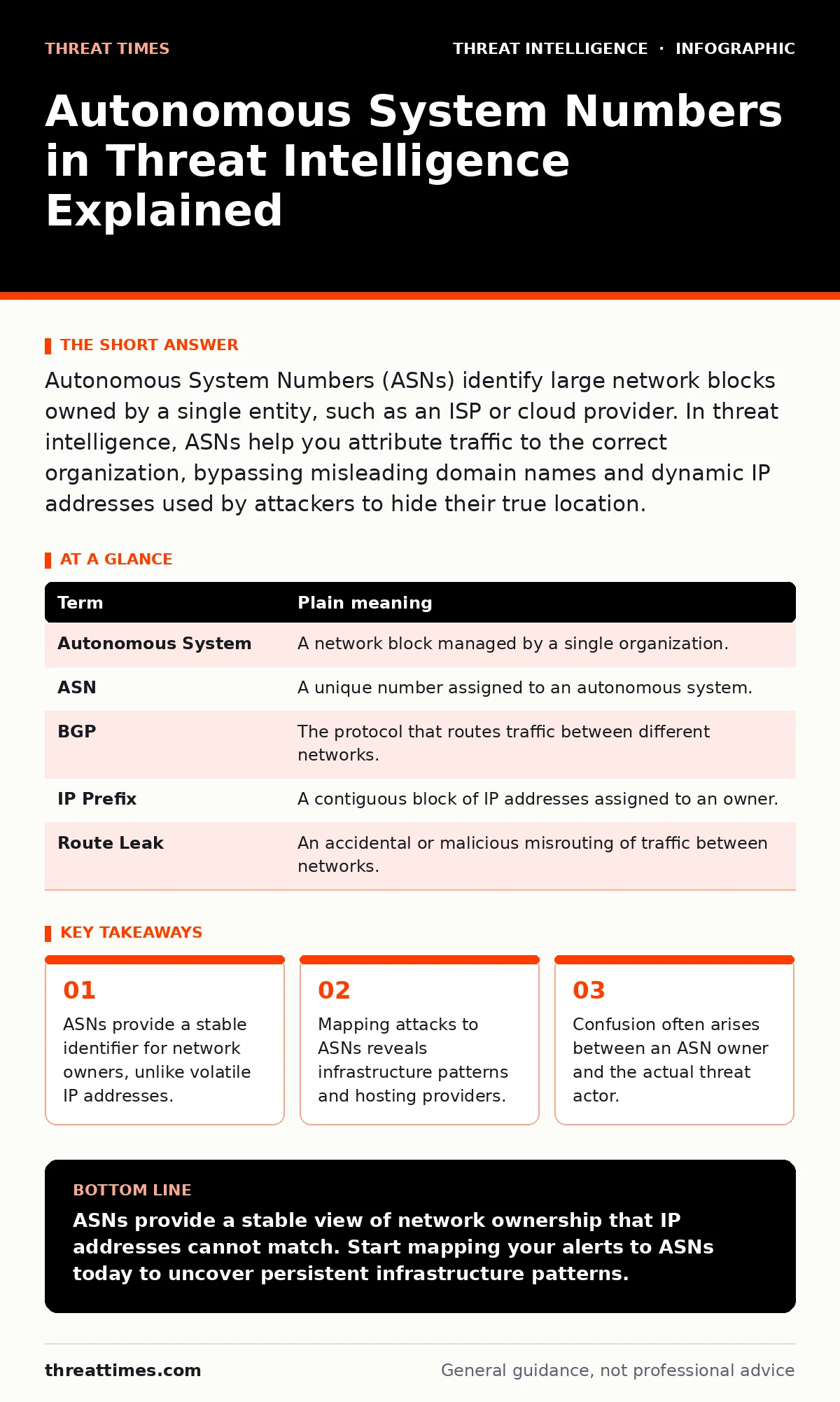
Autonomous System Numbers (ASNs) identify large network blocks owned by a single entity, such as an ISP or cloud provider. In threat intelligence, ASNs help you attribute traffic to the correct organization, bypassing misleading domain names and dynamic IP addresses used by attackers to hide their true location.
The Postal District Analogy
Imagine the internet as a global postal system. An IP address is like a specific house number. That number changes when the owner moves or renovates. An Autonomous System Number (ASN) is like the postal district code. It identifies the large region or municipality that manages the mail routes. When you analyze a threat, knowing the house number tells you where the letter came from today. Knowing the district tells you who manages the streets and how mail flows through that area. This distinction matters because attackers frequently change house numbers to avoid detection.
Key Terms for Network Attribution
To work with ASNs effectively, you must understand the specific components of network routing. The Border Gateway Protocol (BGP) is the standard routing protocol used to exchange network reachability information between autonomous systems. An Autonomous System is a collection of IP prefixes and routers under a single administrative domain. A prefix is a block of IP addresses assigned to an organization. Understanding these terms allows you to read routing tables and identify where traffic originates.
| Term | Plain meaning |
|---|---|
| Autonomous System | A network block managed by a single organization. |
| ASN | A unique number assigned to an autonomous system. |
| BGP | The protocol that routes traffic between different networks. |
| IP Prefix | A contiguous block of IP addresses assigned to an owner. |
| Route Leak | An accidental or malicious misrouting of traffic between networks. |
Why IP Addresses Fail in Detection
IP addresses are transient assets for many attackers. They use dynamic hosting services that assign new IP addresses frequently. If you block an IP address, the attacker simply acquires a new one. This creates a game of whack-a-mole that drains security resources. An ASN remains stable because it represents the underlying infrastructure provider. Blocking or monitoring an ASN allows you to track the broader infrastructure rather than chasing individual, short-lived IP addresses. This approach reduces the noise in your detection systems.
Common Points of Confusion
Practitioners often confuse the ASN owner with the threat actor. An ASN belongs to the Internet Service Provider or hosting company, not necessarily the person sending malicious traffic. For example, a botnet may operate on servers hosted by a major cloud provider. The ASN identifies the cloud provider, not the hacker. Another confusion involves route hijacking. Attackers can manipulate BGP to make traffic appear to come from a different ASN. This technique masks the true origin of an attack. You must cross-reference ASN data with other indicators to confirm attribution.
Integrating ASNs into Your Workflow
You can integrate ASN data into your existing security processes. Start by mapping your observed traffic to known ASNs. Look for patterns in the hosting providers used by malicious actors. Many attackers prefer specific regions or providers with lax security policies. This intelligence helps you prioritize which networks to monitor closely. You can also use ASN data to identify new infrastructure before it is fully operational. Early detection of new ASN allocations can reveal preparatory activities for large-scale campaigns.
Mapping Infrastructure to Threat Actors
When you see multiple attacks originating from the same ASN, investigate the commonalities. Are they using the same hosting provider? Do they share similar configuration errors? This pattern recognition helps you build a profile of the attacker's infrastructure preferences. This profile is more durable than a list of blocked IP addresses. It allows you to anticipate future movements by the same group. This method supports a proactive stance rather than a reactive one.
Practical Application Steps
You can apply this knowledge immediately with three concrete steps. These actions require no special software, only access to public routing information.
- Identify the ASN of any suspicious IP address using a public lookup tool.
- Check if that ASN has been associated with other malicious activity in your logs.
- Document the hosting provider and region to build a profile of common infrastructure.
Limitations of ASN Intelligence
ASNs do not provide complete protection. They cannot identify the specific user or device within a large network. A single ASN may cover millions of devices. This lack of granularity means you must combine ASN data with other intelligence sources. Use ASN data to narrow the search space, not to pinpoint the exact target. Additionally, some attackers use peer-to-peer networks that obscure the ASN entirely. In these cases, ASN analysis provides limited value. Always validate findings with additional context.
Connecting to Broader Intelligence
ASN analysis works best when combined with other intelligence disciplines. It complements threat intelligence platforms by adding a layer of infrastructure context. It helps refine incident response runbooks by providing clearer attribution data. When analyzing fast flux DNS, ASN data reveals the underlying hosting infrastructure. This combination allows you to see the full picture of an attack campaign. You move from seeing isolated incidents to understanding systemic risks. This depth of analysis supports more effective long-term security strategies.
Key takeaways
- ASNs provide a stable identifier for network owners, unlike volatile IP addresses.
- Mapping attacks to ASNs reveals infrastructure patterns and hosting providers.
- Confusion often arises between an ASN owner and the actual threat actor.
ASNs provide a stable view of network ownership that IP addresses cannot match. Start mapping your alerts to ASNs today to uncover persistent infrastructure patterns.
Frequently asked questions
How do I find the ASN for an IP address?
Use public BGP lookup tools or WHOIS databases to trace the IP address back to its registered autonomous system.
Can an ASN be spoofed?
The ASN itself cannot be spoofed in transit, but attackers can manipulate BGP routes to make traffic appear to originate from a different ASN.
Is ASN blocking a good defense strategy?
ASN blocking is risky because it affects all traffic from that network. Use it only for small, isolated networks or as a last resort.
Do ASNs change frequently?
ASNs are stable identifiers that rarely change. They provide a consistent reference point for long-term threat tracking.
How this guide was produced: written by the Threat Times editorial team with AI assistance, checked against the public references listed below, and reviewed when the facts change. See our editorial policy or report an error.