Are Proxy Servers Safe? The Hidden Risks and Configuration Rules
Proxy servers hide your origin but create a single point of failure where all your encrypted traffic becomes visible to the operator.

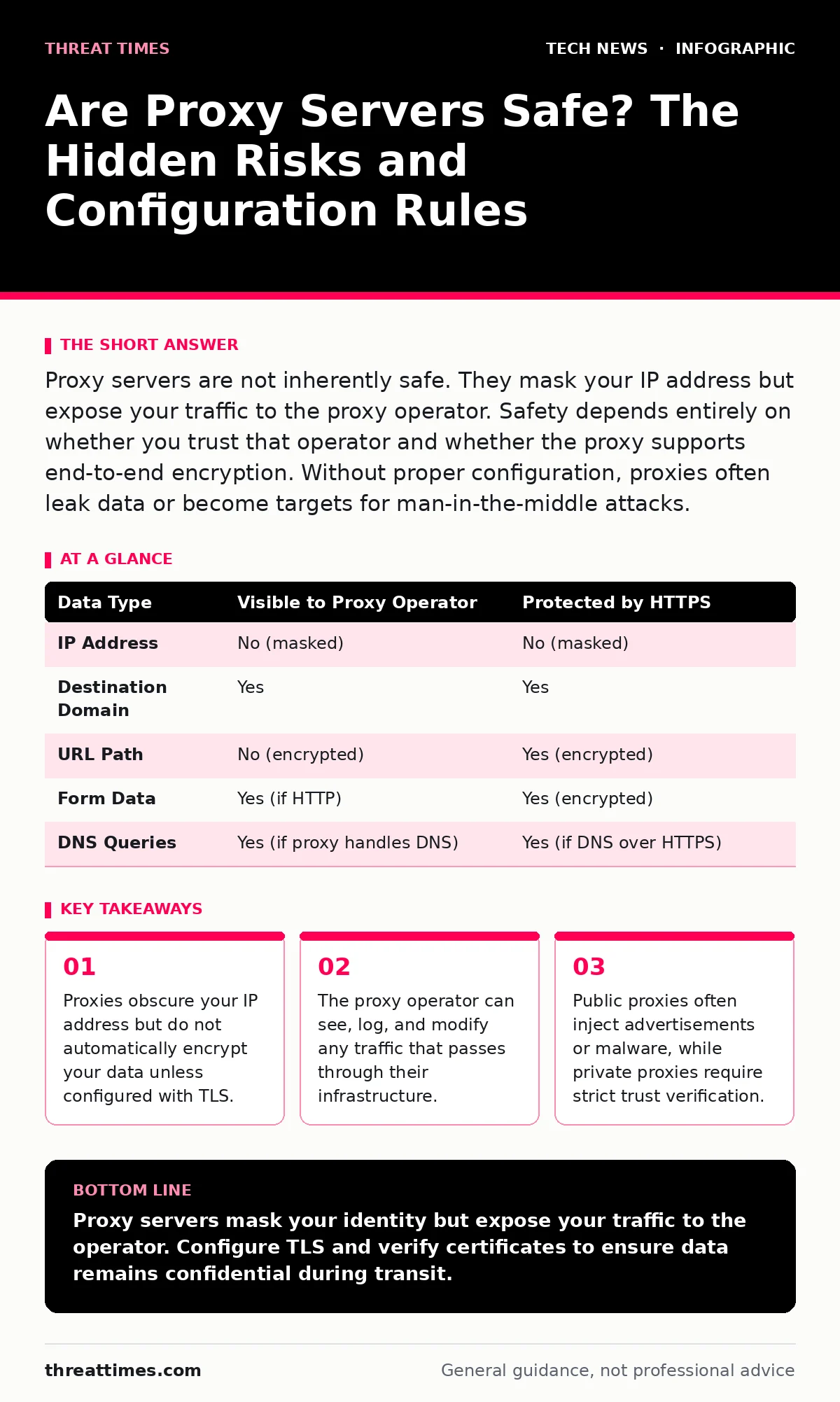
Proxy servers are not inherently safe. They mask your IP address but expose your traffic to the proxy operator. Safety depends entirely on whether you trust that operator and whether the proxy supports end-to-end encryption. Without proper configuration, proxies often leak data or become targets for man-in-the-middle attacks.
Are proxy servers safe for general use?
Proxy servers are safe only when you control the infrastructure or trust the operator implicitly. The core function of a proxy is to act as an intermediary between your device and the internet. This design inherently places the proxy operator in a position of power over your data flow. If you use a free public proxy, you assume the risk that the operator logs your activity or injects malicious content. Safety is not a binary state but a spectrum of trust and technical configuration.
How do proxies differ from VPNs in security?
Proxies handle application-layer traffic while VPNs operate at the network layer. A proxy typically forwards HTTP or HTTPS requests, meaning it can inspect the content of unencrypted web pages. A VPN tunnels all network traffic, including DNS queries and non-web applications, through an encrypted channel. This distinction means a proxy cannot protect your DNS leaks or protect traffic from non-browser applications. You must choose based on whether you need to hide specific web requests or all network activity.
What data does the proxy operator see?
The proxy operator sees everything that is not end-to-end encrypted. If you visit a site using HTTP, the proxy can read every character of your request and response. Even with HTTPS, the proxy sees the destination domain, the timing of requests, and the volume of data transferred. This metadata reveals your browsing habits and interests. The operator cannot see the specific page content or form data within an HTTPS session, but they know where you are going and how long you stay.
| Data Type | Visible to Proxy Operator | Protected by HTTPS |
|---|---|---|
| IP Address | No (masked) | No (masked) |
| Destination Domain | Yes | Yes |
| URL Path | No (encrypted) | Yes (encrypted) |
| Form Data | Yes (if HTTP) | Yes (encrypted) |
| DNS Queries | Yes (if proxy handles DNS) | Yes (if DNS over HTTPS) |
Why do public proxies pose a higher risk?
Public proxies are often poorly maintained and lack accountability. Operators of free proxies frequently log user activity to sell to advertisers or data brokers. Some public proxies inject JavaScript code into web pages to display ads or track user behavior. This injection breaks the integrity of the website you are trying to visit. You cannot verify the security practices of a public proxy operator. Using a public proxy for sensitive tasks like banking or email is equivalent to sending a postcard through a crowded room.
How to verify proxy encryption standards?
You must ensure the proxy supports TLS (Transport Layer Security) for all connections. An unencrypted proxy connection allows anyone on the same network to sniff your traffic. Check the proxy configuration for explicit TLS requirements. If the proxy does not support TLS, it cannot protect your data from network eavesdropping. Verify that the proxy uses valid certificates to prevent man-in-the-middle attacks. Invalid or self-signed certificates indicate a misconfiguration or a malicious actor impersonating the proxy.
What are the performance trade-offs of secure proxies?
Secure proxies add latency and reduce bandwidth. Encrypting traffic at the proxy and decrypting it at the destination requires computational resources. This process introduces delay, which is noticeable in real-time applications like video conferencing or online gaming. High-security configurations often limit the number of concurrent connections to prevent abuse. You must balance security needs against performance requirements. A highly secure proxy may be too slow for large file transfers or streaming media.
How do proxies interact with certificate management?
Corporate proxies often use SSL inspection to scan for malware. This process requires the proxy to terminate the TLS connection, inspect the content, and re-encrypt it. This creates a new certificate chain that your device must trust. You must install the corporate root certificate on your devices to allow this inspection. Without this certificate, your browser will flag the proxy as untrusted. This configuration creates a single point of failure for your trust model. If the corporate root certificate is compromised, an attacker can decrypt all inspected traffic. Refer to our guide on certificate management for best practices in handling root certificates.
What are the edge cases in proxy security?
Some applications bypass proxy settings entirely. Hardcoded IP addresses or direct socket connections in certain applications ignore system proxy configurations. This behavior can leak sensitive data outside the protected proxy tunnel. Additionally, DNS leaks can occur if the proxy does not handle DNS resolution. Your device may send DNS queries to your local ISP instead of the proxy, revealing your browsing intent. You must configure DNS to route through the proxy or use DNS over HTTPS to prevent these leaks. Operating system hardening includes verifying that all applications respect network proxy settings.
How to secure internal proxy infrastructure?
Internal proxies require strict access controls and regular updates. Limit access to the proxy server to authorized users and devices. Disable unnecessary services on the proxy server to reduce the attack surface. Implement rate limiting to prevent abuse and denial-of-service attacks. Monitor logs for unusual traffic patterns that may indicate a breach. Regularly update the proxy software to patch known vulnerabilities. Secure internal proxies are critical for protecting your network perimeter and preventing data exfiltration.
Key takeaways
- Proxies obscure your IP address but do not automatically encrypt your data unless configured with TLS.
- The proxy operator can see, log, and modify any traffic that passes through their infrastructure.
- Public proxies often inject advertisements or malware, while private proxies require strict trust verification.
Proxy servers mask your identity but expose your traffic to the operator. Configure TLS and verify certificates to ensure data remains confidential during transit.
Frequently asked questions
Can a proxy hide my location from the government?
A proxy hides your IP address from the destination server, but the proxy operator knows your location. Government agencies can request logs from the proxy operator.
Do proxies protect against malware?
Proxies do not inherently block malware. Some corporate proxies include scanning features, but most standard proxies simply forward traffic without inspection.
Is a SOCKS proxy safer than an HTTP proxy?
SOCKS proxies are more flexible as they handle any protocol, but neither is inherently safer. Both require TLS encryption to protect data from eavesdropping.
Can I use a proxy for anonymous browsing?
Proxies provide anonymity from the destination server, but not from the proxy operator. True anonymity requires multiple layers of routing, such as Tor.
How this guide was produced: written by the Threat Times editorial team with AI assistance, checked against the public references listed below, and reviewed when the facts change. See our editorial policy or report an error.