Coordinated Vulnerability Disclosure for Small Teams
Small businesses face disproportionate risk from unpatched software because coordinated disclosure creates a window where attackers know flaws exist before fixes ship.

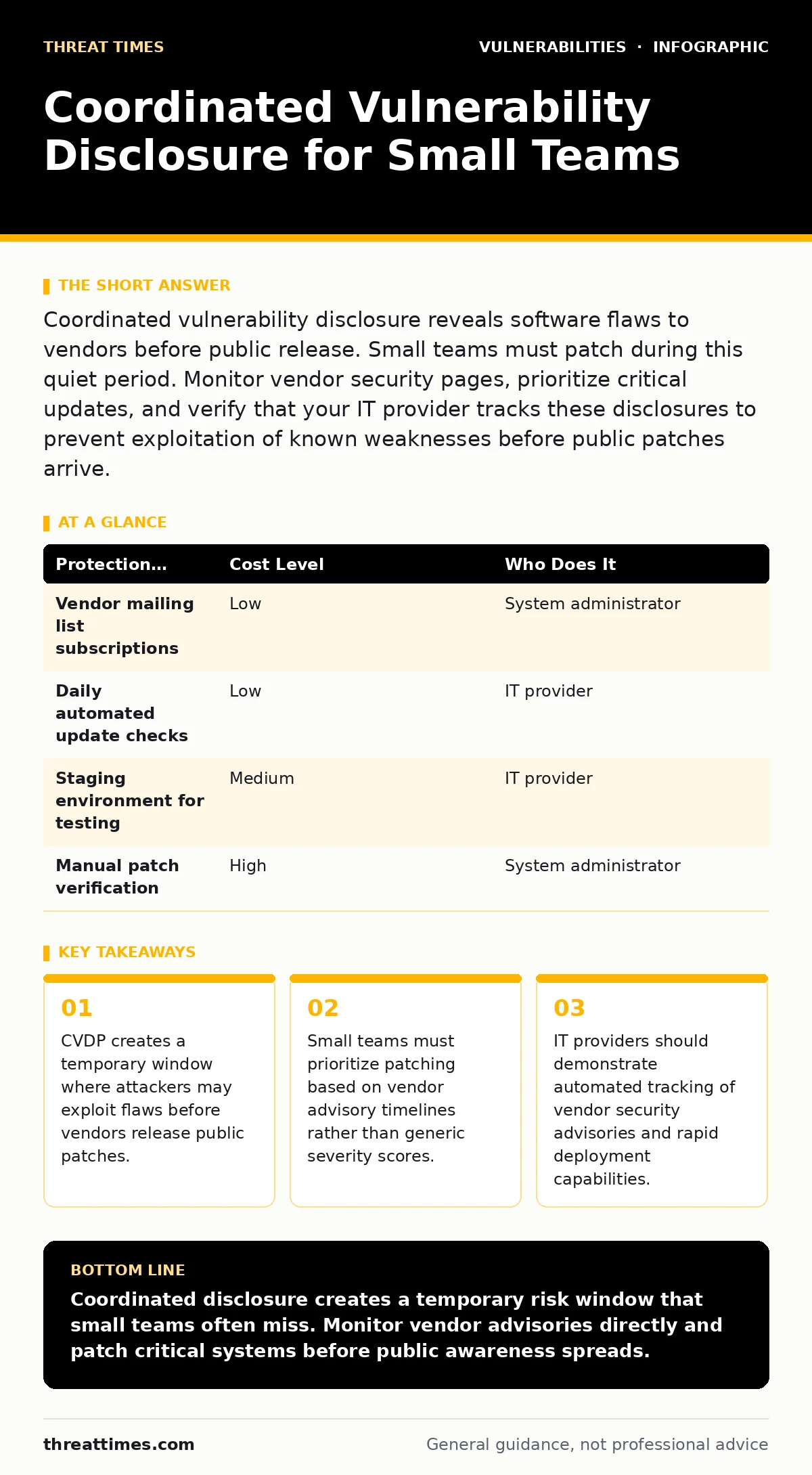
Coordinated vulnerability disclosure reveals software flaws to vendors before public release. Small teams must patch during this quiet period. Monitor vendor security pages, prioritize critical updates, and verify that your IT provider tracks these disclosures to prevent exploitation of known weaknesses before public patches arrive.
The Hidden Window of Exposure
Coordinated vulnerability disclosure follows a structured process where security researchers report flaws to software vendors privately. The vendor fixes the issue and releases a patch. Only then is the flaw made public. This process protects users by giving vendors time to respond. It creates a temporary period of risk. During this window, the flaw is known to the researcher and the vendor. Attackers who monitor researcher disclosures or scan for known patterns can exploit the weakness. Small businesses often miss this window because they wait for public news. By the time a news article appears, the patch is already available. The damage may already be done.
Why Small Scale Increases Risk
Large enterprises have dedicated security teams monitoring vendor advisories daily. Small teams rely on automated updates or infrequent manual checks. This delay creates a gap. A small company might run a single critical server. If that server runs software with a known, unpatched flaw, the entire business is exposed. The attack surface is smaller, but the margin for error is tighter. There is no backup team to respond to an incident. The cost of downtime is higher relative to revenue. Understanding this dynamic shifts the focus from general security hygiene to precise patch management. You must treat vendor security advisories as immediate operational tasks, not optional reading.
Practical Steps for Immediate Defense
You need a mechanism to receive alerts before the public knows about a flaw. Subscribe to security mailing lists for every major software product you use. Do not rely on general news feeds. Configure your systems to check for updates daily. Test patches in a non-production environment first. This prevents broken systems from taking down your business. Prioritize patches based on the vendor’s severity rating and your exposure. A flaw in a web-facing server requires faster action than a flaw in an internal printer driver. Maintain an IT asset inventory to know exactly what software runs on each device. You cannot patch what you do not know you have.
| Protection Measure | Cost Level | Who Does It |
|---|---|---|
| Vendor mailing list subscriptions | Low | System administrator |
| Daily automated update checks | Low | IT provider |
| Staging environment for testing | Medium | IT provider |
| Manual patch verification | High | System administrator |
Evaluating Your IT Provider’s Role
Your IT provider should not just install updates; they should anticipate them. Ask how they track coordinated disclosure timelines. A good provider monitors vendor security blogs and GitHub repositories. They should have a process for deploying critical patches within hours of release. Ask about their testing strategy. Blindly applying updates can break business applications. A balanced approach includes a staging server where patches are validated. Ask how they communicate urgency. You need to know when a patch is optional and when it is mandatory. Do not accept vague promises of "regular maintenance." Demand specific timelines for critical fixes.
- How do you monitor vendor security advisories before public release?
- What is your average time to deploy a critical patch after release?
- Do you test patches in a staging environment before production deployment?
- How do you notify us of urgent security updates outside regular hours?
- What is your process for verifying that a patch has resolved the specific vulnerability?
The Trade-Off of Speed and Stability
Patching quickly carries the risk of breaking functionality. Vendors sometimes release flawed patches that introduce new issues. Small teams cannot afford prolonged downtime. You must balance speed with stability. This is why risk-based vulnerability management is necessary. Not all vulnerabilities are equal. A flaw that requires physical access to exploit is less urgent than one reachable from the internet. Assess your exposure. If a server is isolated, you have more time to test. If it faces the public, you must patch immediately. This judgment call requires clear policies defined before an incident occurs.
See also: IT Asset Inventory: How Blind Spots Create Unpatched Risks
Beyond Patching: Defense in Depth
Patching is not the only line of defense. Some flaws cannot be patched immediately due to legacy systems or custom code. In these cases, you must isolate the vulnerable component. Use network segmentation to limit access. Disable unnecessary features that increase the attack surface. Consider output encoding practices if you handle user-generated content. This prevents certain types of injection attacks even if the underlying software has flaws. Layering defenses ensures that a single failure does not lead to total compromise. This approach reduces the impact of the disclosure window.
Long-Term Security Posture
Coordinated disclosure is a continuous cycle. New flaws are found every day. Your security posture must adapt. Review your software portfolio regularly. Remove unused applications. Each application adds potential risk. Engage in attack surface management to identify and reduce exposure. Train staff to recognize phishing attempts that may exploit known vulnerabilities. Security is not a one-time project. It is an ongoing process of monitoring, patching, and verifying. Small businesses can achieve enterprise-level security by focusing on precision and consistency. The goal is to close the window of exposure before attackers can exploit it.
Key takeaways
- CVDP creates a temporary window where attackers may exploit flaws before vendors release public patches.
- Small teams must prioritize patching based on vendor advisory timelines rather than generic severity scores.
- IT providers should demonstrate automated tracking of vendor security advisories and rapid deployment capabilities.
Coordinated disclosure creates a temporary risk window that small teams often miss. Monitor vendor advisories directly and patch critical systems before public awareness spreads.
Frequently asked questions
How long is the disclosure window typically?
The window varies by vendor policy, often ranging from 30 to 90 days. Some critical flaws are disclosed immediately.
Should I disable automatic updates for security?
No. Automatic updates ensure you receive patches quickly. Use a staging environment to test if stability is a concern.
What if a patch breaks my application?
Roll back to the previous version if possible. Contact the vendor for support. Isolate the system until a stable patch is available.
Do all vendors follow coordinated disclosure?
Most reputable vendors do. Open-source projects may have different timelines. Check the project’s security policy.
How this guide was produced: written by the Threat Times editorial team with AI assistance, checked against the public references listed below, and reviewed when the facts change. See our editorial policy or report an error.