Attack Surface Management for Small Businesses: Practical Steps
Small organizations often expose more digital entry points than they realize because shadow IT and forgotten cloud services create hidden access paths.

Attack surface management identifies every digital entry point attackers could exploit. Small businesses benefit by mapping external assets, prioritizing risks, and delegating complex scanning to managed providers. This reduces exposure without requiring a large security team.
EXAMPLE: The Ten-Person Company
This scenario highlights why attack surface management matters at a small scale. Small businesses often assume their size makes them invisible to attackers. This assumption is incorrect. Automated bots scan the entire internet for vulnerable services regardless of company size. A single exposed service can provide entry into the entire organization.
The core problem is visibility. You cannot protect what you do not know exists. In small teams, employees often procure software independently. This creates shadow IT. Shadow IT expands your attack surface without your knowledge. Attack surface management begins with identifying every digital asset that faces the internet.
Why Visibility Fails at Small Scale
Small organizations frequently rely on memory or spreadsheets to track assets. This approach fails because technology changes rapidly. Cloud services can be provisioned in minutes. When an employee leaves, their accounts may remain active. These dormant accounts become high-value targets.
An IT asset inventory is the foundation of security. It lists every device, application, and service. Without this list, you are guessing. Guessing leaves gaps. Attackers exploit these gaps. They look for services that are outdated or misconfigured. They do not care about your company size. They care about easy access.
Visibility also reveals misconfigurations. A cloud storage bucket might be set to public by mistake. A development environment might be left exposed after a project ends. These errors are common. They are also dangerous. Regular checks catch these errors before attackers do.
Affordable Ways to Manage Exposure
You do not need expensive tools to start. Many free or low-cost tools provide basic visibility. Open-source scanners can identify open ports and services. These tools help you see what is exposed to the internet. They are a good first step.
However, free tools have limits. They often produce false positives. They require manual verification. This takes time. Time is a scarce resource for small teams. You must balance cost with effort. A paid tool might cost more but save hours of manual work.
Prioritize external assets first. Internal networks are harder to secure. External assets are easier to map. Start with your website, email servers, and cloud services. Ensure these are patched and configured correctly. Then move to internal assets. This approach maximizes impact for minimal cost.
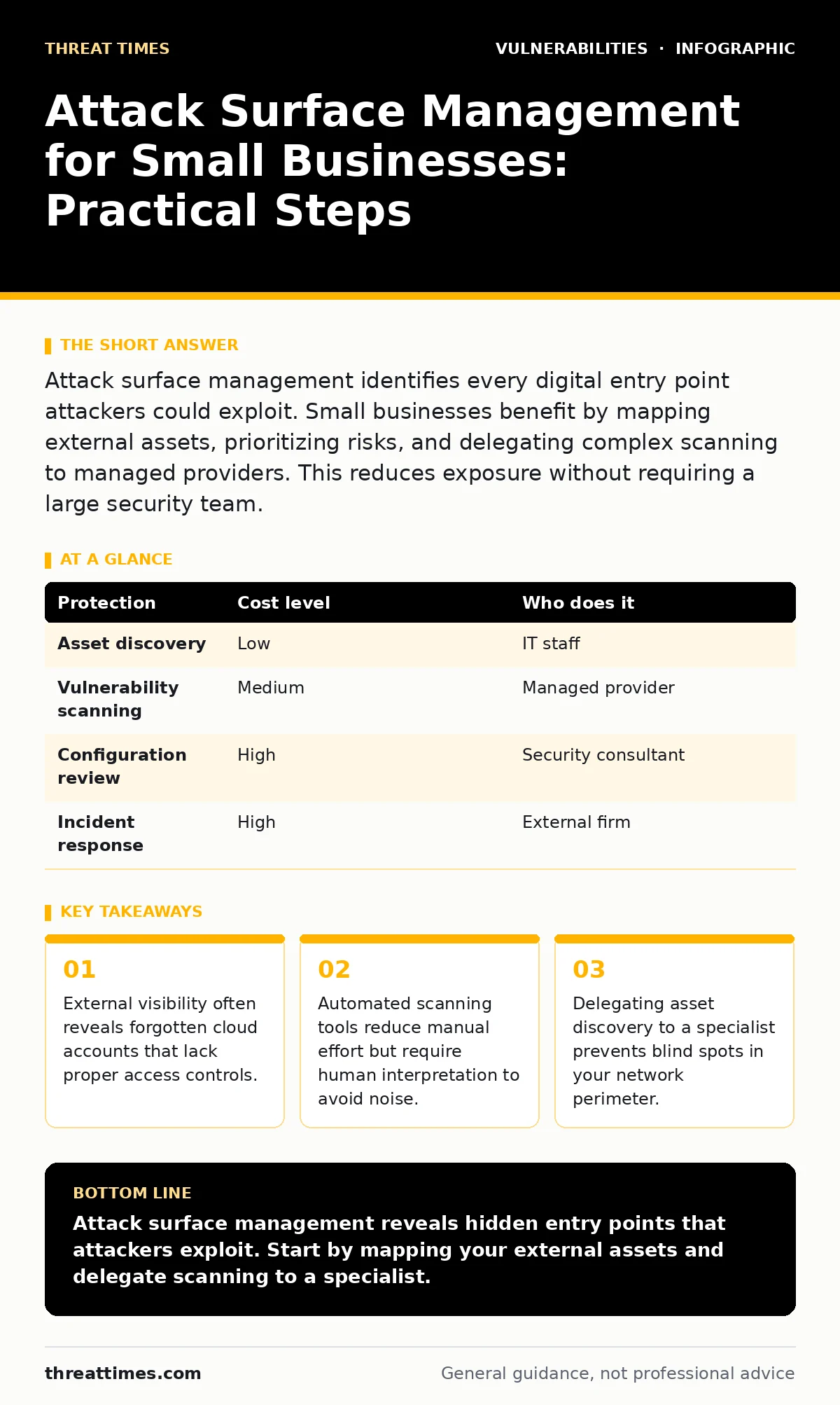
| Protection | Cost level | Who does it |
|---|---|---|
| Asset discovery | Low | IT staff |
| Vulnerability scanning | Medium | Managed provider |
| Configuration review | High | Security consultant |
| Incident response | High | External firm |
What to Delegate to Providers
Small teams lack the bandwidth for continuous monitoring. Attack surface management requires constant attention. New vulnerabilities appear daily. Misconfigurations happen frequently. Keeping up is difficult. Delegating parts of the process is wise.
Delegate external scanning to a managed provider. They have the tools and expertise to scan your assets continuously. They can identify new exposures quickly. This frees your internal team to focus on other tasks. It also provides an independent check. An outside perspective often sees what insiders miss.
Do not delegate decision-making. You must still decide which risks to accept. You must still patch critical vulnerabilities. The provider gives you data. You make the choices. This balance ensures you retain control while gaining efficiency. It also clarifies responsibilities in case of an incident.
The Hidden Cost of False Positives
Automated tools are not perfect. They often report vulnerabilities that do not exist. These are false positives. Investigating them wastes time. This is a hidden cost of attack surface management. Small teams can be overwhelmed by noise.
You need a process to triage alerts. Not every finding requires immediate action. Some are low risk. Some are irrelevant. Focus on high-severity issues first. Use context to filter noise. For example, a vulnerability on a test server is less urgent than one on a production server.
This filtering requires skill. It takes time to learn. Do not ignore alerts because they seem noisy. Instead, refine your process. Adjust your scanning rules. Tune your tools. This reduces noise over time. It makes the process more efficient.
Integrating with Risk-Based Strategies
Attack surface management is not enough on its own. You must prioritize risks. Not all vulnerabilities are equal. Some are easier to exploit. Some have greater impact. Risk-based vulnerability management helps you focus on what matters.
Combine asset data with risk scores. This tells you which issues to fix first. A critical vulnerability on a public-facing server is high risk. A low-severity issue on an internal tool is lower risk. This approach optimizes your resources. It ensures you spend time where it counts.
This integration also helps with reporting. You can show stakeholders the risk reduction. You can justify security investments. You can demonstrate progress. This builds trust. It also aligns security with business goals.
Common Mistakes to Avoid
One common mistake is ignoring internal assets. External visibility is important. Internal assets matter too. Attackers often move laterally after gaining initial access. They look for more value inside. Your internal network is part of your attack surface.
Another mistake is setting and forgetting. Attack surface management is continuous. New assets appear. Old ones change. Vulnerabilities emerge. You must update your maps regularly. Static lists become outdated quickly. Regular reviews keep your data accurate.
Finally, do not neglect output encoding. This prevents cross-site scripting attacks. It is a simple fix. It is often overlooked. Ensure your web applications encode user input. This reduces the risk of code injection. It is a basic but effective control.
Questions for IT Providers
When hiring a provider, ask specific questions. This ensures they understand your needs. It also clarifies their capabilities. Use these questions to evaluate potential partners.
- How do you discover new assets?
- What is your false positive rate?
- How often do you scan?
- Do you provide risk prioritization?
- Who interprets the results?
- How do you handle urgent findings?
- What is your reporting format?
- Do you offer remediation advice?
Ask for references. Talk to other clients. This gives you real-world insights. It helps you assess reliability. It also reveals how they handle problems. Do not rely on marketing claims. Verify their track record.
Building a Sustainable Process
Attack surface management is a journey. It requires patience and persistence. Start small. Focus on external assets. Build your inventory. Scan for vulnerabilities. Prioritize risks. Delegate where needed. This creates a sustainable process.
Over time, you will gain more visibility. You will identify more risks. You will reduce your exposure. This makes your organization more resilient. It also builds confidence. You know what you face. You know how to respond.
Remember that security is never complete. New threats emerge. New technologies appear. You must adapt. Keep learning. Keep improving. This mindset ensures long-term success. It also protects your business.
Key takeaways
- External visibility often reveals forgotten cloud accounts that lack proper access controls.
- Automated scanning tools reduce manual effort but require human interpretation to avoid noise.
- Delegating asset discovery to a specialist prevents blind spots in your network perimeter.
Attack surface management reveals hidden entry points that attackers exploit. Start by mapping your external assets and delegate scanning to a specialist.
Frequently asked questions
How often should I scan my attack surface?
Scan continuously or at least weekly. New vulnerabilities appear daily. Frequent scans catch new exposures quickly. This reduces the window of opportunity for attackers.
Can I do attack surface management alone?
You can start alone with free tools. However, continuous monitoring is difficult. Delegating scanning to a provider saves time. It also provides expert analysis. This balances effort and effectiveness.
What is the difference between asset inventory and attack surface management?
An asset inventory lists what you own. Attack surface management identifies how those assets are exposed. It focuses on external visibility. It prioritizes risks based on exposure. This adds context to the list.
Do I need to protect internal networks?
Yes. Attackers often move laterally. Internal assets are part of your surface. Protecting only the perimeter is insufficient. You must secure the entire environment. This includes internal servers and devices.
How this guide was produced: written by the Threat Times editorial team with AI assistance, checked against the public references listed below, and reviewed when the facts change. See our editorial policy or report an error.