Risk Based Vulnerability Management: Prioritize Fixes by Actual Threat
Risk based vulnerability management ignores patch scores and focuses on whether an attacker can actually reach the flaw to compromise critical business assets.

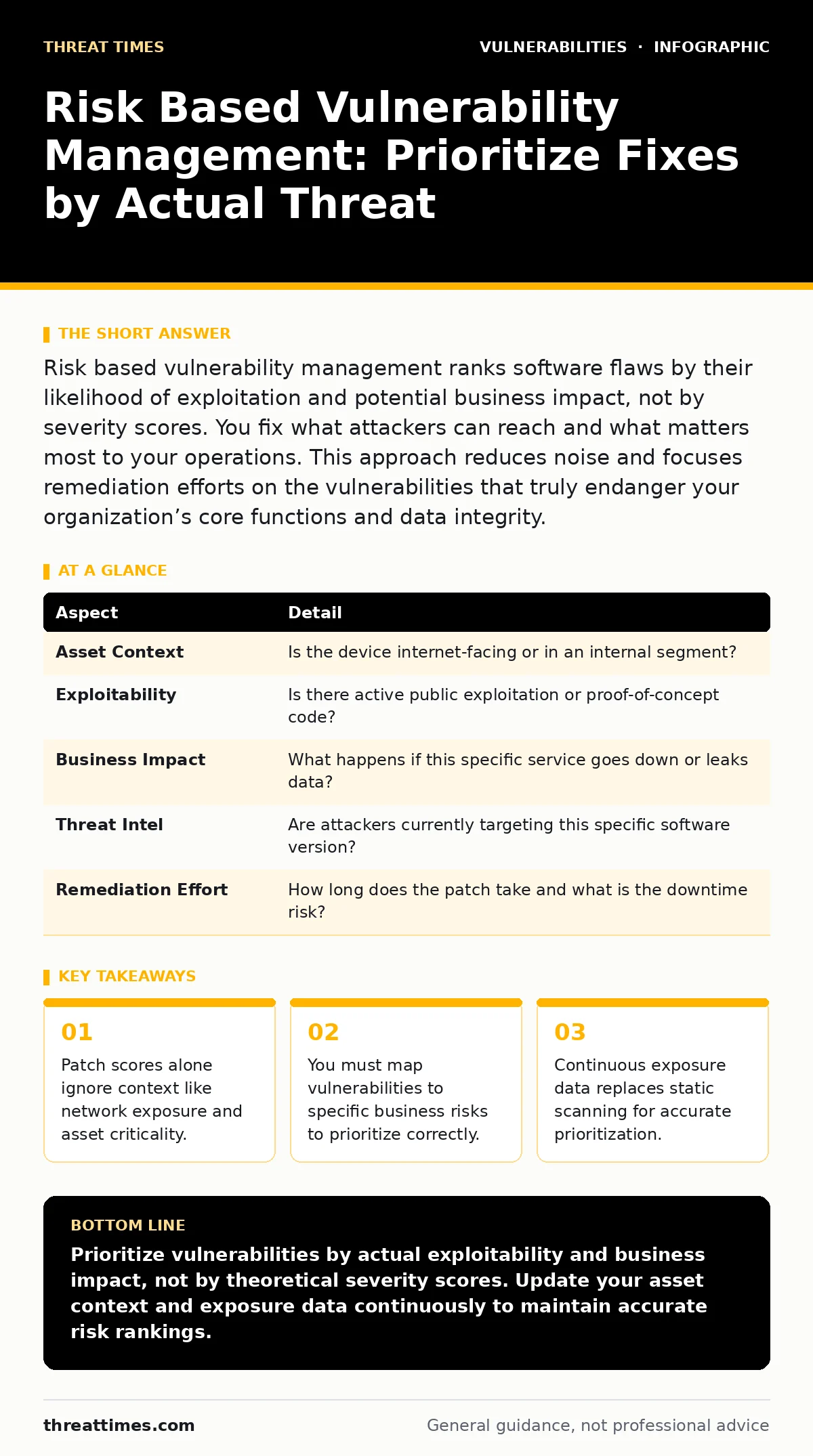
Risk based vulnerability management ranks software flaws by their likelihood of exploitation and potential business impact, not by severity scores. You fix what attackers can reach and what matters most to your operations. This approach reduces noise and focuses remediation efforts on the vulnerabilities that truly endanger your organization’s core functions and data integrity.
Why Patch Scores Fail in Real Environments
Risk based vulnerability management shifts the focus from theoretical severity to actual exploitability. Traditional scanning tools assign a score to every flaw, suggesting you fix the highest numbers first. This method assumes all vulnerabilities are equally reachable and equally damaging. In practice, a critical flaw on an isolated printer is less dangerous than a moderate flaw on a public web server. You prioritize based on the combination of reachability and impact. This method stops teams from chasing low-value patches while ignoring high-risk exposures.
How Risk Based Vulnerability Management Works
The process begins with a complete map of your technology. You cannot assess risk for assets you do not know exist. This requires a reliable IT asset inventory that includes operating systems, applications, and network configurations. Once you know what you have, you identify which vulnerabilities affect those specific assets. The system then evaluates how exposed each asset is to external or internal attackers. It combines this exposure data with the criticality of the data or service the asset supports. The output is a ranked list of remediation tasks.
| Aspect | Detail |
|---|---|
| Asset Context | Is the device internet-facing or in an internal segment? |
| Exploitability | Is there active public exploitation or proof-of-concept code? |
| Business Impact | What happens if this specific service goes down or leaks data? |
| Threat Intel | Are attackers currently targeting this specific software version? |
| Remediation Effort | How long does the patch take and what is the downtime risk? |
The Mechanics of Exposure Analysis
Exposure analysis determines whether an attacker can actually trigger a vulnerability. A flaw in a library that is never called by the application is theoretically present but practically useless to an adversary. You must distinguish between installed software and active attack surfaces. This requires attack surface management techniques that monitor open ports and services in real time. If a server has no open ports facing the internet, the risk of remote exploitation drops significantly. You treat internal threats differently, evaluating lateral movement paths rather than perimeter breaches.
Business Impact Drives Priority
Not all systems are equal. A flaw in a legacy internal tool used by two people carries less risk than the same flaw in the customer checkout system. You assign criticality levels based on revenue impact, regulatory obligations, and reputational damage. This step removes the bias of treating every patch as equally urgent. It aligns security work with business goals. When resources are limited, you protect the crown jewels first. This approach ensures that security spending delivers measurable protection for the functions that keep the organization running.
What People Usually Get Wrong
Teams often treat risk scoring as a one-time calculation. They run a scan, generate a report, and then stop updating the risk context. Risk changes when network topology changes or when new exploit code appears. Static snapshots become stale quickly. Another common error is ignoring the remediation effort. A high-risk flaw that requires a full system reboot during business hours may be deferred for a lower-risk flaw that patches instantly. You must balance risk reduction with operational reality. Ignoring effort leads to burnout and incomplete patching.
Integrating Technical Depth
Technical accuracy in risk scoring requires understanding how vulnerabilities manifest. For instance, memory corruption bugs often require specific conditions to trigger, making them harder to exploit remotely than logic errors. You should factor in the complexity of exploitation when ranking items. Similarly, insecure deserialization flaws can lead to remote code execution but only if an attacker can control the input stream. Understanding these nuances allows for more precise prioritization. It prevents overreacting to theoretical risks while underreacting to easy wins.
The Hidden Cost of Automation
Automated prioritization tools rely on accurate data inputs. If your asset inventory is incomplete, the risk scores are wrong. Garbage in, garbage out. Many organizations struggle with shadow IT, where employees use unauthorized applications. These assets appear in scans but lack context. You cannot assess risk for unknown assets. This creates blind spots that attackers exploit. Regular validation of your data sources is necessary. You must reconcile scan results with actual network traffic to ensure the risk model reflects reality.
Sustaining the Process
Risk based vulnerability management is a continuous cycle, not a project. You must re-evaluate priorities as new vulnerabilities emerge and your environment changes. Integrate this process into your development lifecycle to catch issues early. Use coordinated vulnerability disclosure channels to get early warnings about new flaws. This proactive stance reduces the window of exposure. Regularly review your criticality assignments to ensure they match current business priorities. As services evolve, their risk profile changes. Keeping the model current ensures you always protect what matters most.
Key takeaways
- Patch scores alone ignore context like network exposure and asset criticality.
- You must map vulnerabilities to specific business risks to prioritize correctly.
- Continuous exposure data replaces static scanning for accurate prioritization.
Prioritize vulnerabilities by actual exploitability and business impact, not by theoretical severity scores. Update your asset context and exposure data continuously to maintain accurate risk rankings.
Frequently asked questions
Does risk based vulnerability management replace patching?
No, it prioritizes patching. You still must fix vulnerabilities, but you address the most dangerous ones first to maximize security return on investment.
How do I handle zero-day vulnerabilities?
Zero-days have unknown exploitability. Treat them as high risk if the asset is internet-facing or handles sensitive data, and monitor for public exploit code.
Can I use this for cloud environments?
Yes, but you must include cloud configuration risks. Misconfigured storage buckets often pose higher risk than software bugs in well-configured instances.
What if I lack complete asset visibility?
Focus on known critical assets first. Expand visibility gradually. Prioritizing unknown assets is impossible, so start with what you can map and protect.
How this guide was produced: written by the Threat Times editorial team with AI assistance, checked against the public references listed below, and reviewed when the facts change. See our editorial policy or report an error.