Risk-Based Vulnerability Management: Prioritize Fixes by Actual Danger
Risk-based vulnerability management stops teams from chasing every CVE by measuring the real business impact of each flaw before spending repair hours.
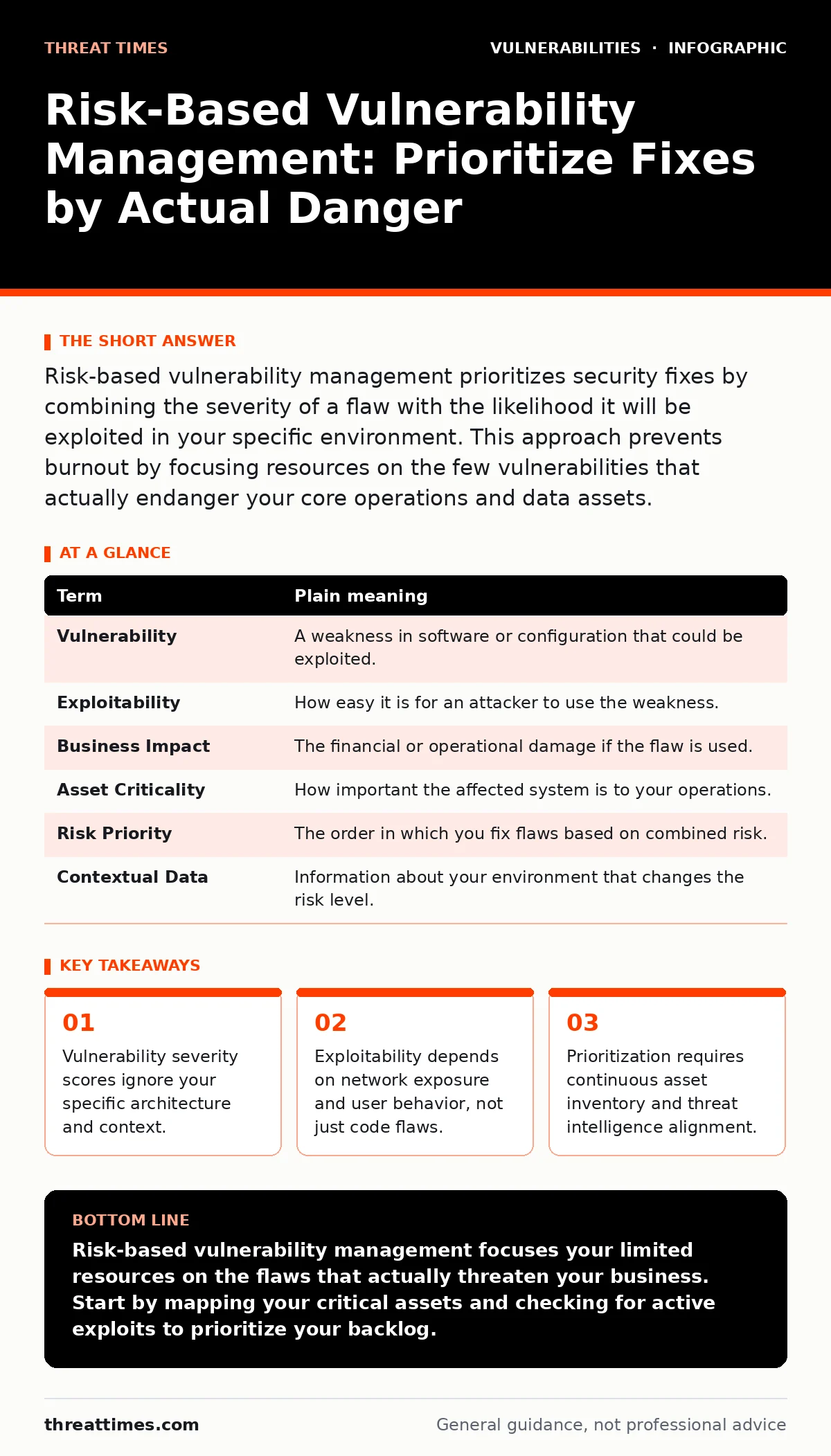
Risk-based vulnerability management prioritizes security fixes by combining the severity of a flaw with the likelihood it will be exploited in your specific environment. This approach prevents burnout by focusing resources on the few vulnerabilities that actually endanger your core operations and data assets.
The Broken Window Analogy
Imagine you manage a large office building. Every day, maintenance reports list hundreds of issues: a cracked window on the ground floor, a loose hinge on a storage closet, and a scratch on a server room door. Treating every item with equal urgency is impossible. A cracked ground-floor window invites intruders immediately. A scratched door is cosmetic. Risk-based vulnerability management is the process of deciding which window to fix first based on who can see it and what is behind it.
You cannot fix every flaw. You must decide which flaws pose the greatest danger to your specific occupants and assets. This decision-making process replaces panic with precision. It shifts the focus from the number of open tickets to the reduction of actual business risk.
Defining the Core Terms
Many organizations confuse a vulnerability with a risk. A vulnerability is a weakness in the system, like the cracked glass. Risk is the potential for loss if that weakness is used. To speak the same language as your engineering and security teams, you need clear definitions for how you measure and prioritize these issues.
| Term | Plain meaning |
|---|---|
| Vulnerability | A weakness in software or configuration that could be exploited. |
| Exploitability | How easy it is for an attacker to use the weakness. |
| Business Impact | The financial or operational damage if the flaw is used. |
| Asset Criticality | How important the affected system is to your operations. |
| Risk Priority | The order in which you fix flaws based on combined risk. |
| Contextual Data | Information about your environment that changes the risk level. |
Why Standard Scores Fail
Common Vulnerability Scoring System (CVSS) scores measure technical severity in a vacuum. They assume the worst-case scenario for every system. A score of 9.8 means the flaw is critical in theory. It does not mean it is critical for you. If the vulnerable service is isolated from the internet, the CVSS score remains high, but the actual risk drops significantly.
Relying solely on these scores leads to alert fatigue. Your team spends days patching low-risk internal servers while ignoring exposed web applications. This misalignment wastes engineering hours and leaves real threats unaddressed. You must look beyond the generic score to understand your specific exposure.
The Hidden Cost of Context
A hidden cost of risk-based management is the effort required to maintain accurate context. You need to know what is connected to what. If you lack a reliable IT asset inventory, you cannot determine if a vulnerable server holds customer data or just temporary logs. Without this mapping, you are guessing.
Imagine a flaw in a legacy system. If that system has no network connections, the risk is near zero. If it connects to your payment processor, the risk is severe. The flaw is the same. The context changes the priority entirely. Maintaining this context requires continuous discovery and verification.
Integrating Threat Intelligence
Threat intelligence adds another layer of reality. Not all vulnerabilities are actively exploited in the wild. Some remain theoretical for years. If there is no known exploit for a specific flaw, and the asset is behind strict access controls, the immediate risk is low. You can defer this fix.
Conversely, if attackers are actively using a flaw to breach similar organizations, the exploitability is high. You must address this immediately, even if the CVSS score is moderate. This dynamic adjustment keeps your efforts aligned with current attacker behavior rather than static historical data.
Try This Now: 3 Steps
Start applying risk-based logic to your current backlog. Do not try to overhaul your entire process overnight. Begin with these three concrete actions to immediately improve your prioritization accuracy.
- Identify your top 5 critical assets. List the systems that hold sensitive data or support core revenue. Flag any vulnerabilities on these systems for immediate review.
- Check for active exploits. Search public security advisories for known exploits affecting your current vulnerabilities. Prioritize those with active exploitation over those without.
- Map network exposure. Verify which vulnerable systems are accessible from the internet. Deprioritize isolated internal systems until internet-facing issues are resolved.
The Role of Exposure Management
Risk-based management works best when paired with exposure reduction. You cannot prioritize what you cannot see. If you have shadow IT or unmanaged devices, your risk calculations are flawed. Attack surface management helps you discover and classify all external-facing assets.
Imagine a developer creates a test server and forgets to decommission it. It becomes an unmanaged entry point. Risk-based tools might miss it if it is not in your inventory. By continuously monitoring your external footprint, you ensure that your risk scores reflect reality. You reduce the chance of surprises during an audit or incident.
Beyond the Quick Fix
Some vulnerabilities require architectural changes, not simple patches. Insecure deserialization flaws, for example, often stem from fundamental design choices. Fixing them takes time and resources. Risk-based management allows you to justify this delay if the immediate exploitability is low.
You can implement compensating controls while the fix is in development. Web application firewalls can block known exploit patterns. This buys time without accepting unacceptable risk. The goal is not perfect security, but managed risk. You accept that some flaws will remain open while you fix the most dangerous ones.
Continuous Refinement
Risk is not static. New assets appear. Old ones decommission. Attack techniques evolve. Your risk models must update continuously. Manual spreadsheets become outdated quickly. Automated tools that integrate with your ticketing system and asset inventory provide real-time prioritization.
You should review your prioritization rules quarterly. Did a deferred flaw become critical? Did a new asset change the context? Coordinated vulnerability disclosure processes also feed into this loop. When vendors announce fixes, you must reassess your exposure. The process is iterative. It improves with every cycle.
Key takeaways
- Vulnerability severity scores ignore your specific architecture and context.
- Exploitability depends on network exposure and user behavior, not just code flaws.
- Prioritization requires continuous asset inventory and threat intelligence alignment.
Risk-based vulnerability management focuses your limited resources on the flaws that actually threaten your business. Start by mapping your critical assets and checking for active exploits to prioritize your backlog.
Frequently asked questions
How do I calculate business impact for a specific vulnerability?
Assign a value to the data or service the affected system protects. Multiply this by the likelihood of exploitation to estimate potential loss.
Does this replace patching low-severity vulnerabilities?
No. It defers them. Low-severity flaws still need patching, but they can wait until higher-risk items are resolved and resources are available.
How this guide was produced: written by the Threat Times editorial team with AI assistance, checked against the public references listed below, and reviewed when the facts change. See our editorial policy or report an error.