7 Common Incident Response Runbook Errors And How To Fix Them
Runbooks fail when they assume linear attacks, ignore human fatigue, and lack validation steps for automated response actions.

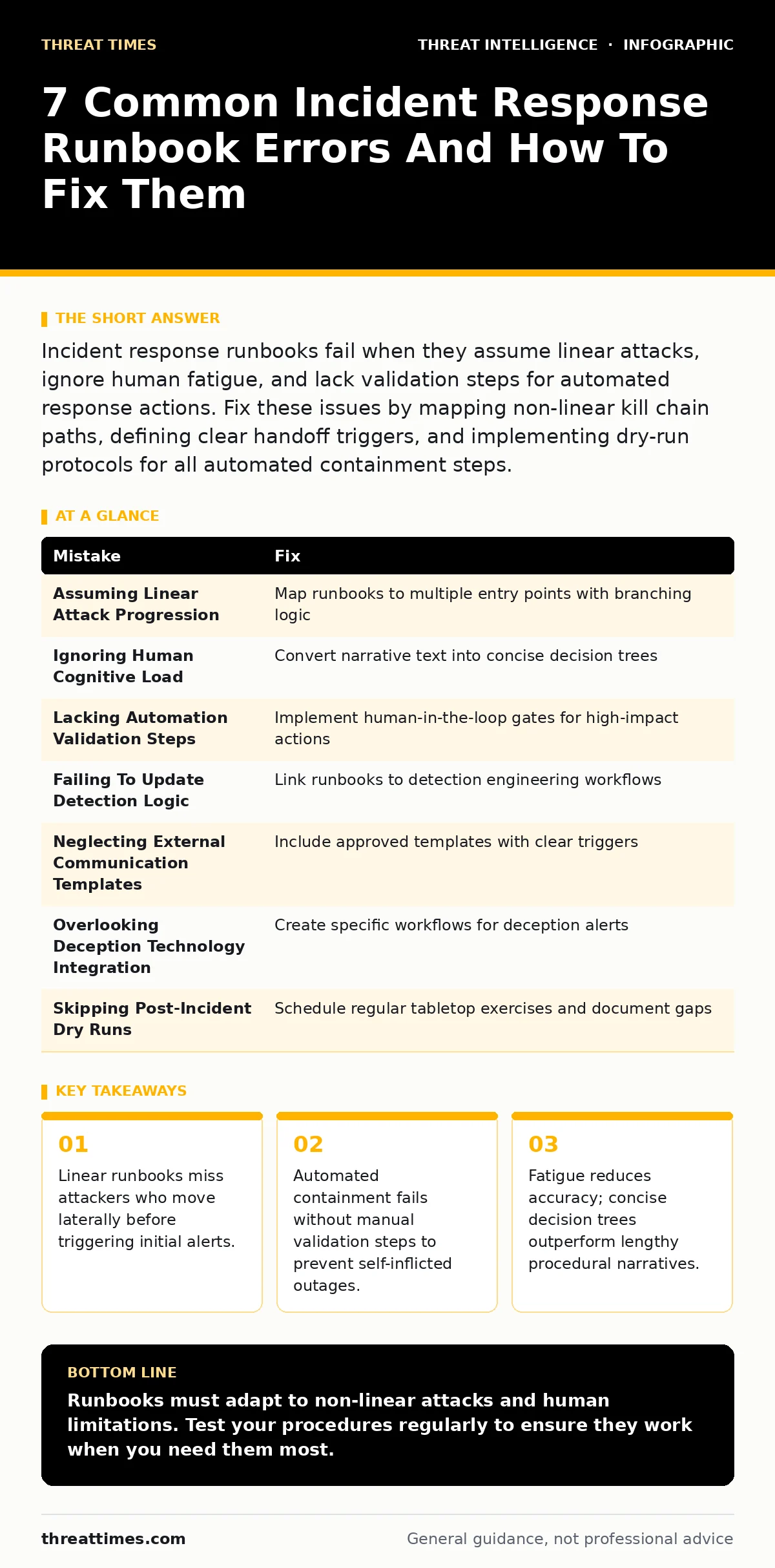
Incident response runbooks fail when they assume linear attacks, ignore human fatigue, and lack validation steps for automated response actions. Fix these issues by mapping non-linear kill chain paths, defining clear handoff triggers, and implementing dry-run protocols for all automated containment steps.
Mistake 1: Assuming Linear Attack Progression
Attackers rarely follow the standard stages of the Unified Kill Chain in a straight line. Many adversaries perform lateral movement or data staging before their initial reconnaissance is detected. A runbook that assumes detection happens at the entry point leaves responders unprepared for mid-chain discoveries.
Why it hurts: Responders waste time looking for indicators that already passed. The attacker establishes persistence while the team follows a script designed for an earlier stage. This delay increases data loss and extends the dwell time significantly.
The fix: Map runbooks to multiple entry points. Create branching logic that allows responders to jump to containment or eradication phases immediately upon detection, regardless of the assumed stage. Test these branches regularly to ensure readiness for non-linear scenarios.
Mistake 2: Ignoring Human Cognitive Load
Runbooks often contain dense paragraphs of technical instructions. During a high-stress incident, cognitive load spikes. Responders cannot process complex sentences or search for relevant details in long text blocks. This leads to skipped steps and critical errors.
Why it hurts: Fatigue causes responders to miss subtle but critical steps. They may skip verification checks or misinterpret commands under pressure. This increases the likelihood of false positives or incomplete containment, compromising the integrity of the response effort.
The fix: Convert narrative text into decision trees. Use conditional logic: if this alert, then do this. Keep steps to single actions. Place critical commands and contact information at the top of the page. Reduce cognitive friction by designing for speed, not completeness.
Mistake 3: Lacking Automation Validation Steps
Integrating SOAR platforms allows for rapid containment. However, automating actions without manual verification steps is dangerous. Automated plays may misinterpret context or trigger containment on critical production systems due to false positives.
Why it hurts: False containment disrupts business operations. Isolating a legitimate server causes immediate financial loss and customer dissatisfaction. Responders lose trust in automation, leading to manual overrides that slow down future legitimate responses.
The fix: Implement human-in-the-loop gates for high-impact actions. Require manual approval before isolating critical infrastructure. Log every automated action for post-incident review. Regularly audit automation logs to refine rules and reduce false positive rates over time.
Mistake 4: Failing To Update Detection Logic
Runbooks reference specific alerts and signatures. These detection rules degrade over time. Attackers modify their tools to evade known signatures. If the runbook refers to outdated indicators, the playbook becomes irrelevant and misleading.
Why it hurts: Responders follow a dead end. They look for indicators that no longer exist. This wastes valuable time during the initial triage phase. The attacker continues their activity undetected while the team searches for ghosts in the data.
The fix: Link runbooks directly to detection engineering workflows. Update runbooks whenever detection rules change. Schedule quarterly reviews to verify that referenced alerts are still active and effective. Remove deprecated steps immediately to keep the document accurate.
Mistake 5: Neglecting External Communication Templates
Runbooks often focus solely on technical containment. They ignore the need for external communication. Organizations must notify customers, partners, and regulators within strict timeframes. Without pre-written templates, drafting messages takes too long.
Why it hurts: Delayed communication erodes trust. Regulators may impose fines for late notification. Customers feel abandoned and lose confidence in the organization. Poorly drafted messages can also leak sensitive details or admit liability prematurely.
The fix: Include approved communication templates in the runbook. Define triggers for when each template applies. Specify who has authority to send notifications. Keep templates generic enough to adapt to specific incidents but detailed enough to ensure compliance.
Mistake 6: Overlooking Deception Technology Integration
Deception technology deploys fake assets to detect attackers. Runbooks often treat these alerts as standard incidents. This misses the unique opportunity to gather intelligence on attacker techniques and tools without risking real assets.
Why it hurts: Responders may isolate a honeypot instead of letting it collect data. This reduces the value of the deception layer. The team misses chances to understand attacker behavior and improve detection rules based on real-world interaction data.
The fix: Create specific workflows for deception alerts. Define how long to allow interaction before containment. Document the data collection process. Use this intelligence to refine threat intelligence platforms and improve overall detection capabilities.
Mistake 7: Skipping Post-Incident Dry Runs
Many organizations update runbooks after an incident but never test the changes. Dry runs are often skipped due to time pressures. This leaves updated procedures unverified and potentially flawed.
Why it hurts: New errors go undetected until the next real incident. Responders discover missing steps or broken links under pressure. This undermines confidence in the runbook and leads to ad-hoc responses that are less effective.
The fix: Schedule regular tabletop exercises. Simulate specific scenarios using the updated runbook. Identify gaps and refine steps. Document lessons learned and update the runbook immediately. Treat dry runs as critical maintenance, not optional training.
| Mistake | Fix |
|---|---|
| Assuming Linear Attack Progression | Map runbooks to multiple entry points with branching logic |
| Ignoring Human Cognitive Load | Convert narrative text into concise decision trees |
| Lacking Automation Validation Steps | Implement human-in-the-loop gates for high-impact actions |
| Failing To Update Detection Logic | Link runbooks to detection engineering workflows |
| Neglecting External Communication Templates | Include approved templates with clear triggers |
| Overlooking Deception Technology Integration | Create specific workflows for deception alerts |
| Skipping Post-Incident Dry Runs | Schedule regular tabletop exercises and document gaps |
Key takeaways
- Linear runbooks miss attackers who move laterally before triggering initial alerts.
- Automated containment fails without manual validation steps to prevent self-inflicted outages.
- Fatigue reduces accuracy; concise decision trees outperform lengthy procedural narratives.
Runbooks must adapt to non-linear attacks and human limitations. Test your procedures regularly to ensure they work when you need them most.
Frequently asked questions
How often should incident response runbooks be updated?
Update runbooks immediately after any significant incident or detection rule change. Schedule quarterly reviews to ensure accuracy and relevance.
Can runbooks replace human decision-making?
No. Runbooks provide structure and guidance. Human judgment is required for context-specific decisions and complex scenarios that scripts cannot handle.
What is the best way to test runbook effectiveness?
Conduct regular tabletop exercises. Simulate realistic scenarios and follow the runbook steps. Identify gaps and refine procedures based on lessons learned.
How do you handle port scanning alerts in runbooks?
Treat port scanning as a potential precursor to attack. Include steps to verify if the scanning is authorized. Escalate to investigation if it appears malicious.
How this guide was produced: written by the Threat Times editorial team with AI assistance, checked against the public references listed below, and reviewed when the facts change. See our editorial policy or report an error.