How to Remove Data from Data Brokers: The Manual Cleanup Process
Data brokers sell your information because they aggregate it from public records, and manual opt-out requests remain the only reliable method to delete it from their databases.

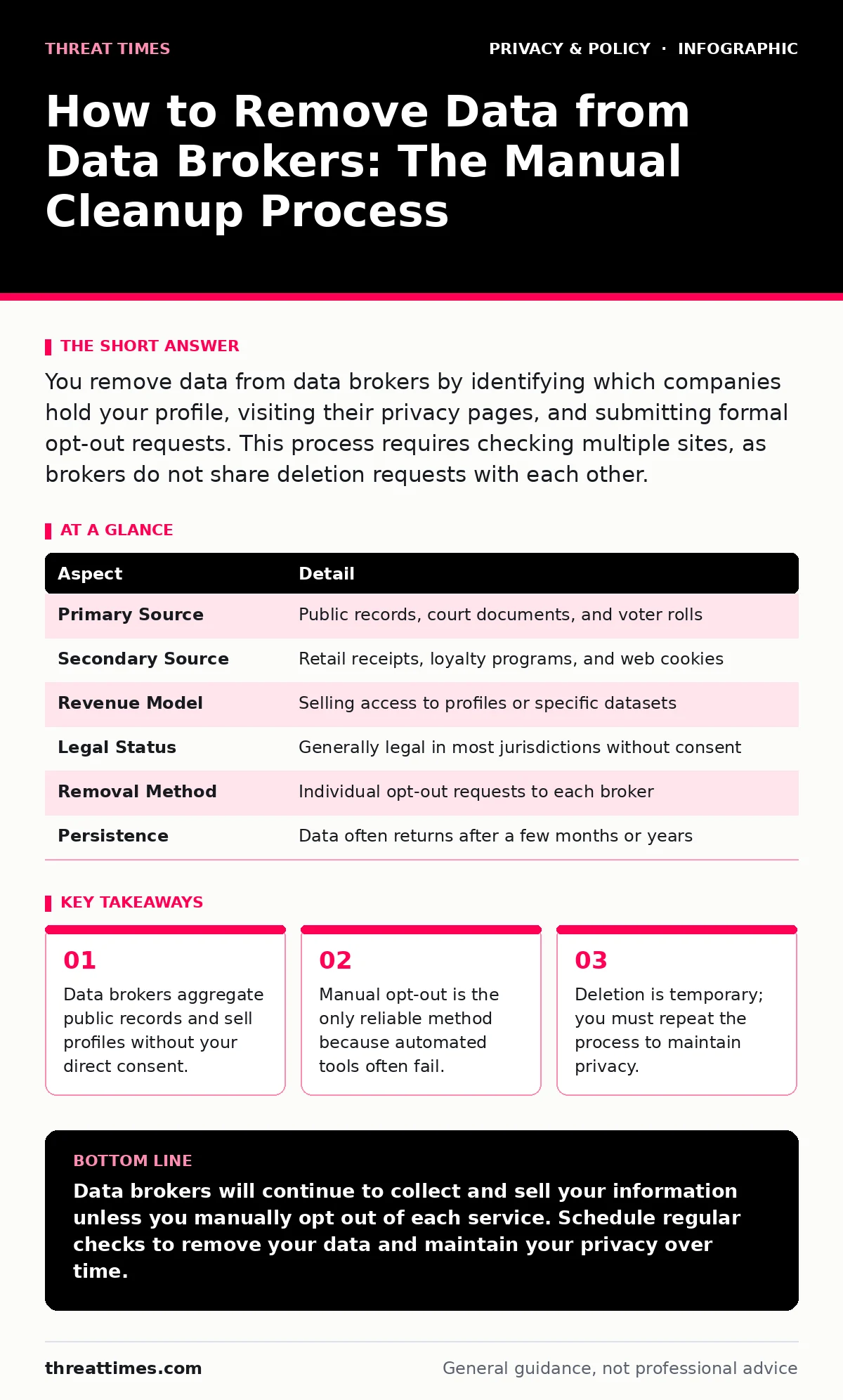
You remove data from data brokers by identifying which companies hold your profile, visiting their privacy pages, and submitting formal opt-out requests. This process requires checking multiple sites, as brokers do not share deletion requests with each other.
Understanding the Data Broker Economy
Data brokers are companies that collect personal information from public records, social media, and purchase histories to create detailed profiles. These profiles are then sold to marketers, insurers, and other businesses who use them for targeted advertising or risk assessment. You did not sign up for this service, and you did not agree to have your address, family relationships, or estimated income compiled.
Imagine a library that copies every book you check out, notes who sits at the same table as you, and sells that list to a bookstore. Data brokers operate on a larger scale. They scrape government websites for property records, court filings, and voter registrations. They then cross-reference this data with commercial lists to fill in gaps, such as your hobbies or political leanings.
| Aspect | Detail |
|---|---|
| Primary Source | Public records, court documents, and voter rolls |
| Secondary Source | Retail receipts, loyalty programs, and web cookies |
| Revenue Model | Selling access to profiles or specific datasets |
| Legal Status | Generally legal in most jurisdictions without consent |
| Removal Method | Individual opt-out requests to each broker |
| Persistence | Data often returns after a few months or years |
Why Automated Removal Tools Fail
Many services promise to remove your data from hundreds of brokers for a fee. These tools often fail because they rely on generic scripts that cannot handle unique website layouts or new verification steps. When a broker changes its privacy policy or form structure, the automated tool breaks and stops deleting your data. You pay for a service that is no longer working, while your information remains exposed.
Manual removal is slower but more accurate. You see exactly which data is being deleted and can verify the result. Automated tools also struggle with brokers that require identity verification, such as uploading a photo of your driver’s license or answering security questions based on past addresses. These steps are designed to prevent mass deletion by competitors or malicious actors, and they require human intervention.
Identifying Who Holds Your Information
You cannot remove data from a broker if you do not know which broker holds it. The industry is fragmented, with hundreds of companies operating under different names. Some specialize in criminal records, while others focus on health data or financial information. To find them, you must search for your name and address on major search engines. Look for profiles that display your home address, phone number, or relatives.
Click through these profiles to find the source. Many directories link back to the original broker. You can also use lists of known data brokers published by privacy advocacy groups. Keep a spreadsheet to track which sites you have contacted and when. This record helps you monitor whether they re-publish your data after you delete it.
The Manual Opt-Out Process
Removing data from data brokers requires patience and attention to detail. Start by locating the privacy policy or opt-out page on each broker’s website. These links are often buried in the footer of the page. Look for terms like "Do Not Sell My Information," "Opt-Out," or "Privacy Request." Some brokers require you to send an email with specific subject lines, while others provide a web form.
When you submit a request, you must provide enough information to identify your profile, such as your full name, current address, and date of birth. Be cautious about sharing more than necessary. Some brokers ask for your social security number or driver’s license number for verification. Providing this sensitive data to an unverified third party creates a new security risk. Prefer methods that use less sensitive information, such as answering questions about your past residences.
What People Usually Get Wrong
Most people believe that deleting their data from one site removes it from all sources. This is incorrect. Data brokers buy and sell data among themselves. If you delete your profile from one broker, another broker may have already purchased that same profile and stored it in their own database. You must treat each company as an independent entity.
Another common mistake is assuming that opt-out is permanent. Brokers often re-ingest data from public sources. If you get married, move, or appear in a new public record, the broker may create a new profile for you. This means removal is a continuous process, not a one-time fix. You must re-check your online presence every six months to ensure your data has not returned.
Legal Limits and Expectations
Privacy laws like the California Consumer Privacy Act and the Virginia Consumer Data Protection Act give you the right to opt out of the sale of your personal information. However, these laws do not always require brokers to delete all your data. They may retain certain information for legal compliance or fraud prevention. Understand the difference between "opting out of sale" and "deletion." Opting out stops them from selling your data to new buyers, but it may not remove your existing profile.
If a broker refuses to delete your data, you can file a complaint with your state attorney general or the Federal Trade Commission. These agencies do not typically intervene in individual cases, but a pattern of non-compliance can lead to investigations. Document every interaction, including screenshots of your opt-out request and any responses you receive. This evidence is useful if you need to escalate the issue.
For those concerned with broader privacy issues, consider reading about reducing your digital footprint to understand how much data you expose daily. You may also want to explore social media privacy risks to limit the amount of personal information available for brokers to scrape.
Maintaining Your Privacy Long Term
Privacy is a practice, not a product. You must regularly audit your online presence to stay ahead of data brokers. Set a calendar reminder to search for your name and address every quarter. Check for new profiles and repeat the opt-out process. Use a dedicated email address for these requests to keep your communication organized and separate from your personal inbox.
Consider using privacy-focused browsers and search engines to reduce the amount of data you leave behind. Tools like Tor Browser can help you browse without revealing your identity to websites, though they do not remove data that has already been collected. Be mindful of the applications you install on your phone, as mobile app permission abuse can feed your location and usage data directly to brokers.
Key takeaways
- Data brokers aggregate public records and sell profiles without your direct consent.
- Manual opt-out is the only reliable method because automated tools often fail.
- Deletion is temporary; you must repeat the process to maintain privacy.
Data brokers will continue to collect and sell your information unless you manually opt out of each service. Schedule regular checks to remove your data and maintain your privacy over time.
Frequently asked questions
Can I sue a data broker for selling my information?
Most data brokers operate within legal frameworks that allow the sale of public record data. Unless they violate specific privacy laws in your state, you generally cannot sue them for collecting publicly available information.
Does deleting my social media accounts remove my data from brokers?
Deleting social media accounts removes new data from those platforms, but brokers have already collected and stored your historical data. You must still opt out of brokers to remove that existing information.
How long does it take for data to be removed?
Removal times vary by broker, typically ranging from a few days to several weeks. Some brokers take longer if they require identity verification. You should check back after 30 days to confirm deletion.
Are there any data brokers that do not allow opt-outs?
Reputable brokers comply with privacy laws and provide opt-out mechanisms. If a site does not offer a clear way to opt out, it may be operating illegally or may be a scam. Avoid interacting with such sites.
How this guide was produced: written by the Threat Times editorial team with AI assistance, checked against the public references listed below, and reviewed when the facts change. See our editorial policy or report an error.