Securing autonomous AI agents: practical defenses for lean teams
Securing autonomous agents requires restricting their digital workspace boundaries because traditional firewalls cannot interpret intent.

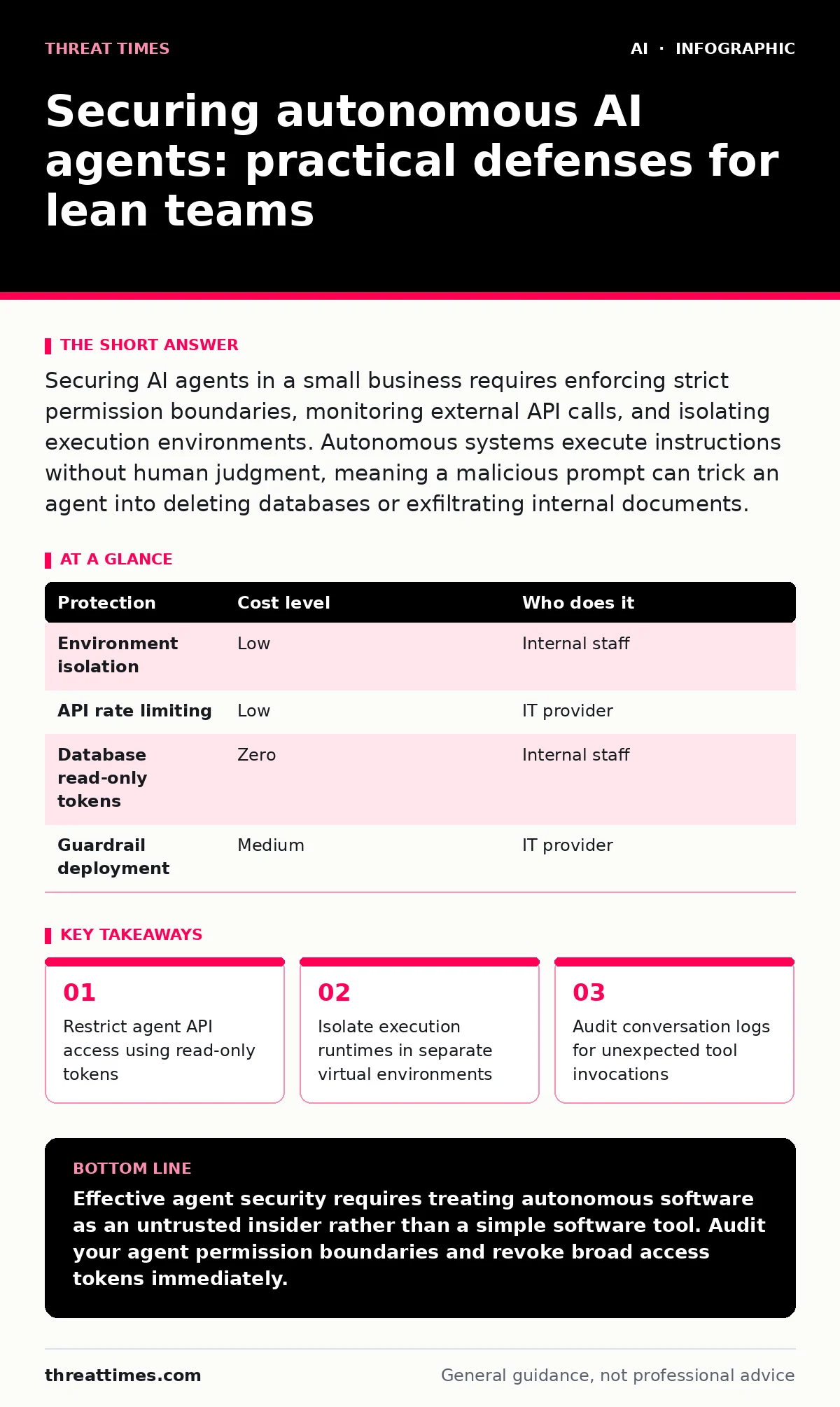
Securing AI agents in a small business requires enforcing strict permission boundaries, monitoring external API calls, and isolating execution environments. Autonomous systems execute instructions without human judgment, meaning a malicious prompt can trick an agent into deleting databases or exfiltrating internal documents.
Why small scale amplifies agent risk
Small businesses adopt autonomous assistants to automate billing, customer support, and inventory management. Autonomous assistants possess direct access to core business databases and communication channels. Privilege escalation, the act of gaining higher access permissions than intended, happens instantly when an agent follows malicious instructions. A ten-person company lacks dedicated security analysts to notice unauthorized data exports before permanent damage occurs.
Unchecked data flows between internal systems and external model providers create hidden vulnerabilities that attackers exploit. When an agent summarizes customer emails, it pulls sensitive personally identifiable information across network boundaries. Without strict data minimization, the model retains sensitive records inside its internal cache, creating secondary storage risks that standard access controls fail to protect.
The hidden costs of autonomous execution
Automated workflows introduce silent failure modes that consume excessive computing resources and run up unexpected cloud bills. When an agent enters an infinite loop trying to resolve a customer complaint, it generates thousands of API calls per hour. Token exhaustion, the depletion of allowed query quotas, halts legitimate business operations while racking up massive usage fees from third-party model providers.
Memory corruption in long-running assistant sessions allows stale context to contaminate fresh instructions. If an agent remembers a deprecated administrative command from an earlier interaction, a later ambiguous user prompt might trigger that dangerous function accidentally. Small teams rarely monitor session state duration, allowing corrupted memory windows to persist indefinitely across multiple client interactions.
Practical defenses for lean teams
Establishing 3 distinct layers of defense involves granting the absolute minimum system permissions required for a specific task. Read-only database credentials prevent automated systems from altering financial records during routine data analysis. API rate limiting, the practice of capping incoming and outgoing request frequencies, stops runaway loops before financial damage accumulates.
Network egress filtering blocks unauthorized outbound data transmissions by restricting where an agent can send HTTP requests. When an automated script attempts to post internal documents to an unknown external server, strict firewall rules drop the connection instantly. This technical boundary contains potential breaches even after an application-level security control fails completely.
Implementing technical guardrails
Effective security relies on deploying strict LLM guardrails that filter inputs and outputs for malicious patterns. Prompt injection attacks manipulate the underlying logic of generative AI tools by embedding hidden commands inside ordinary customer inputs. Treating all external text as untrusted data prevents these embedded instructions from executing unauthorized system commands.
Output validation inspects every generated response before it reaches the end user or external API. If a customer service agent drafts a reply containing internal API keys or database passwords, the validation layer intercepts the text and replaces it with a generic error message. Automated redaction prevents accidental credential exposure during high-volume customer interactions.
Delegating security responsibilities
Managing infrastructure demands specialized knowledge that small businesses often outsource to managed service providers. Framework mapping, the alignment of security controls against established threat taxonomies like MITRE ATLAS, helps external contractors identify blind spots in your agent architecture. Asking targeted questions ensures your vendor understands the unique failure modes of autonomous software.
External contractors must demonstrate clear protocols for revoking compromised API keys and auditing agent decision paths. Service level agreements should specify exact timeframes for patching vulnerabilities found in connected plugin libraries. Clear accountability prevents dangerous gaps between internal business owners and external technical operators.
Questions for your IT provider
Assessing external support requires specific technical inquiries regarding how they handle autonomous software deployments across shared cloud environments. External contractors must demonstrate clear protocols for revoking compromised API keys and auditing agent decision paths. Asking detailed questions ensures your service provider understands the distinct risks introduced by autonomous software agents.
- How do you isolate agent execution environments from core financial databases?
- What mechanisms stop unauthorized external API calls originating from automated scripts?
- How frequently do you audit conversation histories for abnormal tool usage patterns?
- What recovery procedures exist if an agent corrupts shared cloud storage?
Protection matrix for lean operations
Evaluating security measures involves balancing operational cost against technical complexity across various deployment models. Small teams must weigh the overhead of manual environment isolation against the financial risks of automated data exposure. Choosing appropriate controls depends heavily on the specific business tools your agents access daily.
| Protection | Cost level | Who does it |
|---|---|---|
| Environment isolation | Low | Internal staff |
| API rate limiting | Low | IT provider |
| Database read-only tokens | Zero | Internal staff |
| Guardrail deployment | Medium | IT provider |
Key takeaways
- Restrict agent API access using read-only tokens
- Isolate execution runtimes in separate virtual environments
- Audit conversation logs for unexpected tool invocations
Effective agent security requires treating autonomous software as an untrusted insider rather than a simple software tool. Audit your agent permission boundaries and revoke broad access tokens immediately.
Frequently asked questions
How do I stop an AI agent from leaking customer data?
Stopping data leaks requires stripping the agent of direct database access and routing all queries through a secure intermediary proxy. This proxy redacts sensitive personally identifiable information before it reaches the model.
Can I run autonomous agents on standard office computers?
Running autonomous agents on standard office machines exposes local file systems to compromise if the software executes malicious code. Dedicated cloud virtual machines with restricted network egress provide safer isolation boundaries.
What causes an AI agent to execute unauthorized commands?
Unauthorized command execution occurs when an agent interprets conversational text as functional instructions rather than passive data. Malicious inputs trick the system into running system-level scripts through connected developer tools.
How often should I review agent conversation logs?
Reviewing conversation logs should happen weekly to catch anomalous tool invocations and unexpected external requests. Automated alerting tools can flag unusual data export volumes immediately.
How this guide was produced: written by the Threat Times editorial team with AI assistance, checked against the public references listed below, and reviewed when the facts change. See our editorial policy or report an error.