What is ssh key used for and how to manage them securely
Unlike passwords, cryptographic key pairs for remote shells bypass authentication prompts entirely while creating invisible auditing blind spots.

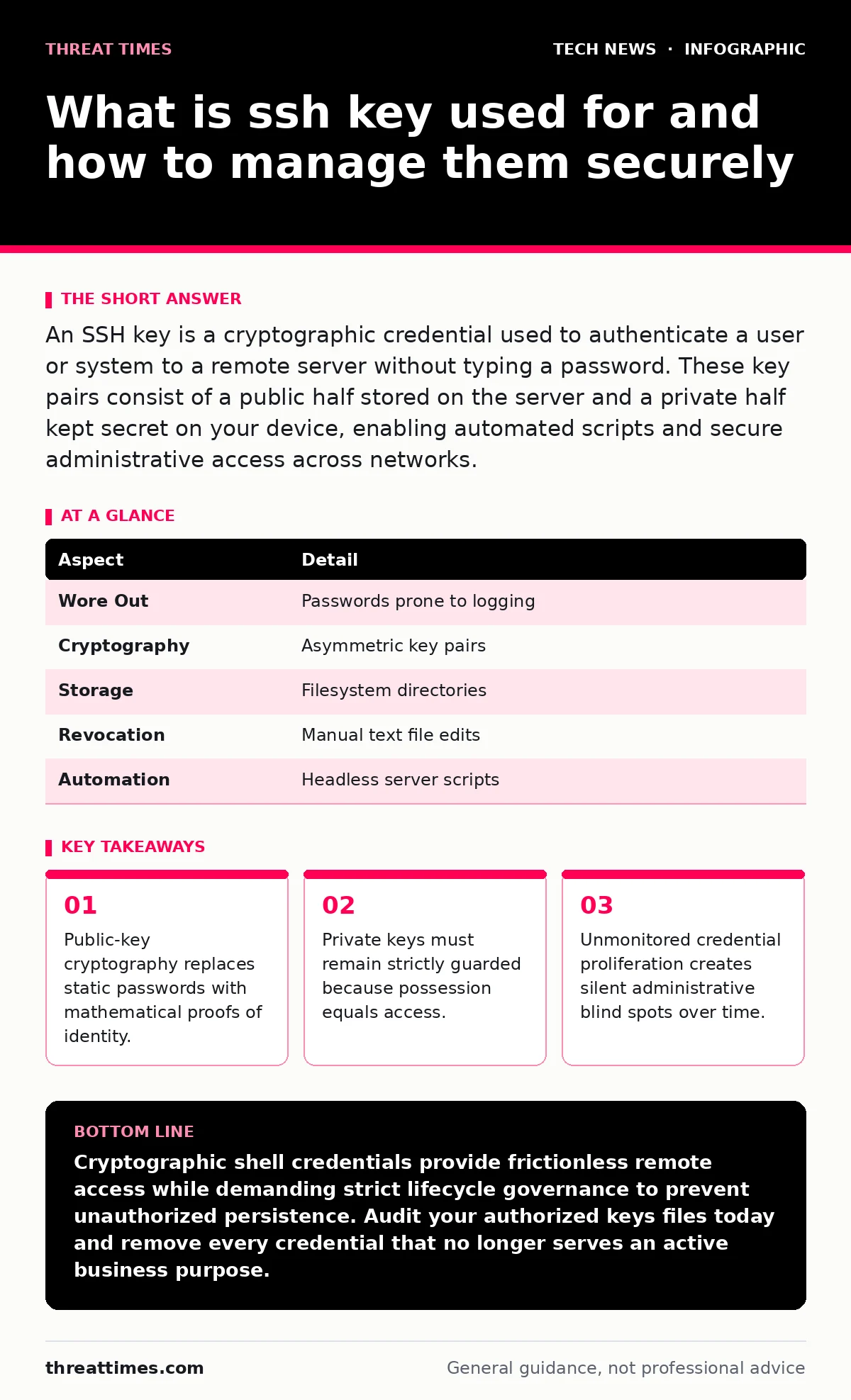
An SSH key is a cryptographic credential used to authenticate a user or system to a remote server without typing a password. These key pairs consist of a public half stored on the server and a private half kept secret on your device, enabling automated scripts and secure administrative access across networks.
The Master Key Analogy for Remote Access
Imagine a heavy brass padlock hanging on a secure storage gate, where you hand unique copies of a specially shaped metal blank to trusted couriers. An SSH key, formally known as a secure shell key, functions as this cryptographic padlock system for remote computer infrastructure. Instead of typing a memorable passphrase over an encrypted network connection every time you log in, your local machine and the remote server perform a silent mathematical handshake. This mechanism eliminates brute-force password guessing attacks against exposed network login prompts.
| Aspect | Detail |
|---|---|
| Wore Out | Passwords prone to logging |
| Cryptography | Asymmetric key pairs |
| Storage | Filesystem directories |
| Revocation | Manual text file edits |
| Automation | Headless server scripts |
How Cryptographic Authentication Works
Public-key cryptography relies on mathematically linked pairs of data files generated on your local workstation. The public key acts as an open lock that you can safely paste onto any remote server inside a designated configuration file. The private key acts as the only matching key that can unlock that specific lock during a connection attempt. When you initiate a remote connection, the server challenges your local machine to prove it possesses the private key without actually revealing the key itself. Successful completion of this challenge grants access to the shell environment.
What is ssh key used for in modern infrastructure
What is ssh key used for beyond simple human login represents the backbone of modern software deployment and cloud administration. Automated deployment pipelines, configuration management tools, and inter-server communication rely entirely on these credentials to run without human intervention. Developers embed them into continuous integration systems so that code changes can push directly to production servers automatically.
Virtualization security frameworks often depend on these exact credentials to provision virtual machines and inject initial configuration files safely. Headless servers lacking physical screens or keyboards rely exclusively on pre-configured public keys for initial setup and ongoing remote maintenance.
The Hidden Costs of Credential Sprawl
Cryptographic credentials accumulate quietly across enterprise environments because generating a new pair takes only a fraction of a second. Administrators often scatter these files across multiple developer laptops, CI servers, and cloud instances without maintaining a centralized inventory. Unlike expired certificates, an orphaned private key sitting on an abandoned virtual machine grants permanent access until manually removed from the target server. This accumulation creates silent administrative blind spots where nobody knows which systems trust which keys.
What People Usually Get Wrong About Storage
Common security advice emphasizes choosing long passwords, but credential management requires a fundamentally different operational mindset. People frequently protect their private keys with weak passphrases or store them unencrypted on shared developer workstations. Another widespread error involves copying the exact same key pair across dozens of unrelated infrastructure projects for convenience. When a single machine suffers a malware infection, every connected server falls simultaneously because the trust relationship is universal rather than compartmentalized.
How to Establish Rigorous Governance
Effective credential hygiene starts with generating distinct key pairs for every individual service and distinct project you manage. Operating system hardening practices should restrict filesystem permissions on your local machine so that private key files remain unreadable to other local users or background applications.
Pair your private keys with hardware security tokens that require physical touch to authorize a connection, ensuring malware cannot silently export your credentials. Regularly audit the authorized keys files on your production servers to purge stale credentials belonging to former contractors and decommissioned systems. Integrating proper credential lifecycle management works best alongside robust laptop security measures to prevent physical theft of local secrets.
Key takeaways
- Public-key cryptography replaces static passwords with mathematical proofs of identity.
- Private keys must remain strictly guarded because possession equals access.
- Unmonitored credential proliferation creates silent administrative blind spots over time.
Cryptographic shell credentials provide frictionless remote access while demanding strict lifecycle governance to prevent unauthorized persistence. Audit your authorized keys files today and remove every credential that no longer serves an active business purpose.
Frequently asked questions
Can an SSH key expire automatically like a standard password?
Standard cryptographic keys do not expire on their own and remain valid indefinitely until manually deleted from the target server.
What happens if someone steals your private key file?
Possession of an unencrypted private key grants complete, undetected access to every remote server that trusts its matching public key.
Should I use a passphrase to protect my private key?
Adding a strong passphrase encrypts the private key file on your disk, preventing unauthorized use if your local machine is stolen.
How do hardware tokens improve key security?
Hardware tokens store the private key inside a secure microchip that never exposes the raw cryptographic material to the host operating system.
How this guide was produced: written by the Threat Times editorial team with AI assistance, checked against the public references listed below, and reviewed when the facts change. See our editorial policy or report an error.