Difference Between OAuth and API Key and How to Choose
An API key grants static access to a resource, while OAuth delegates granular permissions on behalf of a user.

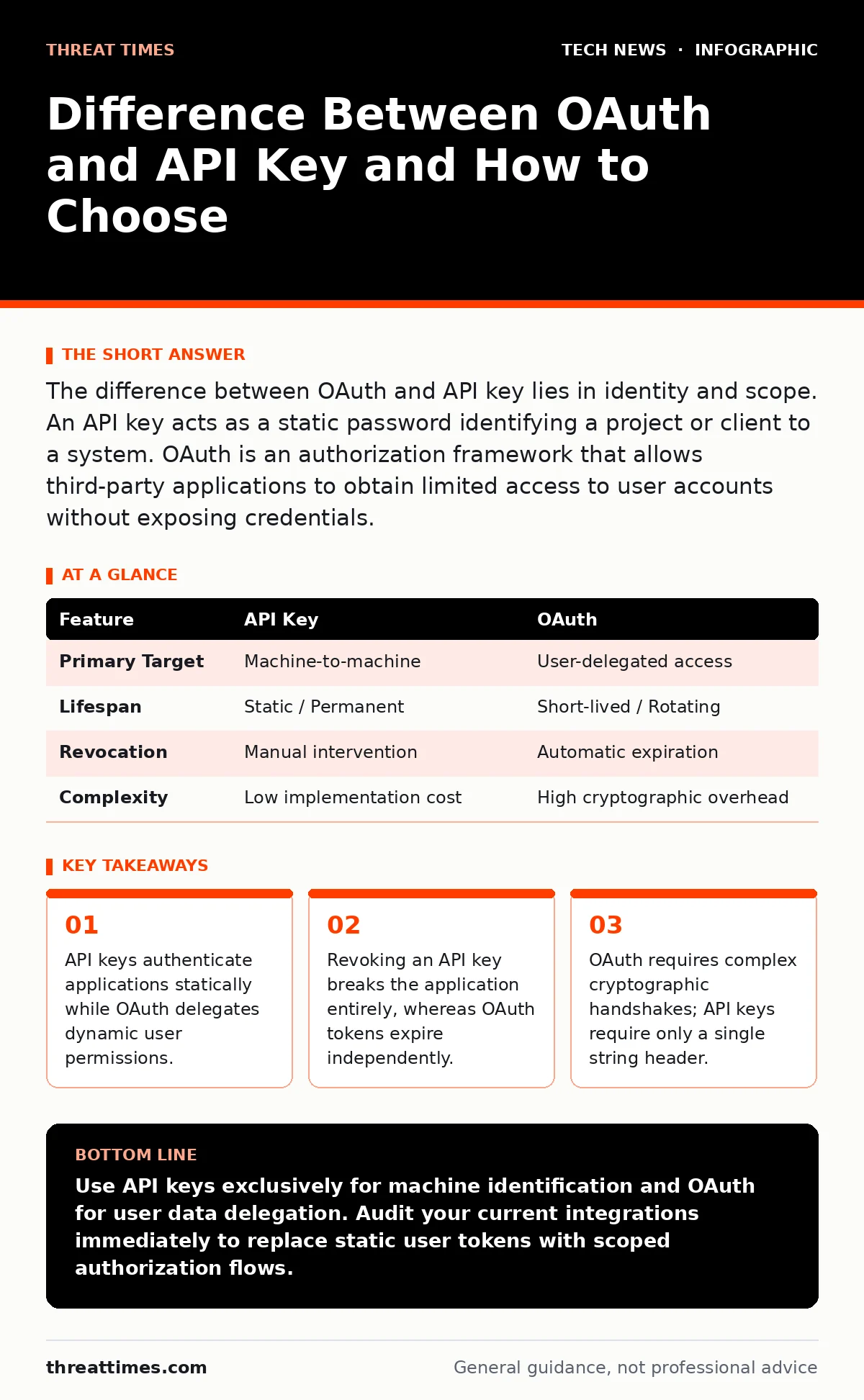
The difference between OAuth and API key lies in identity and scope. An API key acts as a static password identifying a project or client to a system. OAuth is an authorization framework that allows third-party applications to obtain limited access to user accounts without exposing credentials.
What is the fundamental difference between OAuth and API key architectures?
The difference between OAuth and API key models is that one establishes machine identity while the other delegates user consent. An API key is a unique string that a developer embeds in application code to identify the calling project. Authorization servers treat this key as a permanent bearer token, meaning whoever holds the string possesses the associated permissions. APIs often rely on these keys to meter traffic, enforce rate limits, and track software consumption without knowing who operates the client software.
OAuth, formally known as Open Authorization, separates the application from the resource owner entirely. Instead of handing your password to a third-party tool, you log in to the identity provider directly. The provider issues short-lived access tokens containing specific scopes. Scopes limit what the token can read or modify, preventing a compromised client application from draining an entire database.
How do security boundaries diverge between these two mechanisms?
Security boundaries diverge because API keys provide broad, unbounded access while OAuth enforces strict contextual limitation. Imagine a backup utility configured with an API key that accidentally leaks through a public code repository. Anyone who finds that key gains immediate, unfettered access to every resource assigned to that project until an administrator manually revokes it.
OAuth tokens mitigate this exposure through automatic expiration and narrow scope definitions. Suppose a calendar application requests permission to read your schedule for 2 days. The resulting token expires rapidly and cannot access your emails or files. Even if an attacker intercepts that specific token, the blast radius remains strictly contained to calendar reads.
| Feature | API Key | OAuth |
|---|---|---|
| Primary Target | Machine-to-machine | User-delegated access |
| Lifespan | Static / Permanent | Short-lived / Rotating |
| Revocation | Manual intervention | Automatic expiration |
| Complexity | Low implementation cost | High cryptographic overhead |
Why does scope limitation fail when using static credentials?
Scope limitation fails with static credentials because API keys lack a mechanism to represent the distinct privileges of individual human users. When 5 different employees use an internal tool backed by a single administrative API key, the receiving system cannot distinguish between their actions. Every request carries identical administrative weight, rendering audit logs nearly useless for forensic investigations.
OAuth solves this attribution problem by binding every access token to a verified user context. The authorization server records exactly which human approved the interaction and what specific actions were permitted during that session. This design ensures that security teams can trace anomalous behavior back to a specific user account rather than a generic application identity.
What are the hidden operational costs of adopting OAuth?
Adopting OAuth introduces significant operational complexity, including persistent state management, cryptographic key rotation, and dependency on external identity providers. Unlike a static string stored in an environment variable, an OAuth implementation requires managing authorization endpoints, redirect URIs, and token refresh logic. If the identity provider experiences an outage, applications depending on it fail immediately, even if the core backend services remain fully operational.
When should an engineering team choose an API key over a token framework?
Engineering teams should choose an API key for public data retrieval, simple webhook validation, and internal machine-to-machine communication where user consent is irrelevant. Building a weather reporting widget that fetches public temperature data does not justify the cryptographic overhead of an authorization flow. A simple static header satisfies the technical requirement with minimal latency.
Deploying OAuth becomes mandatory whenever an application handles private user data, financial transactions, or administrative controls. If software needs to read personal emails, modify cloud infrastructure, or post messages on behalf of a human, static credentials create unacceptable risks.
How do edge computing architectures handle credential validation differently?
Edge computing architectures validate credentials closer to the user to reduce latency, shifting validation logic from central data centers to distributed proxy servers. When validating API keys at the edge, caching mechanisms can reject unauthorized requests instantly without hitting primary databases. OAuth validation at the edge requires verifying JSON Web Tokens cryptographically using locally stored public keys, avoiding network round-trips entirely.
Key takeaways
- API keys authenticate applications statically while OAuth delegates dynamic user permissions.
- Revoking an API key breaks the application entirely, whereas OAuth tokens expire independently.
- OAuth requires complex cryptographic handshakes; API keys require only a single string header.
Use API keys exclusively for machine identification and OAuth for user data delegation. Audit your current integrations immediately to replace static user tokens with scoped authorization flows.
Frequently asked questions
Can an API key be converted into an OAuth token?
No, because API keys lack the user context and cryptographic structure required to mint valid OAuth tokens.
Do mobile apps require OAuth for backend communication?
Mobile applications should use OAuth when accessing user-specific data, but they can use API keys for public endpoints.
What happens when an OAuth refresh token expires?
The application must prompt the user to re-authenticate interactively to obtain new credentials.
Are API keys encrypted in transit?
API keys are only encrypted in transit if transmitted over secure transport protocols like TLS.
How this guide was produced: written by the Threat Times editorial team with AI assistance, checked against the public references listed below, and reviewed when the facts change. See our editorial policy or report an error.